Overview
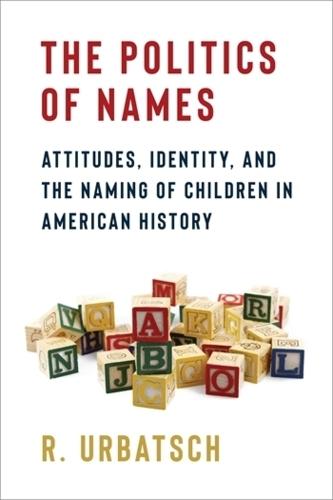
Since the earliest days of the United States, some parents have felt moved to capture their political moment in their children's names. A Massachusetts child received the name Federal Constitution in 1790. The nineteenth century saw the name States Rights crop up across the South. A younger brother of a boy called McKinley in the early twentieth century was disproportionately likely to be named Roosevelt. Residents of areas that supported Reagan were prone to choose the spelling ""Meagan"" over ""Megan."" The name Hillary surged in popularity after the Clintons emerged on the political scene-then crashed just as dramatically. What do trends like these tell us about political identities and enthusiasms in the United States? R. Urbatsch explores the politics of naming across American history, revealing the surprising ways parents' choices shed light on public opinion past and present. He argues that naming is a weathervane for political attitudes: Names touch on every sort of identity, from race and gender to nationalism and religion. Tracing the rise and fall of names that evoked the leaders, ideas, and issues that fired political imaginations of their times, Urbatsch opens new windows onto a wide range of historical questions. By analyzing when politics-tinged names gained or lost popularity, this book offers an unconventional and illuminating new perspective on identity, public sentiment, and political behavior in the United States.
Full Product Details
Author: R. Urbatsch
Publisher: Columbia University Press
Imprint: Columbia University Press
ISBN: 9780231221696
ISBN 10: 023122169
Pages: 272
Publication Date: 20 January 2026
Audience:
College/higher education
,
Professional and scholarly
,
Postgraduate, Research & Scholarly
,
Professional & Vocational
Format: Paperback
Publisher's Status: Active
Availability: Awaiting stock

The supplier is currently out of stock of this item. It will be ordered for you and placed on backorder. Once it does come back in stock, we will ship it out for you.
Reviews
By using children’s names as a way to gauge public opinion across American political history, Urbatsch creates a masterpiece of innovative, non-traditional social science research. Creative, insightful, and entertaining throughout, this engaging book convincingly establishes why names are an important measure for understanding our nation’s political development across time. -- Adam Chamberlain, Coastal Carolina University This book insightfully demonstrates how, across centuries, parents have connected their children's identities to political contexts through the act of naming. It offers a compelling illustration of how names reflect public opinion and societal trends. Far from being arbitrary, names serve as a mirror of the social and political landscape. -- Birgit Eggert, University of Copenhagen
By using children’s names as a way to gauge public opinion across American political history, Urbatsch creates a masterpiece of innovative, non-traditional social science research. Creative, insightful, and entertaining throughout, this engaging book convincingly establishes why names are an important measure for understanding our nation’s political development across time. -- Adam Chamberlain, Coastal Carolina University
Author Information
R. Urbatsch is professor of political science at Iowa State University. He is the author of Families’ Values: How Parents, Siblings, and Children Affect Political Attitudes (2014).