|
|
|||
|
||||
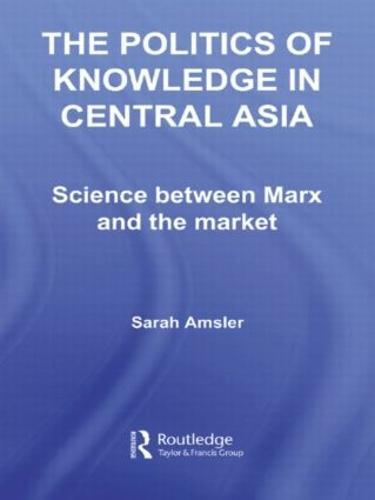
OverviewThrough careful historical and ethnographic research and extensive use of local scholarly works, this book provides a persuasive and careful analysis of the production of knowledge in Central Asia. The author demonstrates that classical theories of science and society are inadequate for understanding the science project in Central Asia. Instead, a critical understanding of local science is more appropriate. In the region, the professional and political ethos of Marxism-Leninism was incorporated into the logic of science on the periphery of the Soviet empire. This book reveals that science, organizes and constructed by Soviet rule, was also defined by individual efforts of local scientists. Their work to establish themselves ‘between Marx and the market’ is therefore creating new political economies of knowledge at the edge of the scientific world system. Full Product DetailsAuthor: Sarah Amsler (Kingston University, UK)Publisher: Taylor & Francis Ltd Imprint: Routledge Dimensions: Width: 15.60cm , Height: 1.70cm , Length: 23.40cm Weight: 0.540kg ISBN: 9780415413343ISBN 10: 0415413346 Pages: 192 Publication Date: 20 April 2007 Audience: College/higher education , Professional and scholarly , Tertiary & Higher Education , Professional & Vocational Format: Hardback Publisher's Status: Active Availability: In Print This item will be ordered in for you from one of our suppliers. Upon receipt, we will promptly dispatch it out to you. For in store availability, please contact us. Table of ContentsIntroduction 1. Knowledge and Power in Post-Soviet Space 2. The Colonial Logic of Science in Central Asia 3. The Social Science Project in Soviet Kirgizia 4. Knowledge and National Identity during Perestroika 5. Social Science after Communism 6. Re-Disciplining Knowledge in Kyrgyzstan: Alternative Visions of Sociology between Marx and the Market 7. Public Social Science in Central Asia 8. ConclusionReviewsAuthor InformationSarah Amsler is Senior Lecturer in Sociology at Kingston University, UK. She held previous posts at the American University–Central Asia in Kyrgyzstan and Central Asian Resource Centre in Kazakhstan. Her fields of expertise are the critical sociology of knowledge, the sociology of cultural institutions and the politics of science, particularly in post-colonial and post-Soviet societies. Tab Content 6Author Website:Countries AvailableAll regions |
||||