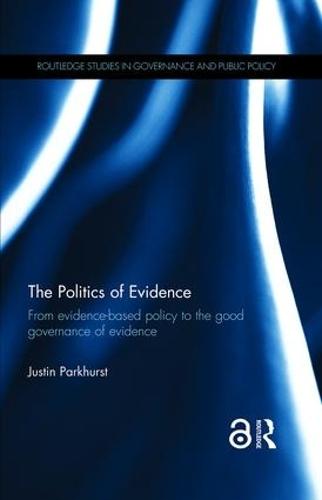
Full Product Details
Author: Justin Parkhurst (London School of Hygiene & Tropical Medicine, University of London, UK)
Publisher: Taylor & Francis Ltd
Imprint: Routledge
Dimensions:
Width: 15.60cm
, Height: 1.50cm
, Length: 23.40cm
Weight: 0.408kg
ISBN: 9781138939400
ISBN 10: 1138939404
Pages: 182
Publication Date: 11 October 2016
Audience:
College/higher education
,
Postgraduate, Research & Scholarly
Format: Hardback
Publisher's Status: Active
Availability: In Print

This item will be ordered in for you from one of our suppliers. Upon receipt, we will promptly dispatch it out to you. For in store availability, please contact us.
Reviews
'This book is a marvellous interdisciplinary synthesis, grounded in case examples and at once critical and constructive. As such, it is both instructive for policy practitioners as well as moving the scholarship of the field forward.' - Vivian Lin, Professor of Public Health, La Trobe University, Australia 'This is essential reading for anybody working on the smarter use of evidence by government. It catalogues the many biases twisting how research is used by policymakers. It also addresses a vital challenge in our sector - a lack of legitimacy. As well as the academic rigour of this book, there are practical tips on what we can do about these problems, and lessons from across the globe showing where we get it wrong - and how we might get it right.' - Jonathan Breckon, Head of the Alliance for Useful Evidence, U.K 'This important book goes well beyond standard analyses of evidence informed policy with detailed discussions of the politics of evidence and the political origins (and the cognitive psychology) of bias in the use of research evidence. It addresses a core and often overlooked issue of the governance of evidence use - including the need to consider the institutions and processes in place that can enable the appropriate use of evidence in decision making. This book will be a pretty essential read for anyone concerned with the policy, practice or study of using research to inform decision making.' - David Gough, Professor of Evidence Informed Policy and Practice, Director of the EPPI- In a time that has been called a post-truth era, The Politics of Evidence demonstrates its importance in how it critically reflects on the quality of evidence, its use, and systems that can be built to ensure policies are better informed by evidence. The book consistently takes the reader through a process of shedding light on current weaknesses in the production of evidence and connecting it to policy-making processes, so as to develop possible options for addressing them. It provides a comprehensive and well-balanced discussion of, for instance, sources of bias in evidence and consequences for policy making, or of the role of democratic process and institutions in the policy-making process. The book helps readers understand how too close a relationship between policy making and evidence generation can motivate biases in research that further compound unconscious biases resulting from human proclivities. - Caroline Heider, Independent Evaluation Group, World Bank
'This book is a marvellous interdisciplinary synthesis, grounded in case examples and at once critical and constructive. As such, it is both instructive for policy practitioners as well as moving the scholarship of the field forward.' - Vivian Lin, Professor of Public Health, La Trobe University, Australia 'This is essential reading for anybody working on the smarter use of evidence by government. It catalogues the many biases twisting how research is used by policymakers. It also addresses a vital challenge in our sector - a lack of legitimacy. As well as the academic rigour of this book, there are practical tips on what we can do about these problems, and lessons from across the globe showing where we get it wrong - and how we might get it right.' - Jonathan Breckon, Head of the Alliance for Useful Evidence, U.K 'This important book goes well beyond standard analyses of evidence informed policy with detailed discussions of the politics of evidence and the political origins (and the cognitive psychology) of bias in the use of research evidence. It addresses a core and often overlooked issue of the governance of evidence use - including the need to consider the institutions and processes in place that can enable the appropriate use of evidence in decision making. This book will be a pretty essential read for anyone concerned with the policy, practice or study of using research to inform decision making.' - David Gough, Professor of Evidence Informed Policy and Practice, Director of the EPPI- 'This book is a marvellous interdisciplinary synthesis, grounded in case examples and at once critical and constructive. As such, it is both instructive for policy practitioners as well as moving the scholarship of the field forward.' - Vivian Lin, Professor of Public Health, La Trobe University, Australia 'This is essential reading for anybody working on the smarter use of evidence by government. It catalogues the many biases twisting how research is used by policymakers. It also addresses a vital challenge in our sector - a lack of legitimacy. As well as the academic rigour of this book, there are practical tips on what we can do about these problems, and lessons from across the globe showing where we get it wrong - and how we might get it right.' - Jonathan Breckon, Head of the Alliance for Useful Evidence, U.K 'This important book goes well beyond standard analyses of evidence informed policy with detailed discussions of the politics of evidence and the political origins (and the cognitive psychology) of bias in the use of research evidence. It addresses a core and often overlooked issue of the governance of evidence use - including the need to consider the institutions and processes in place that can enable the appropriate use of evidence in decision making. This book will be a pretty essential read for anyone concerned with the policy, practice or study of using research to inform decision making.' - David Gough, Professor of Evidence Informed Policy and Practice, Director of the EPPI-
'This book is a marvellous interdisciplinary synthesis, grounded in case examples and at once critical and constructive. As such, it is both instructive for policy practitioners as well as moving the scholarship of the field forward.' - Vivian Lin, Professor of Public Health, La Trobe University, Australia 'This is essential reading for anybody working on the smarter use of evidence by government. It catalogues the many biases twisting how research is used by policymakers. It also addresses a vital challenge in our sector - a lack of legitimacy. As well as the academic rigour of this book, there are practical tips on what we can do about these problems, and lessons from across the globe showing where we get it wrong - and how we might get it right.' - Jonathan Breckon, Head of the Alliance for Useful Evidence, U.K 'This important book goes well beyond standard analyses of evidence informed policy with detailed discussions of the politics of evidence and the political origins (and the cognitive psychology) of bias in the use of research evidence. It addresses a core and often overlooked issue of the governance of evidence use - including the need to consider the institutions and processes in place that can enable the appropriate use of evidence in decision making. This book will be a pretty essential read for anyone concerned with the policy, practice or study of using research to inform decision making.' - David Gough, Professor of Evidence Informed Policy and Practice, Director of the EPPI-
Author Information
Justin Parkhurst is an Associate Professor at the London School of Economics and Political Science’s Department of Social Policy. This book was written while he was previously Senior Lecturer at the London School of Hygiene and Tropical Medicine’s Department of Global Health and Development.