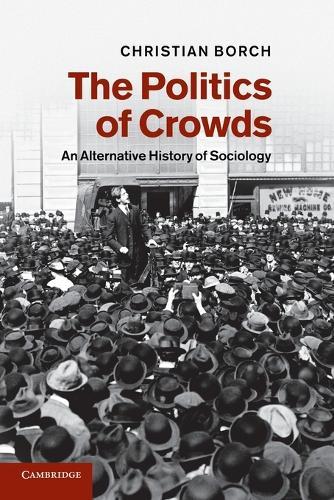
Full Product Details
Author: Christian Borch (Copenhagen Business School)
Publisher: Cambridge University Press
Imprint: Cambridge University Press
Dimensions:
Width: 15.20cm
, Height: 2.00cm
, Length: 22.90cm
Weight: 0.510kg
ISBN: 9781107625464
ISBN 10: 1107625467
Pages: 348
Publication Date: 19 September 2013
Audience:
Professional and scholarly
,
Professional & Vocational
Format: Paperback
Publisher's Status: Active
Availability: Manufactured on demand

We will order this item for you from a manufactured on demand supplier.
Reviews
'There are over seven billion people on the planet, many of them crammed into cities. The result is that a politics of crowds is not a curio. It is a pivotal means of understanding how we are moved by the world. Christian Borch's book is the clearest and best guide you could possibly have to the opportunities as well as the risks.' Nigel Thrift, University of Warwick 'A truly fascinating, learned and deeply thought-provoking reminder of the importance of crowd theory to the discipline of sociology. [The] Politics of Crowds persuasively explains why the 'problem of crowds' would have arisen in both the general and the academic culture of the 1880s, threatened to overwhelm the social sciences through the mid-twentieth century, and then (most fascinating of all) ebbed away again.' John Plotz, Brandeis University 'As The Politics of Crowds usefully reveals the persistent and hidden presence of crowd in social theory and the tensions that are intrinsic in such uncomfortable presence, one cannot but concur with its author in his final call: 'let the spectre of crowds once again haunt sociological thought!'. In short, this almost amounts to a renewal of sociology's own program.' Andrea Mubi Brighenti, University of Trento 'The book traces a series of modifications of 'crowd semantics': disciplinary frontiers, intradisciplinary struggles and historical conditions are brought together to account for the rise and decline of crowds as analytical objects of predilection for sociological research.' Claudia Aradau, Radical Philosophy 'Far more than an essay on the concept of the crowd, [The Politics of Crowds] is a virtual encyclopedia of scholarship and debate about the concept, well documented, clearly written, and full of insight and clarification.' Christopher Kelty, Institute for Society and Genetics, University of California, Los Angeles 'We have here a study that indeed provides novel insights for both the history of sociological thought as well as for the sociology of modernity, given that the book covers major experiences of late-nineteenth- and twentieth-century European and North American socio-political life and their interpretations by concerned, scholarly informed and often politically motivated actors. The book delivers a narrative that may defy some concerns of methodology or intra-disciplinary positioning, as the author is well aware, but that increases our understanding of both the sociological enterprise and the world we live in. As such, it is without doubt a remarkable achievement.' Peter Wagner, ICREA and University of Barcelona 'In this authoritative, extremely learned and well organized book, Christian Borch, who is Associate Professor of Political Science at the Copenhagen Business School, traces the development of a specific 'crowd semantics' that cuts across the history of sociology since its inception ... Borch makes a powerful argument that, despite their being increasingly marginalized or reconfigured, crowds have remained as sort of indelible residuum of all sociological theories and categories that form the backbone of twentieth-century sociological lexicon.' Journal of Cultural Economy
'There are over seven billion people on the planet, many of them crammed into cities. The result is that a politics of crowds is not a curio. It is a pivotal means of understanding how we are moved by the world. Christian Borch's book is the clearest and best guide you could possibly have to the opportunities as well as the risks.' Nigel Thrift, University of Warwick 'A truly fascinating, learned and deeply thought-provoking reminder of the importance of crowd theory to the discipline of sociology. [The] Politics of Crowds persuasively explains why the 'problem of crowds' would have arisen in both the general and the academic culture of the 1880s, threatened to overwhelm the social sciences through the mid-twentieth century, and then (most fascinating of all) ebbed away again.' John Plotz, Brandeis University 'As The Politics of Crowds usefully reveals the persistent and hidden presence of crowd in social theory and the tensions that are intrinsic in such uncomfortable presence, one cannot but concur with its author in his final call: 'let the spectre of crowds once again haunt sociological thought!'. In short, this almost amounts to a renewal of sociology's own program.' Andrea Mubi Brighenti, University of Trento
Author Information
Christian Borch is Associate Professor at the Department of Management, Politics and Philosophy, Copenhagen Business School, Denmark. His PhD was on the history of modern crime semantics where he studied how notions of crime and criminals evolved in the twentieth century and what responses were launched to deal with crime. In his more recent research Borch has focused on crowds, architecture and urban theory. He has published widely on these issues as well as on key social theorists such as Gabriel Tarde, Niklas Luhmann and Peter Sloterdijk. He is co-founder and editor-in-chief of Distinktion: Scandinavian Journal of Social Theory.