Overview
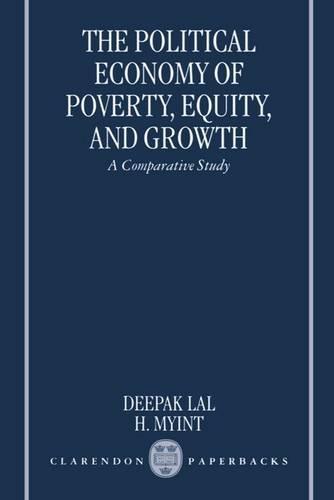
This wide-ranging and innovative book synthesises the findings of a major international study of the political economy of poverty, equity, and growth. It is based primarily on analytical economic histories of 21 developing countries from 1950 to 1985, but also takes account of the wider literature on the subject. The authors take an ambitious interdisciplinary approach to identify patterns in the interplay of initial conditions, instiuttions, interests, and ideas which can help to explain the different growth and poverty alleviation outcomes in the Third World. Three different types of poverty are distinguished, based on their causes, and a more nebulous idea of equityin contrast to egalitarianismis shown to have influenced policy. Since growth is found to be the major means of alleviating mass structural poverty, much of the book is concerned with discovering explanations for policies which are found to be the most important influences on the proximate causes of growth. Lal and Mynt also consider the available evidence on the role of direct transferspublic and privatein alleviating destitution and conjunctural poverty. The Political Economy of Poverty, Equity, and Growth develops a novel framework for the comparative analysis of different growth outcomes. This framework distinguishes between the different relative factor endowments of land, labour, and capital, and between the different organizational structures of pesent versus plantation and mining economies. It also differentiates between the polities of 'autonomous' and 'factional' states in the countries studied, breaking the analysis down into further typological subdivisions and providing important new insights into the differing behaviour of economies that are rich in natural resources and those with abundant labour. These insights constitute a richer explanation for the divergent developmental outcomes in East Asia compared with Latin America and Africa. The evidence collated is used to argue for the continuing relevance of the classical liberal viewpoint on public policies for development, and to show why, even so, nationalist ideologies are likely to be adopted and lead to cycles of interventionism and liberalism. The evidence is also used to provide an explanation for the surprising current worldwide Age of Reform.
Full Product Details
Author: Deepak Lal (James S. Coleman Professor of International Development Studies, James S. Coleman Professor of International Development Studies, University of California, Los Angeles) ,
H. Myint (Emeritus Professor of Economics, Emeritus Professor of Economics, London School of Economics)
Publisher: Oxford University Press
Imprint: Oxford University Press
Edition: New edition
Dimensions:
Width: 15.60cm
, Height: 2.60cm
, Length: 23.50cm
Weight: 0.755kg
ISBN: 9780198294320
ISBN 10: 0198294328
Pages: 476
Publication Date: 08 October 1998
Audience:
Professional and scholarly
,
Professional & Vocational
Format: Paperback
Publisher's Status: Active
Availability: To order

Stock availability from the supplier is unknown. We will order it for you and ship this item to you once it is received by us.
Reviews
<br> This excellent book is likely to become basic to the study of economic development....Accessible to knowledgeable noneconomists. --Choice<p><br>
This excellent book is likely to become basic to the study of economic development....Accessible to knowledgeable noneconomists. --Choice<br>