Overview
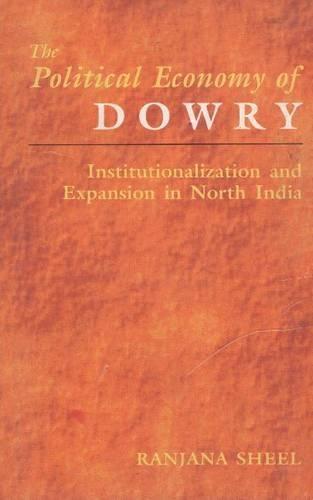
Dowry is one of the most serious problems touching womens lives in modern India. Yet, it remains the least explored subject of historical study. Taking dowry as a crucial index for womens status, Ranjana Sheel locates it within a broad historical framework and a feminist perspective viewing it not as a static custom but as a product of changing political, economic and social processes to comprehend its present shape as well as various dimensions. In doing so, the study raises the questions how integral was dowry to the ancient prevalent marriage forms? How far was it legitimized by a tradition or traditions? What were its linkages with property and inheritance structures? And, how did it become so pervasive over time? Marriage in pre-modern times took varied forms. Dowry or voluntary gift-giving was particularly linked to Brahma from of marriage which was prevalent mostly among the propertied and the upper castes. The modern form of dowry with its forced demands for gift-giving, the author argues, emanates from the colonial reinvention of a tradition whereby patriarchal Hindu tradition and customs were selectively appropriated and deployed. Simultaneously, the colonial restructuring of the socio-economic order strengthened the process of Brahmanisation that in effect institutionalized and expanded dowry to other classes and castes of the society. The consequent unprecedented reach of dowry over Indian society provoked divergent responses from both national and regional womens groups and the state. It built-up a strong womens movement. The state, however, failed to contain dowry primarily because its enactment eventuated from a patriarchal structure and ideology with its specific articulation of property, marriage, and gender issues. The study thus skilfully links complex historical developments with the entrenchment of dowry practices in modern India.
Full Product Details
Author: Ranjana Sheel
Publisher: Manohar Publishers and Distributors
Imprint: Manohar Publishers and Distributors
Edition: UK ed.
Dimensions:
Width: 14.00cm
, Height: 1.70cm
, Length: 21.60cm
Weight: 0.650kg
ISBN: 9788173042645
ISBN 10: 8173042640
Pages: 230
Publication Date: 25 March 2026
Audience:
General/trade
,
College/higher education
,
Professional and scholarly
,
General
,
Undergraduate
Format: Hardback
Publisher's Status: Active
Availability: In Print

This item will be ordered in for you from one of our suppliers. Upon receipt, we will promptly dispatch it out to you. For in store availability, please contact us.
Author Information
Dr Ranjana Sheel is with the Centre for Womens Studies, Banaras Hindu University since 1988. She has completed projects on Girl Child and the Family, and the Mahila Gram Pradhans. Her current research interest pertains to reconstruction of images of women in Colonial and Post-Colonial India.