Overview
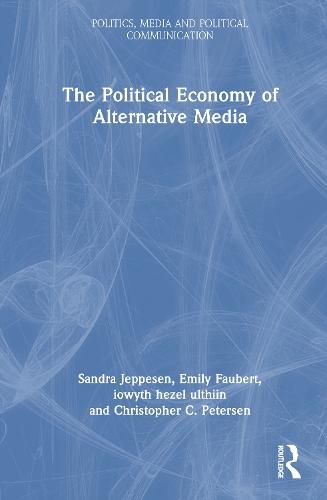
The Political Economy of Alternative Media provides in-depth insights into media practices used by grassroots projects to organize, produce, and distribute the media that support and report on social movements. This book is based on five years of participatory research with global intersectional media activist projects. Mapping out the rich and varied textures of the political economy of media activist projects from small to large and from simple to complex, this book considers structures, funding models, media labor, intersectional power, and media imaginaries, foregrounding the voices of global media activists. It reflects on the changes wrought by shifts to digital media ecologies and economies in the contemporary alternative media space. This book will be of great interest to students and scholars of politics and communication studies interested in the political economy of media, social movements, digital media, alternative media, critical media, citizen media, communication for social change, technopolitics and alternative journalism. It will also appeal to media activists and journalists, providing a roadmap for crucial considerations when developing organizational structures in independent media projects.
Full Product Details
Author: Sandra Jeppesen (Lakehead University, Canada) ,
Emily Faubert (Lakehead University, Canada) ,
iowyth hezel ulthiin (Toronto MetU, Canada) ,
Christopher C. Petersen (Lakehead University, Canada)
Publisher: Taylor & Francis Ltd
Imprint: Routledge
ISBN: 9781032588858
ISBN 10: 1032588853
Pages: 288
Publication Date: 08 April 2026
Audience:
College/higher education
,
Professional and scholarly
,
Tertiary & Higher Education
,
Professional & Vocational
Format: Hardback
Publisher's Status: Forthcoming
Availability: Not yet available

This item is yet to be released. You can pre-order this item and we will dispatch it to you upon its release.
Reviews
Jeppesen’s Political Economy of Alternative Media is a powerful investigation of how activists fromTokyo to São Paulo to Athens and beyond organize and sustain politically resistant media projects andhorizons within the economic conditions of digital capitalism. Building from the political economy ofcommunication tradition and forging a new intersectional activist media industries studies approach,the volume’s vibrant case studies track activist organization, funding and decision-making models,work and the division of labour, intersectional power relations, and media imaginaries. Refusing bothextreme techno-optimist and techno-pessimist assessments of social media and social movementactivism, Jeppesen and her research team illuminate the convergences and divergences betweendreary economic conditions and inspiring political ambitions, contemplating the constraints andpossibilities faced by activists making media try to change the world, for the better. This is essentialreading for alternative media scholars looking for a bold new typology, and for media activistsgrappling with what it means to resist within constraints. A vital resource for understanding howactivism is playing out within and against, and pointing beyond, the real conditions of digitalcapitalism. Tanner Mirrlees, Professor of Communication and Digital Media Studies, author of Work inthe Digital Media and Entertainment Industries: A Critical Introduction Political Economy of Alternative Media is a timely contribution to discussions about the changingstructures of alternative and independent media in a communication landscape increasinglydominated by large corporations. The book off ers analyticaly sound, empirically grounded refl ectionsabout the recent history of alternative media globally. "" Paola Sartoretto, associate professor in media and communication School of Education and Communication - Jönköping University, Sweden. The Media Action Research Group’s book is a major study of the realities of left-wing media. Combining Critical Political Economy of the Media and participatory communicative action research for conducting 80 interviews in 11 countries, the study shows in a meticulous manner how the organisation, funding, labour, power, and imaginaries of such media work. This book is a must-read for everyone who cares about a better media world and saving democracy in the times of fake news and the new authoritarianism. Prof. Christian Fuchs, author of Social Media: A Critical Introduction and Media, Economy and Society: A Critical Introduction This is an impressively broad and deeply grounded exploration of alternative media, born of the Media Action Research Group’s engagement with 80 activists in 11 countries. It vividly captures a turbulent moment when global crises collided with innovations in activist media and uneasy encounters with corporate platforms. A timely and original contribution that will inspire scholars, students, and practitioners alike. Emiliano Treré, Distinguished ATRAE Researcher, University of Santiago de Compostela, Spain
The Political Economy of Alternative Media is a powerful investigation of how activists from Tokyo to São Paulo to Athens and beyond organize and sustain politically resistant media projects and horizons within the economic conditions of digital capitalism. Building from the political economy of communication tradition and forging a new intersectional activist media studies approach, the volume’s vibrant case studies track activist organization, funding and decision-making models, work and the division of labor, intersectional power relations, and media imaginaries. Refusing both extreme techno-optimist and techno-pessimist assessments of social media and social movement activism, Jeppesen and her research team illuminate the convergences and divergences between dreary economic conditions and inspiring political ambitions, contemplating the constraints and possibilities faced by activists making media, trying to change the world for the better. This is essential reading for alternative media scholars looking for a bold new typology, and for media activists grappling with what it means to resist within constraints. A vital resource for understanding how activism is playing out within and against, and pointing beyond, the real conditions of digital capitalism. Tanner Mirrlees, Professor of Communication and Digital Media Studies, Author of Work in the Digital Media and Entertainment Industries: A Critical Introduction The Political Economy of Alternative Media is a timely contribution to discussions about the changing structures of alternative and independent media in a communication landscape increasingly dominated by large corporations. The book offers analytically sound, empirically grounded reflections about the recent history of alternative media globally. Paola Sartoretto, Associate Professor in Media and Communication, School of Education and Communication, Jönköping University, Sweden The Media Action Research Group’s book is a major study of the realities of left-wing media. Combining Critical Political Economy of the Media and Participatory Communicative Action Research for conducting 80 interviews in 11 countries, the study shows in a meticulous manner how the organisation, funding, labor, power, and imaginaries of such media work. This book is a must-read for everyone who cares about a better media world and saving democracy in the times of fake news and the new authoritarianism. Prof. Christian Fuchs, Author of Social Media: A Critical Introduction and Media, Economy and Society: A Critical Introduction This is an impressively broad and deeply grounded exploration of alternative media, born of the Media Action Research Group’s engagement with 80 activists in 11 countries. It vividly captures a turbulent moment when global crises collided with innovations in activist media and uneasy encounters with corporate platforms. A timely and original contribution that will inspire scholars, students, and practitioners alike. Emiliano Treré, Distinguished ATRAE Researcher, University of Santiago de Compostela, Spain
Author Information
Sandra Jeppesen is a Professor of Media, Film, and Communications, and Professor in the MA program in Social Justice Studies at Lakehead University, Orillia, Canada, and co-founder of the Media Action Research Group. Emily Faubert is a PhD student in the Faculty of Information at the University of Toronto, Canada. iowyth hezel ulthiin is a PhD candidate in Communication and Culture at Toronto Metropolitan University, Canada. Christopher C. Petersen is a PhD student in Communication and Culture at Toronto Metropolitan University, Canada.