Overview
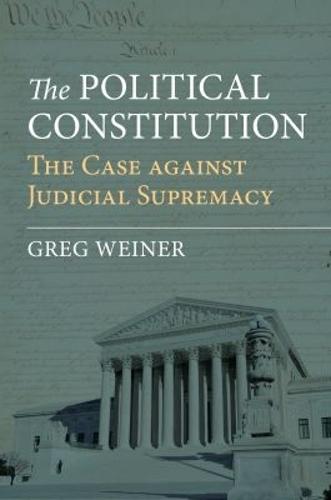
Who should decide what is constitutional? The Supreme Court, of course, both liberal and conservative voices say—but in a bracing critique of the “judicial engagement” that is ascendant on the legal right, Greg Weiner makes a cogent case to the contrary. His book, The Political Constitution, is an eloquent political argument for the restraint of judicial authority and the return of the proper portion of constitutional authority to the people and their elected representatives. What Weiner calls for, in short, is a reconstitution of the political commons upon which a republic stands. At the root of the word “republic” is what Romans called the res publica, or the public thing. And it is precisely this—the sense of a political community engaging in decisions about common things as a coherent whole—that Weiner fears is lost when all constitutional authority is ceded to the judiciary. His book calls instead for a form of republican constitutionalism that rests on an understanding that arguments about constitutional meaning are, ultimately, political arguments. What this requires is an enlargement of the res publica, the space allocated to political conversation and a shared pursuit of common things. Tracing the political and judicial history through which this critical political space has been impoverished, The Political Constitution seeks to recover the sense of political community on which the health of the republic, and the true working meaning of the Constitution, depend.
Full Product Details
Author: Greg Weiner
Publisher: University Press of Kansas
Imprint: University Press of Kansas
Dimensions:
Width: 14.70cm
, Height: 2.20cm
, Length: 22.00cm
Weight: 0.435kg
ISBN: 9780700628377
ISBN 10: 0700628371
Pages: 216
Publication Date: 02 August 2019
Audience:
Professional and scholarly
,
Professional & Vocational
Format: Hardback
Publisher's Status: Active
Availability: In Print

This item will be ordered in for you from one of our suppliers. Upon receipt, we will promptly dispatch it out to you. For in store availability, please contact us.
Reviews
In this insightful study, Greg Weiner explains why the Supreme Court on constitutional matters should not be treated as an entirely independent branch. Instead, it is part of the political process and fully Subject to independent analysis, public debate, and the system of checks and balances. In the act of governing, the judiciary is a coequal partner, not a superior branch. - Louis Fisher, author of Reconsidering Judicial Finality: Why the Supreme Court Is Not the Last Word on the Constitution The Political Constitution argues that legal theorists from across the ideological spectrum too often prefer the authority of unelected judges to the messiness of democracy. The Declaration of Independence promises not only `Inalienable Rights,' but also `The Consent of the Governed.' Greg Weiner calls upon judges to leave space for democratic deliberation on constitutional questions and urges elected officials and ordinary citizens to take responsibility for this difficult but essential work. - James H. Read, author of Majority Rule versus Consensus: The Political Thought of John C. Calhoun
In this insightful study, Greg Weiner explains why the Supreme Court on constitutional matters should not be treated as an entirely independent branch. Instead, it is part of the political process and fully Subject to independent analysis, public debate, and the system of checks and balances. In the act of governing, the judiciary is a coequal partner, not a superior branch. - Louis Fisher, author of Reconsidering Judicial Finality: Why the Supreme Court Is Not the Last Word on the Constitution The Political Constitution argues that legal theorists from across the ideological spectrum too often prefer the authority of unelected judges to the messiness of democracy. The Declaration of Independence promises not only 'Inalienable Rights,' but also 'The Consent of the Governed.' Greg Weiner calls upon judges to leave space for democratic deliberation on constitutional questions and urges elected officials and ordinary citizens to take responsibility for this difficult but essential work. - James H. Read, author of Majority Rule versus Consensus: The Political Thought of John C. Calhoun
This concise, well-written book fills an important role in contemporary debates over the role of the courts.--Political Science QuarterlyA warning against the siren's song of judicial supremacy.--National Review The book is well argued, well written, and substantially researched. Highly recommended.--Choice In this insightful study, Greg Weiner explains why the Supreme Court on constitutional matters should not be treated as an entirely independent branch. Instead, it is part of the political process and fully subject to independent analysis, public debate, and the system of checks and balances. In the act of governing, the judiciary is a coequal partner, not a superior branch.--Louis Fisher, author of Reconsidering Judicial Finality: Why the Supreme Court Is Not the Last Word on the Constitution The Political Constitution argues that legal theorists from across the ideological spectrum too often prefer the authority of unelected judges to the messiness of democracy. The Declaration of Independence promises not only 'Inalienable Rights, ' but also 'The Consent of the Governed.' Greg Weiner calls upon judges to leave space for democratic deliberation on constitutional questions and urges elected officials and ordinary citizens to take responsibility for this difficult but essential work.--James H. Read, author of Majority Rule versus Consensus: The Political Thought of John C. Calhoun This is a book that takes on big and important questions about how aggressively the courts should advance their understanding of the Constitution in the face of disagreements from others. Those questions have faded a bit in recent years, but Weiner takes them up with new urgency and does so in the name of a politics committed to communal conversations about shared values. His argument is carefully considered and well worth reading.--Keith E. Whittington, author of Repugnant Laws: Judicial Review of Acts of Congress from the Founding to the Present
In this insightful study, Greg Weiner explains why the Supreme Court on constitutional matters should not be treated as an entirely independent branch. Instead, it is part of the political process and fully subject to independent analysis, public debate, and the system of checks and balances. In the act of governing, the judiciary is a coequal partner, not a superior branch. --Louis Fisher, author of Reconsidering Judicial Finality: Why the Supreme Court Is Not the Last Word on the Constitution The Political Constitution argues that legal theorists from across the ideological spectrum too often prefer the authority of unelected judges to the messiness of democracy. The Declaration of Independence promises not only 'Inalienable Rights, ' but also 'The Consent of the Governed.' Greg Weiner calls upon judges to leave space for democratic deliberation on constitutional questions and urges elected officials and ordinary citizens to take responsibility for this difficult but essential work. --James H. Read, author of Majority Rule versus Consensus: The Political Thought of John C. Calhoun
Author Information
Greg Weiner is provost and vice president for academic affairs and associate professor of political science at Assumption College in Worcester, MassachuSetts. He was a senior aide to US senator J. Robert Kerrey, 1993–1999. His books include Madison’s Metronome: The Constitution, Majority Rule, and the Tempo of American Politics and American Burke: The Uncommon Liberalism of Daniel Patrick Moynihan, both from Kansas, and Old Whigs: Burke, Lincoln, and the Politics of Prudence.