Overview
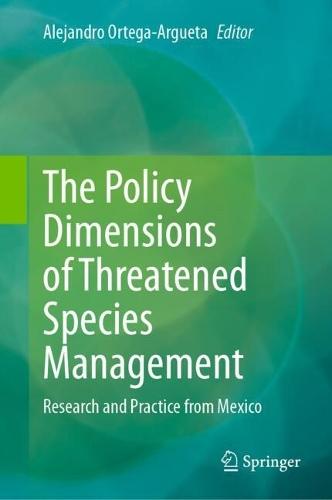
This book describes and analyzes the policies, strategies, and programs developed by the Mexican government over the last thirty years in response to international commitments for biodiversity conservation and threatened species management. The studies presented in this book are based on a multidisciplinary research framework that integrates biological sciences, and their sub-disciplines such as ecology, biodiversity conservation, and wildlife management, with social sciences such as evaluation research on government policies, public administration, and political ecology. Fourteen chapters describe the main historical governmental programs in Mexico, their implementation, and their scope. The book also discusses how management priorities are defined and how programs are implemented in multi-stakeholder co-management arrangements. This type of management has been necessary because of the limited financial capacity of the government and the fact that, to a certain extent, it has been forced to negotiate and reach agreements with other stakeholders in the social and economic sectors to effectively implement the programs. The book identifies not only management successes in achieving program objectives, but also the challenges and failures faced in both planning and implementation. Although all chapters cover aspects of management in the context of Mexico, the research findings might be of international relevance because other governments and international organizations are using similar approaches and programs. The comprehensive scientific literature reviewed through the book attest to this. To date, no book has offered this level of detail in the analysis of conservation policies in Mexico or has been available to a wide international audience. This book will be of relevance to government managers, academics, graduate students, and conservation professionals, as well as other stakeholders who collaborate with government programs.
Full Product Details
Author: Alejandro Ortega-Argueta
Publisher: Springer Nature Switzerland AG
Imprint: Springer Nature Switzerland AG
ISBN: 9783032096890
ISBN 10: 3032096898
Pages: 355
Publication Date: 14 February 2026
Audience:
College/higher education
,
Postgraduate, Research & Scholarly
Format: Hardback
Publisher's Status: Forthcoming
Availability: Not yet available

This item is yet to be released. You can pre-order this item and we will dispatch it to you upon its release.
Author Information
Alejandro Ortega-Argueta. Researcher and professor. B.S. in Biology, Universidad Veracruzana, Mexico, 1994. M.Sc. in wildlife management, Instituto de Ecología, A.C., Mexico, 2000. Ph.D., University of Queensland, Australia, 2008. He has worked at the Instituto de Investigaciones Biológicas and the Centro de Investigaciones Tropicales of the Universidad Veracruzana, and the Instituto de Ecologia, A.C., Mexico. Since 2013, he has been a senior researcher at El Colegio de la Frontera Sur. He has more than twenty-five years of experience in biodiversity research and conservation projects. He has conducted academic stays in Mexico, the United States, Belize, Puerto Rico, Brazil, Australia, and the United Kingdom. He was secretary of the Technical Advisory Committee for the Conservation of Manatees in Mexico and is co-author of the Recovery Program for the Conservation of Manatees in Mexico, in its 2001, 2010, and 2020 versions. He has collaborated with agencies in Mexico, Australia, Belize, Brazil, and the United States . As a researcher, he has participated in more than 50 publications (articles, chapters, and books written in Spanish and English). His fields of work include research and participation in planning, management, and analysis of environmental policies for biodiversity conservation and sustainability. He is a member of the IUCN Conservation Planning Specialist Group. In 2023 he carried out an academic stay at the Durrell Institute of Conservation and Ecology, University of Kent, UK.