Overview
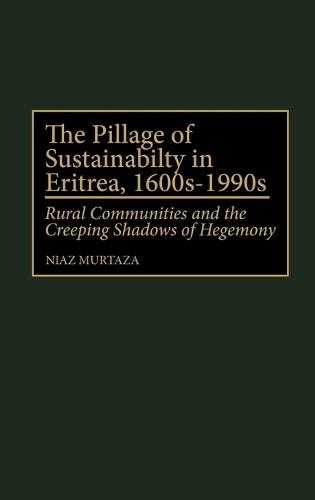
Because of its history and location, Eritrea is an ideal example for a study of the sustainability of traditional rural communities and the impact of local and external actors on them. This book provides a lucid account of the pillage of rural sustainability under modern hegemonic conditions. It traces the manner in which the imprints left by European rule were accentuated during Ethiopian control. These legacies continue to haunt rural communities after independence in the shape of resource shortages, the dominance of western civilization, and the modernization-based policies of the ruling Eritrean class which originated under European rule.
Full Product Details
Author: Niaz Murtaza
Publisher: Bloomsbury Publishing Plc
Imprint: Praeger Publishers Inc
Dimensions:
Width: 15.60cm
, Height: 1.50cm
, Length: 23.50cm
Weight: 0.510kg
ISBN: 9780313306334
ISBN 10: 0313306338
Pages: 224
Publication Date: 20 August 1998
Recommended Age: From 7 to 17 years
Audience:
College/higher education
,
Professional and scholarly
,
Undergraduate
,
Postgraduate, Research & Scholarly
Format: Hardback
Publisher's Status: Active
Availability: Manufactured on demand

We will order this item for you from a manufactured on demand supplier.
Reviews
[T]his is a clearly organized and valuable study that provides a good starting point for further inquiry. Murtaza's striving to identify the nexus between the policies of hegemonic actors and the downward trajectory of indigenous social systems is revealing. His contention that famine and poverty are consequences of policy rather than a dictate of nature is salutatory. The numerous graphs and statistical tables are instructive. Morevoer, the book comes at an opportune time, serving as a clarion call not only against the horrifying war currently unfolding in the region, but also the long-term threat it poses to the viabilty of rural communities. -African Studies Quarterly Murran's work is exciting for its originality and insight in to the new Eritrean state and the challenges it faces as a predominantly agricultural and pastoral society entering the fray of globally-determined and locally-implemented capitalist processes. His serious attention to the extensive variation within and between rural Eritrean communities is fascinating and commendable. Moreover, his critical approach to the new Eritrean state does not engage in the political axe-grinding characterizing too much Horn of Africa scholarship. -Northeast African Studies �T�his is a clearly organized and valuable study that provides a good starting point for further inquiry. Murtaza's striving to identify the nexus between the policies of hegemonic actors and the downward trajectory of indigenous social systems is revealing. His contention that famine and poverty are consequences of policy rather than a dictate of nature is salutatory. The numerous graphs and statistical tables are instructive. Morevoer, the book comes at an opportune time, serving as a clarion call not only against the horrifying war currently unfolding in the region, but also the long-term threat it poses to the viabilty of rural communities. -African Studies Quarterly ?Murran's work is exciting for its originality and insight in to the new Eritrean state and the challenges it faces as a predominantly agricultural and pastoral society entering the fray of globally-determined and locally-implemented capitalist processes. His serious attention to the extensive variation within and between rural Eritrean communities is fascinating and commendable. Moreover, his critical approach to the new Eritrean state does not engage in the political axe-grinding characterizing too much Horn of Africa scholarship.?-Northeast African Studies ?[T]his is a clearly organized and valuable study that provides a good starting point for further inquiry. Murtaza's striving to identify the nexus between the policies of hegemonic actors and the downward trajectory of indigenous social systems is revealing. His contention that famine and poverty are consequences of policy rather than a dictate of nature is salutatory. The numerous graphs and statistical tables are instructive. Morevoer, the book comes at an opportune time, serving as a clarion call not only against the horrifying war currently unfolding in the region, but also the long-term threat it poses to the viabilty of rural communities.?-African Studies Quarterly
?[T]his is a clearly organized and valuable study that provides a good starting point for further inquiry. Murtaza's striving to identify the nexus between the policies of hegemonic actors and the downward trajectory of indigenous social systems is revealing. His contention that famine and poverty are consequences of policy rather than a dictate of nature is salutatory. The numerous graphs and statistical tables are instructive. Morevoer, the book comes at an opportune time, serving as a clarion call not only against the horrifying war currently unfolding in the region, but also the long-term threat it poses to the viabilty of rural communities.?-African Studies Quarterly
[T]his is a clearly organized and valuable study that provides a good starting point for further inquiry. Murtaza's striving to identify the nexus between the policies of hegemonic actors and the downward trajectory of indigenous social systems is revealing. His contention that famine and poverty are consequences of policy rather than a dictate of nature is salutatory. The numerous graphs and statistical tables are instructive. Morevoer, the book comes at an opportune time, serving as a clarion call not only against the horrifying war currently unfolding in the region, but also the long-term threat it poses to the viabilty of rural communities. -African Studies Quarterly Murran's work is exciting for its originality and insight in to the new Eritrean state and the challenges it faces as a predominantly agricultural and pastoral society entering the fray of globally-determined and locally-implemented capitalist processes. His serious attention to the extensive variation within and between rural Eritrean communities is fascinating and commendable. Moreover, his critical approach to the new Eritrean state does not engage in the political axe-grinding characterizing too much Horn of Africa scholarship. -Northeast African Studies T his is a clearly organized and valuable study that provides a good starting point for further inquiry. Murtaza's striving to identify the nexus between the policies of hegemonic actors and the downward trajectory of indigenous social systems is revealing. His contention that famine and poverty are consequences of policy rather than a dictate of nature is salutatory. The numerous graphs and statistical tables are instructive. Morevoer, the book comes at an opportune time, serving as a clarion call not only against the horrifying war currently unfolding in the region, but also the long-term threat it poses to the viabilty of rural communities. -African Studies Quarterly ?Murran's work is exciting for its originality and insight in to the new Eritrean state and the challenges it faces as a predominantly agricultural and pastoral society entering the fray of globally-determined and locally-implemented capitalist processes. His serious attention to the extensive variation within and between rural Eritrean communities is fascinating and commendable. Moreover, his critical approach to the new Eritrean state does not engage in the political axe-grinding characterizing too much Horn of Africa scholarship.?-Northeast African Studies ?[T]his is a clearly organized and valuable study that provides a good starting point for further inquiry. Murtaza's striving to identify the nexus between the policies of hegemonic actors and the downward trajectory of indigenous social systems is revealing. His contention that famine and poverty are consequences of policy rather than a dictate of nature is salutatory. The numerous graphs and statistical tables are instructive. Morevoer, the book comes at an opportune time, serving as a clarion call not only against the horrifying war currently unfolding in the region, but also the long-term threat it poses to the viabilty of rural communities.?-African Studies Quarterly
Author Information
NIAZ MURTAZA is a Researcher at the University of California, Berkeley, with a focus on International Rural Development.