Overview
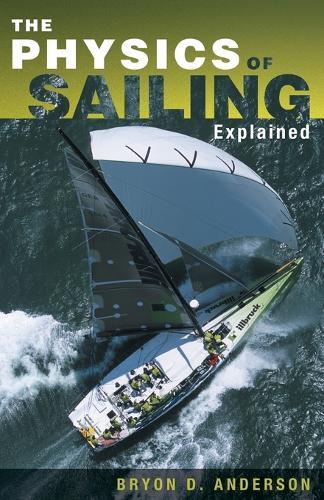
What is the best shape for a sailboat? How does turbulence affect a sailboat's movement through the water? Why do some keels have wings? Is it true that some sailboats can sail faster upwind than downwind? Authoritative yet accessible, The Physics of Sailing Explained is the perfect book for all those sailors who want to enhance their understanding and enjoyment of life at sea. It will enable cruisers and racers alike to better grasp how sails, keels, and hulls work together to keep boats afloat, and will sharpen their skills with a more subtle and thorough appreciation of why various boat design features are present and why certain tactics work in certain situations. Anderson outlines the science behind sailing in a way that anyone can understand and benefit from without having to trudge through a physics text or became a naval architect. Concepts are conveyed simply, concisely, and with many examples and illustrations. With the help of this invaluable book, sailors will be better prepared to handle any situations that might arise on the water.
Full Product Details
Author: Bryon D. Anderson
Publisher: Rowman & Littlefield
Imprint: Sheridan House
Dimensions:
Width: 14.10cm
, Height: 1.00cm
, Length: 21.80cm
Weight: 0.222kg
ISBN: 9781574091700
ISBN 10: 1574091700
Pages: 160
Publication Date: 01 December 2003
Audience:
General/trade
,
General
Format: Paperback
Publisher's Status: Active
Availability: Awaiting stock

The supplier is currently out of stock of this item. It will be ordered for you and placed on backorder. Once it does come back in stock, we will ship it out for you.
Reviews
Brian Anderson is well qualified to write on how sail boats sail, being a lecturer in physics as well as a keen cruiser and racer. If you have ever wondered why you were being overtaken by a similar boat to yours which seems to be doing everything you are doing but still managing that extra speed, this book will explain the reason and next time out he may not get in front. A wealth of subjects such as vortex formation, surface resistance, induced drag and even parasitic resistance (not an antibiotics!) are all discussed and explained. The black and white photographs and illustrations complement the text as the reader goes from basics such as a boat s maximum speed is fundamentally determined by its length, to a description of Bernoulli s Principle and the effect of the Coriolis force. Clearly and logically written this is an invaluable book for anyone who wants to do a little more than just messing about in boats. Cruising Anderson offers a clear and thorough discussion of sailing, pointed toward people who race their boats but of interest to anyone who sails. Starting with the design of hulls and keels, he analyzes the various ways in which water retards the motion of a boat and shows how they are minimized. He then discusses the physics of sails and the complicated motion of the air that flows around them, and finally the physics of weather and ocean currents. The author shows the general pattern of winds at high and low altitudes and how it is altered by the great land masses, and then follows on how the winds in turn guide the currents below them. There is mathematics, high school style, particularly to explain some surprising aspects of hull shape, but this is neatly segregated into boxes to oblige readers who like to sail in a light breeze. This book will surprise many who think there is not much about boat design that is not obvious. CHOICE Books on the how and what of sailing abound, but few go into great depth to answer the why questions why sailboats behave as they do and the physical properties involved. The Physics of Sailing Explained by Bryon Anderson attempts to answer some of these questions. A thin little book at fewer than 150 pages, The Physics of Sailing Explained is not intended for physicists or for yacht and sail designers. It is, however, intended as a basic primer for those interested in gaining a better understanding of the fundamental principles of sailing, and therefore a better appreciation of the sport as a whole. Anderson explores, in layman terms, the mechanics of such phenomena as lift, resistance, turbulence and weather. Our familiar friends Bernoulli and Coriolis are given due treatment, as are such lesser-known names as Reynolds and Van der Waals. A professor of physics at Kent State University, Anderson backs up some of the more important theories with hard equations for the mathematically inclined. Fortunately, knowing these derivations are not necessary to understanding the text. Illustrations, while rather simple from a graphic-design standard, help further explain the principle. Sailing
Brian Anderson is well qualified to write on how sail boats sail, being a lecturer in physics as well as a keen cruiser and racer. If you have ever wondered why you were being overtaken by a similar boat to yours which seems to be doing everything you are doing but still managing that extra speed, this book will explain the reason and next time out he may not get in front. A wealth of subjects such as vortex formation, surface resistance, induced drag and even parasitic resistance (not an antibiotics!) are all discussed and explained. The black and white photographs and illustrations complement the text as the reader goes from basics such as a boat s maximum speed is fundamentally determined by its length, to a description of Bernoulli s Principle and the effect of the Coriolis force. Clearly and logically written this is an invaluable book for anyone who wants to do a little more than just messing about in boats. * Cruising * Anderson offers a clear and thorough discussion of sailing, pointed toward people who race their boats but of interest to anyone who sails. Starting with the design of hulls and keels, he analyzes the various ways in which water retards the motion of a boat and shows how they are minimized. He then discusses the physics of sails and the complicated motion of the air that flows around them, and finally the physics of weather and ocean currents. The author shows the general pattern of winds at high and low altitudes and how it is altered by the great land masses, and then follows on how the winds in turn guide the currents below them. There is mathematics, high school style, particularly to explain some surprising aspects of hull shape, but this is neatly segregated into boxes to oblige readers who like to sail in a light breeze. This book will surprise many who think there is not much about boat design that is not obvious. * CHOICE * Books on the how and what of sailing abound, but few go into great depth to answer the why questions why sailboats behave as they do and the physical properties involved. The Physics of Sailing Explained by Bryon Anderson attempts to answer some of these questions. A thin little book at fewer than 150 pages, The Physics of Sailing Explained is not intended for physicists or for yacht and sail designers. It is, however, intended as a basic primer for those interested in gaining a better understanding of the fundamental principles of sailing, and therefore a better appreciation of the sport as a whole. Anderson explores, in layman terms, the mechanics of such phenomena as lift, resistance, turbulence and weather. Our familiar friends Bernoulli and Coriolis are given due treatment, as are such lesser-known names as Reynolds and Van der Waals. A professor of physics at Kent State University, Anderson backs up some of the more important theories with hard equations for the mathematically inclined. Fortunately, knowing these derivations are not necessary to understanding the text. Illustrations, while rather simple from a graphic-design standard, help further explain the principle. * Sailing *
Author Information
Bryon D. Anderson is a professor of physics at Kent State University and an avid sailor. As a graduate student, he spent many summers sailing Lake Erie, even making a trip to Canada and back, and has since developed a passion for cruising and club racing. This is his first nautical book.