Overview
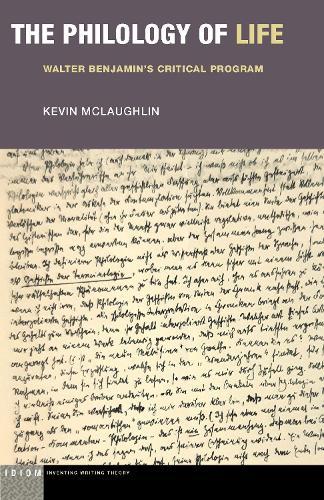
The Philology of Life retraces the outlines of the philological project developed by Walter Benjamin in his early essays on Hoelderlin, the Romantics, and Goethe. This philological program, McLaughlin shows, provides the methodological key to Benjamin's work as a whole. According to Benjamin, German literary history in the period roughly following the first World War was part of a wider ""crisis of historical experience""-a life crisis to which Lebensphilosophie (philosophy of life) had instructively but insufficiently responded. Benjamin's literary critical struggle during these years consisted in developing a philology of literary historical experience and of life that is rooted in an encounter with a written image. The fundamental importance of this ""philological"" method in Benjamin's work seems not to have been recognized by his contemporary readers, including Theodor Adorno who considered the approach to be lacking in dialectical rigor. This facet of Benjamin's work was also elided in the postwar publications of his writings, both in German and English. In recent decades, the publication of a wider range of Benjamin's writings has made it possible to retrace the outlines of a distinctive philological project that starts to develop in his early literary criticism and that extends into the late studies of Baudelaire and Paris. By bringing this innovative method to light this study proposes ""the philology of life"" as the key to the critical program of one of the most influential intellectual figures in the humanities.
Full Product Details
Author: Kevin McLaughlin
Publisher: Fordham University Press
Imprint: Fordham University Press
Edition: New edition
ISBN: 9781531501693
ISBN 10: 1531501699
Pages: 208
Publication Date: 17 January 2023
Audience:
Professional and scholarly
,
Professional & Vocational
Format: Paperback
Publisher's Status: Active
Availability: Out of stock

The supplier is temporarily out of stock of this item. It will be ordered for you on backorder and shipped when it becomes available.
Reviews
This is a rare book that addresses Benjamin as reader of literature, as a failed academic Literaturwissenschaftler but a highly successful, even prophetic reader. The manuscript is marked by a lapidary quality that speaks to the expertise and depth of the author's approach. ---Leif Weatherby, New York University,
McLaughlin's book is a model of literary studies in which the idea of life becomes a primary focal point. This life is neither the typical material of literary biography nor the 'mere life' that comes under discussion in assessments and critiques of biopolitics. By presenting the question of life as fundamentally a matter of reading, McLaughlin's biophilology makes an invaluable contribution to our understanding of Benjamin's early work as well as the theory of literature in general. ---Peter Fenves, Northwestern University This is a rare book that addresses Benjamin as reader of literature, as a failed academic Literaturwissenschaftler but a highly successful, even prophetic reader. The manuscript is marked by a lapidary quality that speaks to the expertise and depth of the author's approach. ---Leif Weatherby, New York University
Author Information
Kevin McLaughlin was Dean of Faculty at Brown University from 2011–22. He is George Hazard Crooker University Professor of English, Comparative Literature, and German Studies at Brown. He is the author of Poetic Force: Poetry after Kant (Stanford University Press, 2014), Paperwork: Literature and Mass Mediacy in the Age of Paper (University of Pennsylvania Press, 2005), and Writing in Parts: Imitation and Exchange in Nineteenth-Century Literature (Stanford University Press, 1995), and the co- translator with Howard Eiland of Walter Benjamin's Arcades Project (Harvard University Press, 1999).