Overview
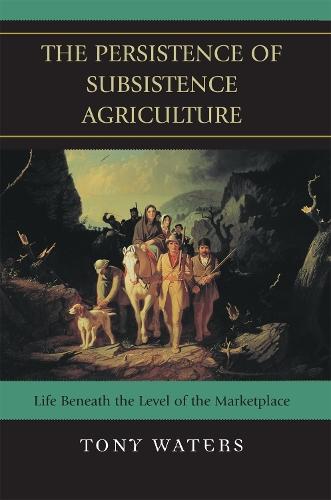
The story told by The Persistence of Subsistence Agriculture begins 8,000 years ago as humans began using the land and weather to provide themselves with food, housing, and clothing. Productive farmers took care of most daily needs within the small conservative world in which they lived. This world organized around small-scale subsistence farming is ending as the ancient world of farmers has given away to that dominated by the modern marketplace. This book is about how the modern market world transformed these remote agricultural farmers. Waters uses diverse examples to illustrate how the modern market economy captured persistent subsistence farmers and forever altered life in 18th century Scotland, 19th century United States, 20th century Tanzania, and indeed, the entire modern world.
Full Product Details
Author: Tony Waters
Publisher: Bloomsbury Publishing Plc
Imprint: Lexington Books
Dimensions:
Width: 15.60cm
, Height: 1.80cm
, Length: 23.20cm
Weight: 0.404kg
ISBN: 9780739128367
ISBN 10: 0739128361
Pages: 272
Publication Date: 15 April 2008
Audience:
General/trade
,
General
Format: Paperback
Publisher's Status: Active
Availability: In Print

This item will be ordered in for you from one of our suppliers. Upon receipt, we will promptly dispatch it out to you. For in store availability, please contact us.
Reviews
Waters takes us on a journey to the highlands of Scotland, the plains of America, and the savannah of modern Tanzania to display the deep-rooted appeal of subsistence farming.... In a brilliant combination of historical sociology and modern anthropology, Waters forces us to re-examine the views of market theorists, and shows that converting subsistence agriculturalists to industrial life is not a matter of encouraging a smooth 'take-off, ' but of wrestling with powerful attachments to a way of life. Breathing new life into classic views of the peasantry and industrial transition, Waters's book should be required reading for development professionals and analysts of economic change.--Goldstone, Jack A.
Tony Waters explains how costly economic development can be and how incompatible are the goals of subsistence farmers, yet he states the case for growth fairly too. This is a highly original work, based on Waters' personal experience of Tanzania, illuminated throughout by social science, and buttressed by rich, unexpected case studies of eighteenth-century Scotland and Daniel Boone's America. It will set tongues wagging in the development agencies. -- Eric Jones Waters takes us on a journey to the highlands of Scotland, the plains of America, and the savannah of modern Tanzania to display the deep-rooted appeal of subsistence farming... In a brilliant combination of historical sociology and modern anthropology, Waters forces us to re-examine the views of market theorists, and shows that converting subsistence agriculturalists to industrial life is not a matter of encouraging a smooth 'take-off,' but of wrestling with powerful attachments to a way of life. Breathing new life into classic views of the peasantry and industrial transition, Waters's book should be required reading for development professionals and analysts of economic change. -- Goldstone, Jack A. Tony Waters...sets out to give a general explanation...in this ambitious and passionately written book...Drawing upon a wide body of anecdotal and historical evidence, he makes a strong case...The book is recommendable...A book that is...greatly accessible and written in an enjoyable style...and whose final conclusions on development work are just remarkable. Journal Of Agraraian Change This masterful and exhaustive analysis of the role of subsistence farming in a comparative historical and societal perspective is a powerful reminder to all developmentalists - on the left or the right - that social transformation is a long-winding and often painful process. Waters cleverly illustrates the similarities between contemporary Tanzania and historical Scotland and the United States teasing out why the prospect for a transformation to a fully fledged market economy is so much more difficult in the former place. At a point when there is growing interest in informal institutions and the role culture plays in development, this is a timely contribution of interest to the academic community as well as analysts and practitioners in the international development field. -- Distinguished Professor Goran Hyden
Author Information
Tony Waters is Department Chair and Professor of Sociology at California State University, Chico.