Overview
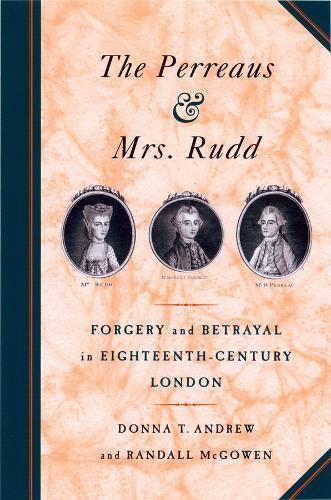
The Perreaus and Mrs. Rudd tells the remarkable story of a complex forgery uncovered in London in 1775. Like the trials of Martin Guerre and O.J. Simpson, the Perreau-Rudd case-filled with scandal, deceit, and mystery-preoccupied a public hungry for sensationalism. Peopled with such familiar figures as John Wilkes, King George III, Lord Mansfield, and James Boswell, this story reveals the deep anxieties of this period of English capitalism. The case acts as a prism that reveals the hopes, fears, and prejudices of that society. Above all, this episode presents a parable of the 1770s, when London was the center of European finance and national politics, of fashionable life and tell-all journalism, of empire achieved and empire lost. The crime, a hanging offense, came to light with the arrest of identical twin brothers, Robert and Daniel Perreau, after the former was detained trying to negotiate a forged bond. At their arraignment they both accused Daniel's mistress, Margaret Caroline Rudd, of being responsible for the crime. The brothers' trials coincided with the first reports of bloodshed in the American colonies at Lexington and Concord and successfully competed for space in the newspapers. From March until the following January, people could talk of little other than the fate of the Perreaus and the impending trial of Mrs. Rudd. The participants told wildly different tales and offered strikingly different portraits of themselves. The press was filled with letters from concerned or angry correspondents. The public, deeply divided over who was guilty, was troubled by evidence that suggested not only that fair might be foul, but that it might not be possible to decide which was which. While the decade of the 1770s has most frequently been studied in relation to imperial concerns and their impact upon the political institutions of the day, this book draws a different portrait of the period, making a cause célèbre its point of entry. Exhaustively researched and brilliantly presented, it offers both a vivid panorama of London and a gauge for tracking the shifting social currents of the period.
Full Product Details
Author: Donna T. Andrew ,
Randall McGowen
Publisher: University of California Press
Imprint: University of California Press
Dimensions:
Width: 15.60cm
, Height: 2.80cm
, Length: 23.50cm
Weight: 0.680kg
ISBN: 9780520220621
ISBN 10: 0520220625
Pages: 358
Publication Date: 01 October 2001
Audience:
General/trade
,
General
Format: Hardback
Publisher's Status: Active
Availability: Out of stock

The supplier is temporarily out of stock of this item. It will be ordered for you on backorder and shipped when it becomes available.
Reviews
An absorbing tale of the lifestyles of the rich and infamous. The Perreaus and Mrs. Rudd gets positively gripping as the authors walk us through the political, social, financial, legal and media background of the whole episode. -- Toronto Star
"""An absorbing tale of the lifestyles of the rich and infamous. ""The Perreaus and Mrs. Rudd gets positively gripping as the authors walk us through the political, social, financial, legal and media background of the whole episode.""--""Toronto Star"
A tale of two crimes: the first, an endlessly juicy mystery that captivated England in the late 18th century; the second, the tragedy of that fascinating episode being done in by lifeless prose. History profs Andrew (Univ. of Guelph) and McGowen (Univ. of Oregon) dredge up a sordid affair that figures in few standard histories of England, and one that begs to be turned into a film: two 40-something twin brothers fall under the spell of a skillful courtesan who enlists them in trying to pass off a forged bond; caught in the act, the brothers are nearly let off by their would-be victims but protest their innocence a little too loudly; enter the constabulary, the judiciary, and the hangman. The tale, open-and-shut in the eyes of the presiding judge, turns out to be a bit more complicated: in exploring the case of the brothers Perreau and the beguiling Mrs. Rudd, the authors call forth conflicting testimonies, contemporary newspaper accounts marked by a loose regard for the facts, and the political climate in a time of colonial revolt and widespread anti-Scottish and anti-Semitic sentiment, all of which had bearing on the outcome. Andrew and McGowen are careful researchers, and they do a good job of elucidating the social history of the time and some of the Rashomonish qualities of Perreau/Rudd affair. Ultimately, however, their bloodless exposition overcomes the inherent interest of the story: Although newspaper accounts dominated discussion of the case, they were supplemented by the several versions of events that appeared in pamphlet form ; Although publishers expressed a general commitment to fairness, objectivity, and honesty, the conditions of publication militated against their realization ; The actions undertaken to bring Mrs. Rudd to trial struck some as an abuse of power loaded with disturbing consequences for society. And so on, until it all becomes such a bitter chore to read that only the most dogged student of the era will persist to the index. In the hands of, say, Luc Sante, this tale of the London lowlife would have been gold. As it is, general readers should hold out for the movie. (Kirkus Reviews)
Author Information
Donna T. Andrew is Professor of History at the University of Guelph and author of Philanthropy and Police (1989). Randall McGowen is Professor of History at the University of Oregon.