Overview
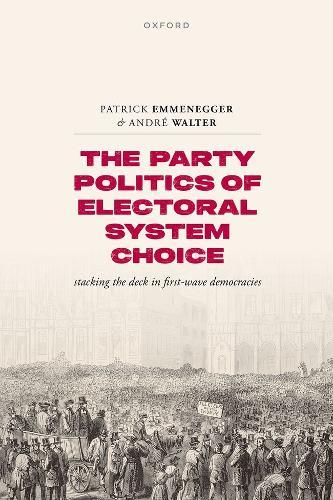
The Party Politics of Electoral System Choice explores the strategic manipulation of electoral systems by political actors to maintain access to power. It delves into how electoral systems are more than mere governance tools; they are pivotal instruments that shape power dynamics. The book shows that the choice of an electoral system is one of the most consequential decisions in any democracy.The authors develop a 'neo-Rokkanian' theory of electoral system choice, arguing that incumbent parties try to contain electoral threats through district design and electoral alliances. When successful, incumbent parties resist electoral reform. However, this strategy leads to growing seat-vote distortions, which is why disadvantaged parties demand proportional representation. In the absence of any exogenous shock, however, disadvantaged parties will struggle to overcome the incumbent parties' resistance to electoral reform. If incumbent parties cannot resort to containment measures, for example because the electoral geography is not suitable, they support the adoption of proportional representation. In this response, incumbent parties opt for a more inclusive electoral system that allows them to limit their seat losses in the face of a rapidly growing electoral threat that they cannot neutralize.Through a comprehensive analysis of first-wave democracies and a combination of quantitative and qualitative methods, the authors reveal the broader patterns of strategic behaviour of political actors seeking to optimize their positions through electoral reform. This comprehensive study is essential for understanding the politics of electoral system choice, offering new insights into electoral geography, district design, electoral alliances, and party preferences for electoral reform.This is an open access title available under the terms of a CC BY-NC-ND 4.0 International licence. It is free to read at Oxford Scholarship Online and offered as a free PDF download from OUP and selected open access locations.
Full Product Details
Author: Patrick Emmenegger (Professor of Political Science, Professor of Political Science, University of St.Gallen, Switzerland) ,
André Walter (Postdoctoral Researcher, Postdoctoral Researcher, University of St.Gallen, Switzerland)
Publisher: Oxford University Press
Imprint: Oxford University Press
Dimensions:
Width: 15.60cm
, Height: 23.40cm
, Length: 2.10cm
Weight: 0.633kg
ISBN: 9780192885661
ISBN 10: 0192885669
Pages: 344
Publication Date: 19 February 2026
Audience:
Professional and scholarly
,
Professional & Vocational
Format: Hardback
Publisher's Status: Active
Availability: To order

Stock availability from the supplier is unknown. We will order it for you and ship this item to you once it is received by us.
Author Information
Patrick Emmenegger is Professor of Comparative Political Economy and Public Policy at the University of St.Gallen, Switzerland. He obtained his PhD from the University of Bern in 2008, and his research focuses on questions of democratization, electoral reform, and state building, on the political economy of welfare and skills, as well as institutional theory. André Walter is a research group leader at the University of St.Gallen in Switzerland with a PhD from University of St.Gallen, Switzerland. In his research, he focuses on democratization, electoral systems, and state formation. Methodologically, he is interested in causal inference and machine learning.