Overview
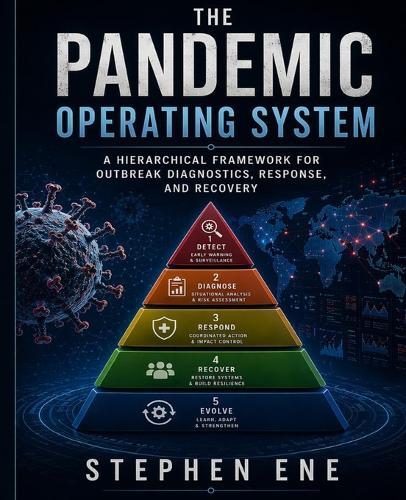
The COVID-19 pandemic (2019-2020) exposed a fundamental vulnerability in global public health: the absence of a unified, scalable, and bidirectional decision-making framework. Without a shared operating system, responses oscillated between panic and denial, escalation was delayed until crisis was inevitable, and de-escalation was so halting that emergency powers and restrictions persisted for years beyond their epidemiological justification. The Pandemic Operating System provides the missing framework. Drawing on systems engineering, computer science, and disaster management, this textbook introduces a state-machine model for pandemic response: eight hierarchical states-Debug, Informational, Notification, Warning, Error, Critical, Alert, Emergency-that define the full spectrum from routine preparedness to total systemic collapse. For each state, the text specifies objective escalation and de-escalation thresholds, decision authorities, resource allocations, and communication protocols. The framework is bidirectional. Unlike linear emergency management models that assume a single event with a clear endpoint, this system recognizes that pandemics move in waves. The same rigor applied to escalation is applied to de-escalation, with pre-defined exit criteria, automatic triggers, and deliberate management of the ascent from collapse back to a strengthened baseline. Structured as a comprehensive textbook, the volume is organized into six parts: Foundational Concepts establishes the logic of state-machine response, defines the eight states, and articulates six core principles, including the critical insight that de-escalation is not automatic. Escalation Protocol - The Descent details each transition from Debug through Emergency, with triggers, protocols, authorities, and historical examples from the first wave of COVID-19. De-Escalation Protocol - The Ascent addresses the neglected half of crisis management, providing objective exit criteria and step-down protocols for moving from Emergency back to Debug. Applied Cases examines real-world responses-Lombardy, South Korea, New York City, Australia, and the global vaccine rollout-through the lens of the framework, extracting lessons from both success and catastrophic failure. Implementation Guide offers practical tools: threshold-setting worksheets, authority matrices, communication templates, after-action review protocols, and exercise scenarios for training and drills. Future Directions extends the framework to novel pathogens (Pathogen X), climate disasters, cybersecurity incidents, and civil unrest, while addressing the political economy of state transitions and the ethical dimensions of triage, equity, privacy, and moral injury. Appendices provide state reference cards, templates, a glossary, and an index. Written for public health officials, hospital administrators, emergency managers, policymakers, and students of health systems engineering, The Pandemic Operating System is both a post-COVID autopsy and a pre-pandemic blueprint. It argues that the next emerging pathogen will judge us not by whether we are surprised, but by whether we have learned. This textbook ensures we have no excuse for failing to do so.
Full Product Details
Author: Stephen Ene
Publisher: Independently Published
Imprint: Independently Published
Dimensions:
Width: 19.10cm
, Height: 1.40cm
, Length: 23.50cm
Weight: 0.467kg
ISBN: 9798258126016
Pages: 270
Publication Date: 20 April 2026
Audience:
General/trade
,
General
Format: Paperback
Publisher's Status: Active
Availability: Available To Order

We have confirmation that this item is in stock with the supplier. It will be ordered in for you and dispatched immediately.