Overview
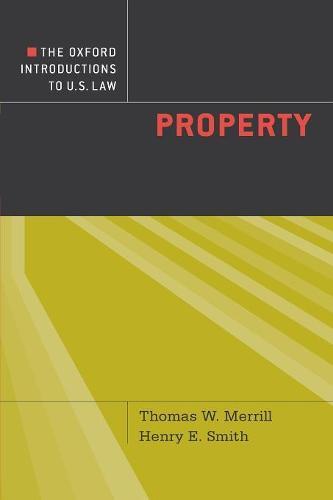
The Oxford Introductions to U.S. Law: Property provides both a bird's eye overview of property law and an introduction to how property law affects larger concerns with individual autonomy, personhood, and economic organization. Written by two authorities on property law, this book gives students of property a coherent account of how property law works, with an emphasis on describing the central issues and policy debates. It is designed for law students who want a short and theoretically integrated treatment of the subject, as well as for lawyers who are interested in the conceptual foundations of the law of property.
Full Product Details
Author: Thomas W. Merrill (Professor of Law, Professor of Law, Columbia Law School) ,
Henry E. Smith (Fessenden Professor of Law, Fessenden Professor of Law, Harvard Law School)
Publisher: Oxford University Press Inc
Imprint: Oxford University Press Inc
Dimensions:
Width: 13.70cm
, Height: 1.50cm
, Length: 20.60cm
Weight: 0.318kg
ISBN: 9780195314762
ISBN 10: 019531476
Pages: 284
Publication Date: 29 July 2010
Audience:
College/higher education
,
Professional and scholarly
,
Undergraduate
,
Postgraduate, Research & Scholarly
Format: Paperback
Publisher's Status: Active
Availability: To order

Stock availability from the supplier is unknown. We will order it for you and ship this item to you once it is received by us.
Reviews
Merrill and Smith, both renowned scholars of property law, apply an accessible theoretical framework to illuminate principles that govern the resolution of disputes over resources. This sunlight brings ancient-and, in some instances, superficially musty-doctrines to life. --Robert Ellickson Walter E. Meyer Professor of Property and Urban Law, Yale Law School Merrill and Smith's book is nothing short of a marvel. It gives shape and direction to a field often considered to be diffuse and unmanageable. This volume is full of ideas that enliven all aspects of property law, showing the reader why these topics are interesting and topical. --Carol M. Rose Lohse Chair in Water and Natural Resources, The University of Arizona James E. Rogers College of Law
<br> Merrill and Smith, both renowned scholars of property law, apply an accessible theoretical framework to illuminate principles that govern the resolution of disputes over resources. This sunlight brings ancient-and, in some instances, superficially musty-doctrines to life. <br>--Robert Ellickson <br>Walter E. Meyer Professor of Property and Urban Law, Yale Law School <br><br> Merrill and Smith's book is nothing short of a marvel. It gives shape and direction to a field often considered to be diffuse and unmanageable. This volume is full of ideas that enliven all aspects of property law, showing the reader why these topics are interesting and topical. <br>--Carol M. Rose <br>Lohse Chair in Water and Natural Resources, The University of Arizona James E. Rogers College of Law <br><br>
Author Information
Thomas W. Merrill is a professor of law at Columbia Law School, where he teaches in the areas of property, environmental law, natural resources, administrative law, and legislation. After graduating from Grinnell College and Oxford University, he received his J.D. from the University of Chicago, and then clerked for the Hon. David Bazelon, U.S. Court of Appeals for the D.C. Circuit, and the Hon. Harry Blackmun, U.S. Supreme Court. From 1987-1990 he served as Deputy Solicitor General, U.S. Department of Justice. He began his academic career at the Northwestern University School of Law and has also taught at the Yale Law School. His publications include Property: Principles and Policies (with Henry E. Smith, Foundation 2007), and Property: Takings (with David Dana, Foundation 2002). He is, in addition, the author of more than 75 academic articles on property, environmental law, administrative law, constitutional law, and the Supreme Court. Henry E. Smith is Fessenden Professor of Law at Harvard Law School, where he directs the Project on the Foundations of Private Law and teaches in the areas of property, intellectual property, natural resources, remedies, and taxation. After receiving an A.B. from Harvard, a Ph.D. in Linguistics from Stanford, and a J.D. from Yale, he clerked for the Hon. Ralph K. Winter, U.S. Court of Appeals for the Second Circuit, taught at the Northwestern University School of Law, and was the Fred A. Johnston Professor of Property and Environmental Law at Yale Law School. He has written primarily on the law and economics of property and intellectual property. His publications include Property: Principles and Policies (with Thomas W. Merrill, Foundation 2007), The Privilege Against Self-Incrimination: Its Origins and Development (with R.H. Helmholz et al., Chicago 1997); Restrictiveness in Case Theory (Cambridge studies in linguistics no. 78, 1996). He is the co-editor of the Research Handbook on the Economics of Property Law (with Kenneth Ayotte, forthcoming 2009).