Overview
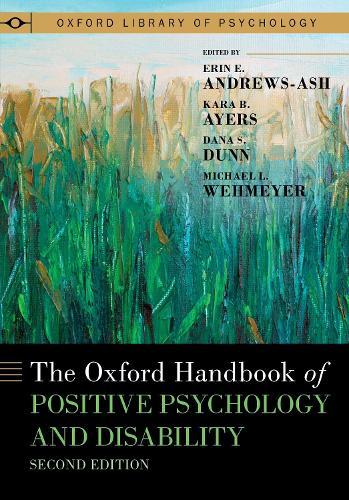
Roughly 61 million people with disabilities live in the United States, and there are many more millions of people with disabilities around the world. Not surprisingly, differences among and between people with disabilities are often as notable as differences between people with and without disabilities. And, while the lack of homogeneity among people with disabilities makes creating a valid taxonomy under this term difficult, if not impossible, there is commonality among and between people with disabilities that justifies an authoritative resource on positive psychology and disability. That is, they have experienced discrimination and marginalization as a function of their disability.This expanded and updated volume assembles chapters by leading scholars in the fields of disability and positive psychology to provide a comprehensive synthesis of the state of the combined field of positive psychology and disability. Chapters are organized into thematic sections, beginning with an introductory section providing information on overarching themes in positive psychology and disability. The second section focuses on specific positive psychological constructs that have relevance to disability, including optimism, hope, social well-being, resilience, and positive education. The following section examines systems that take strengths-based approaches to treatment and intervention, while the fourth section looks at the application of positive psychological principles in specific disciplines such as rehabilitation sciences and disability studies. The final section focuses on topics that merit consideration in positive psychology and disability such as disability ethics, adaptation, and toxic positivity.Disability has always been associated with ""differentness"" and, consequently, people with disabilities have, throughout time, been treated as such. By examining disability from a strengths-based perspective, this volume provides a catalyst to accelerate the application of positive psychology with regard to how disability is understood.
Full Product Details
Author: Erin E. Andrews-Ash (Affiliate Associate Professor, Affiliate Associate Professor, Department of Psychiatry and Behavioral Sciences, Dell Medical School, University of Texas at Austin) , Kara B. Ayers (Associate Professor of Pediatrics, Associate Professor of Pediatrics, Cincinnati Children's Hospital Medical Center and the University of Cincinnati College of Medicine) , Dana S. Dunn (Professor of Psychology and Director of Academic Assessment, Professor of Psychology and Director of Academic Assessment, Moravian University) , Michael L. Wehmeyer (Distinguished Professor Emeritus of Special Education, Distinguished Professor Emeritus of Special Education, University of Kansas)
Publisher: Oxford University Press Inc
Imprint: Oxford University Press Inc
Edition: 2nd Revised edition
Dimensions:
Width: 18.20cm
, Height: 3.80cm
, Length: 25.30cm
Weight: 1.012kg
ISBN: 9780197749760
ISBN 10: 0197749763
Pages: 516
Publication Date: 15 March 2026
Audience:
Professional and scholarly
,
College/higher education
,
Professional & Vocational
,
Postgraduate, Research & Scholarly
Format: Hardback
Publisher's Status: Forthcoming
Availability: To order 
Table of Contents
Part I: Introduction to Positive Psychology and Disability Chapter 1: Embracing Disability Identity: A Positive Psychology Perspective Erin E. Andrews and Jaylene M. Lee Chapter 2: A Brief History of Positive Psychology and Its Application to Disability Dana S. Dunn and Michael L. Wehmeyer Chapter 3: Conceptualizing Disability: Positive Psychology and the ICF Models Michael L. Wehmeyer and Dana S. Dunn Chapter 4: Positive Deviance: Character Strength Development at the Intersectionality of Disability Dan Tomasulo Chapter 5: Cultural Diversity, Equity, and Inclusion in Positive Psychology and Disability Chandra Donnell Carey and Tyra A Bernard-Watts Part II: Application of Positive Psychological Constructs to Disability Chapter 6: Optimism Within the Context of Disability Kevin L. Rand and Naheeda Ahamadeen Chapter 7: Disability and Hope: The Neurodevelopmental Disorder Perspective Malka Margalit and Michal Al-Yagon Chapter 8: Coping and Disability: A Positive Psychology Perspective Ella McNeil, Abigail Wang, Kaitlin Gelman, Jack Holloway, Gissette Noriega, and Michele M. Tugade Chapter 9: Social Well-Being and Friendship Carli Friedman Chapter 10: Self-Determination and Self-Determined Learning Sheida K. Raley, Michael L. Wehmeyer, and Todd D. Little Chapter 11: Resilience, Problem Solving, and the Experience of Disability: A Positive Psychological Perspective Dana S. Dunn and Kara B. Ayers Chapter 12: Interpersonal Decision Making in Individuals With Intellectual and Developmental Disabilities Ishita Khemka Chapter 13: Character Strengths Ryan M. Niemiec Chapter 14: Mindfulness and Disability Nirbhay N. Singh, Giulio E. Lancioni, Rachel E. Myers, Yoon-Suk Hwang, and Oleg N. Medvedev Chapter 15: Disability and Sexual Positivity: The Right to Sexual Citizenship Roxanna Nasseri Pebdani, Rachel Cuesta, Gabrielle Ficchi, Jolie Chantharath, Margaret McGrath Chapter 16: Disability and the Virtues of Interdependency Shane Clifton and Jemma Clifton Chapter 17: A Social Identity Approach to Positive Education: Toward New Sources of Life Satisfaction for Students with Disabilities Jeffrey G. Noel, Thomas P. Dirth, and Michelle R. Nario-Redmond Chapter 18: Understanding and Increasing Well-Being in People With Disabilities and/or Chronic Illness Barry Nierenberg and D'anna Sydow Part III. Strengths-based Processes, Approaches, and Systems Chapter 19: Supports and Support Needs Virginia Walker, Megan E. Carpenter, Yuwadee Viriyangkura, and James R. Thompson Chapter 20: Positive Psychology Measurement and Assessment Lauren A. Stutts and Erin E. Andrews Chapter 21: Micro, Meso, and Macro Actions for an Inclusive and Sustainable Career Future Laura Nota, Maria Cristina Ginevra, Sara Santilli, Denise Zucchini, and Salvatore Soresi Chapter 22: Powering up Family Systems Using Systems-Informed Positive Psychology: Parent-Peer Workers as Levers for Change Sylvana Mahmic, Margaret L. Kern, Annick Janson, Danielle Tracey, and Christine Johnston Chapter 23: Aging With Disability Tamar Heller, Lieke van Heumen, and Abby Schindler Chapter 24: Social Support and Disability Kathleen R. Bogart, Brooke A Bryson, and Amanda Hemmesch Part IV. Positive Psychology and Disability Disciplines Chapter 25: Positive Rehabilitation Psychology: Prospects, Progress, and Potential Dana S. Dunn and Timothy R. Elliott Chapter 26: Disability Studies Brenda Jo Brueggemann and Jessica Gallagher Chapter 27: Positive Psychological Mechanisms and Interventions in Chronic Pain Jennifer G. Pearston and Dawn M. Ehde Chapter 28: Positive Psychology and Brain Injury Systems Jed N. McGiffin, Whitney Morean, and David Sheppard Part V. Considerations in Positive Psychology and Disability Chapter 29: Positive Psychology and Disability Ethics: Foundations and Principles Emily M. Lund Chapter 30: Adaptation and Disability Identity Toni Saia, Joseph Stramondo, Abraham Graber, and Kathleen Green Chapter 31: Toxic Positivity: The Pitfalls of Positivity in the Context of Disability Carrie R. Pilarski and Miso Kwak Chapter 32: Conclusions and Future Directions Erin Andrews, Kara Ayers, Dana S. Dunn, and Michael L. Wehmeyer
Reviews
Author Information
Erin E. Andrews, PsyD, ABPP, is an affiliate faculty member in the Department of Psychiatry and Behavioral Sciences at Dell Medical School, the University of Texas at Austin, and the Chief of Psychology for the Veterans Health Administration VISN 17 Mental Health Clinical Resource Hub. Kara B. Ayers, PhD, is an Associate Professor of Pediatrics in the College of Medicine at the University of Cincinnati and the Associate Director of the University of Cincinnati Center for Excellence. Dana S. Dunn, PhD, is Professor of Psychology and Director of Academic Assessment at Moravian University in Bethlehem, PA. Michael L. Wehmeyer, PhD, is the Ross and Marianna Beach Distinguished Professor in Special Education and Senior Scientist and Director, Beach Center on Disability at the University of Kansas.
Tab Content 6
Author Website:
Countries Available
All regions
|