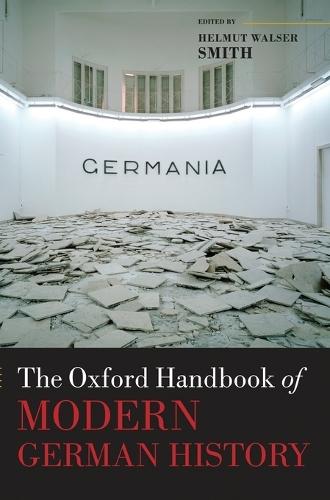
Overview
This is the first comprehensive, multi-author survey of German history that features cutting-edge syntheses of major topics by an international team of leading scholars. Emphasizing demographic, economic, and political history, this Handbook places German history in a denser transnational context than any other general history of Germany. It underscores the centrality of war to the unfolding of German history, and shows how it dramatically affected the development of German nationalism and the structure of German politics. It also reaches out to scholars and students beyond the field of history with detailed and cutting-edge chapters on religious history and on literary history, as well as to contemporary observers, with reflections on Germany and the European Union, and on 'multi-cultural Germany.'Covering the period from around 1760 to the present, this Handbook represents a remarkable achievement of synthesis based on current scholarship. It constitutes the starting point for anyone trying to understand the complexities of German history as well as the state of scholarly reflection on Germany's dramatic, often destructive, integration into the community of modern nations. As it brings this story to the present, it also places the current post-unification Federal Republic of Germany into a multifaceted historical context. It will be an indispensable resource for scholars, students, and anyone interested in modern Germany.
Full Product Details
Author: Helmut Walser Smith (Martha Rivers Ingram Professor of History, Vanderbilt University)
Publisher: Oxford University Press
Imprint: Oxford University Press
Dimensions:
Width: 16.90cm
, Height: 5.60cm
, Length: 24.50cm
Weight: 1.639kg
ISBN: 9780199237395
ISBN 10: 0199237395
Pages: 880
Publication Date: 29 September 2011
Audience:
College/higher education
,
Undergraduate
,
Postgraduate, Research & Scholarly
Format: Hardback
Publisher's Status: Active
Availability: To order 
Stock availability from the supplier is unknown. We will order it for you and ship this item to you once it is received by us.
Table of Contents
1: Helmut Walser Smith: Introduction Part I: History 2: Robert von Friedeburg: The Origins of Modern Germany 3: Celia Applegate: Senses of Place 4: Ann Goldberg: Women and Men: 1760-1960 Part II: States, People and Nation, 1760-1860 5: Ute Planert: International Conflict, War, and the Making of Modern Germany, 1740-1815 6: 1. Jurgen Osterhammel and Franz Leander Fillafer: Cosmopolitanism and the German Enlightenment 7: Jonathan Sperber: The Atlantic Revolutions in the German Lands, 1776-1849 8: James M. Brophy: The End of the Economic Old Order: The Great Transition, 1750-1860 9: Ernest Benz: Escaping Malthus: Population Explosion and Human Movement, 1760-1884 10: George S. Williamson: Protestants, Catholics, and Jews: Enlightenment, Emancipation, New Forms of Piety 11: Christian Jansen: The Formation of German Nationalism, 1740-1850 12: Ritchie Robertson: German Literature and Thought from 1810 to1890 Part III: Germany: The Nation State 13: Siegfried Weichlein: Nation State, Conflict Resolution, and Culture War, 1850-1878 14: Helmut Walser Smith: Authoritarian State, Dynamic Society, Failed Imperialist Power, 1878-1914 15: Cornelius Torp: The Great Transformation: German Economy and Society, 1850-1914 16: Andrew Zimmerman: Race and World Politics: Germany in the Age of Imperialism, 1878-1914 17: Benjamin Ziemann: Germany 1914-1918. Total War as a Catalyst of Change 18: J. Adam Tooze: The German National Economy in an Era of Crisis and War, 1917-1945 19: Thomas Mergel: Democracy and Dictatorship 20: Rebekka Habermas: Piety, Power and Powerlessness: Religion and Religious Groups in Germany, 1870-1945 21: 1. Steve Dowden and Meike G. Werner: The Place of German Modernism 22: Pieter M. Judson: Nationalism in the Era of the Nation State, 1870-1945 23: Thomas Kuhne: Todesraum: War, Peace, and the Experience of Mass Death, 1914-1945 24: William H. Hagen: The Three Horsemen of the Holocaust: Antisemitism, East European Empire, Aryan Folk Community 25: 1. Sebastian Conrad and Philipp Ther: The Uprooted: Expulsion, Exile, Flight, Forced Labor, Expulsion, 1880-1948 Part IV: Germany 1945-1989 26: Stefan Ludwig Hoffman: The Occupation of Germany, a Rubble Society 27: Andrew I. Port: Democracy and Dictatorship in the Cold War: the Two Germanies, 1949-1961 28: Uta Poiger: Generations: The Revolution of the 1960s 29: Donna Harsch: Industrialization, Mass Consumption, Postindustrial Society 30: Benjamin Ziemann: Religion and the Search for Meaning, 1945-1990 31: Lutz Koepnik: Culture in the Shadow of Trauma? 32: Andreas Daum: The Two German States in the International World Part V: Contemporary Germany 33: David F. Patton: Annus Mirabilis: 1989 and German Unification 34: Kiran Patel: Germany and European Integrations since 1945 35: William A. Barbieri, Jr.: Toward a Multicultural Society? Index
Reviews
How else might we organize our thinking about the past? This question is particularly pressing at a time when many look to history for concrete answers and explanations: the media, the general public, school teachers and, last but not least, the students we teach. Oxford University Press have been at the forefront of responding to such demands for general answers by commissioning a series of new handbooks, which included, last year, a new Handbook on Modern German History, edited by Helmut Walser Smith'. German History
Author Information
Helmut Walser Smith is Martha Rivers Ingram Professor of History and Director of the Max Kade Center for European and German Studies at Vanderbilt University. A scholar of German nationalism, religious history, and anti-Semitism, he is a specialist on Imperial Germany and has written on the long continuities of German history.
Tab Content 6
Author Website:
Countries Available
All regions
|