Overview
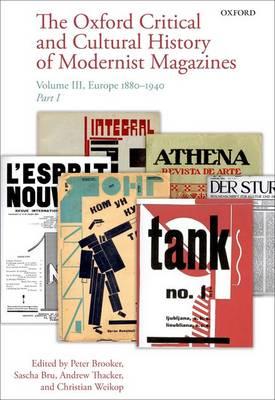
The third of three volumes devoted to the cultural history of the modernist magazine in Britain, North America, and Europe, this collection contains fifty-six original essays on the role of 'little magazines' and independent periodicals in Europe in the period 1880-1940. It demonstrates how these publications were instrumental in founding and advancing developments in European modernism and the avant-garde. Expert discussion of approaching 300 magazines, accompanied by an illuminating variety of cover images, from France, Italy, Germany, Spain and Portugal, Scandinavia, Central and Eastern Europe will significantly extend and strengthen the understanding of modernism and modernity. The chapters are organised into six main sections with contextual introductions specific to national, regional histories, and magazine cultures. Introductions and chapters combine to elucidate the part played by magazines in the broader formations associated with Symbolism, Expressionism, Futurism, Dada, Surrealism, and Constructivism in a period of fundamental social and geo-political change. Individual essays, situated in relation to metropolitan centres bring focussed attention to a range of celebrated and less well-known magazines, including Le Chat Noir, La Revue blanche, Le Festin d'Esope, La Nouvelle Revue Francaise, La Revolution Surrealiste, Documents,De Stijl, Ultra, Lacerba, Energie Nouve, Klingen, Exlex, flamman, Der Blaue Reiter, Der Sturm, Der Dada, Ver Sacrum, Cabaret Voltaire, 391, ReD, Zenit, Ma, Contemporanul, Formisci, Zdroj, Lef ,and Novy Lef . The magazines disclose a world where the material constraints of costs, internal rivalries, and anxieties over censorship ran alongside the excitement of new work, collaboration on a new manifesto and the birth of a new movement. This collection therefore confirms the value of magazine culture to the expanding field of modernist studies, providing a rich and hitherto under-examined resource which helps bring to life the dynamics out of which the modernist avant-garde evolved.
Full Product Details
Author: Peter Brooker , Sascha Bru , Andrew Thacker , Christian Weikop
Publisher: Oxford University Press
Imprint: Oxford University Press
Dimensions:
Width: 18.10cm
, Height: 8.80cm
, Length: 25.30cm
Weight: 3.376kg
ISBN: 9780199659586
ISBN 10: 0199659583
Pages: 1528
Publication Date: 28 March 2013
Audience:
College/higher education
,
Professional and scholarly
,
Tertiary & Higher Education
,
Professional & Vocational
Format: Hardback
Publisher's Status: Active
Availability: Out of stock 
The supplier is temporarily out of stock of this item. It will be ordered for you on backorder and shipped when it becomes available.
Table of Contents
General Introduction: Modernity, modernism, magazines ; FRANCE ; Introduction ; 1. Performing writing: Le Chat Noir (1881-95), Le Courrier francais (1884-1913), Gil Blas illustre (1891-1903), Les Quat'z'arts (1897-8) ; 2. The 'little magazine' as publishing success : Le Scapin (1885-6), La Pleiade (1886-90), Le Mercure de France (1890-1965) ; 3. Between symbolism and avant-garde poetics: La Plume (1889-1905), L'Ermitage (1890-1906), and La Revue blanche (1890-1905) ; 4. Modern classicism: La Nouvelle Revue francaise (1909-43) and Commerce (1924-32) ; 5. Apollinaire and 'the new spirit': Le Festin d'Esope (1903), Les Soirees de Paris (1912 -June 1913; Nov. 1913- July 1914), L'elan (1915-Feb 1916; Dec.1916) ; 6. After Apollinaire: SIC (1916-19), Nord-Sud (1917-18) and L'Esprit Nouveau (1920-5) ; 7. Proto-Dada. The New York connection: The Ridgefield Gazook (1915), The Blind Man (1917), Rongwrong (1917), 391 (1917), TNT (1919), New York Dada (1921) ; 8. A Dada Season: 391 (1919-24), Cannibale (1920), Projecteur (1920), Dada (1920-1), Le Coeur a Barbe (1922) ; 9. Eclecticism and its discontents: Les Ecrits nouveaux (1917-22) and La Revue europeenne (1923-31) ; 10. 'Que faire les surrealistes?': Litterature (1919-24), La Revolution surrealiste, (1925-9), Le Surrealisme au service de la revolution, (1930-3) ; 11. 'A shameless, indecent saintliness': Georges Bataille, Documents (1929-31), and Acephale (1936-9) ; 12. Dangerous games and new mythologies: Cercle et Carre (1930), Art Concret (1930), Abstraction-Creation (1932-5); Minotaure (1933-9) ; THE LOW COUNTRIES ; Introduction ; 13. 'The will to style': the Dutch contribution to the avant-garde: Leiden: De Stijl (1917-32), Mecano (1922-3), Amsterdam: Wendingen (1918-32), i10 (1927-9), Groningen: The Next Call (1923-6) ; 14. Antwerp circles.Languages, locality, and internationalism: Ontwaking (1896, 1901-1910), De Boomgaard (1909-11), Resurrection (1917-18), Het Roode Zeil (1920), Selection (1920-33), Ruimte (1920-1), Het Overzicht (1921-5), De Driehoek (1925-6), Lumiere (1919-23), Ca Ira (1920-3) ; 15. 'Streetscape of new districts permeated by the fresh scent of cement'. Brussels, the avant-garde, and internationalism: La Jeune Belgique (1881-7), Van Nu en Straks (1893-1901), L'Art libre (1919-22), Le Disque Vert (1922-5), Varietes (1928-30), 7 Arts (1922-8) ; SPAIN AND PORTUGAL ; Introduction ; 16. Madrid. Questioning the avant-garde: Helios (1903-4), El Nuevo Mercurio (1907), Prometeo (1908-12), Los Quijotes (1915-18), Cosmopolis (1919-1922), Grecia (1918-20), Ultra (1921-2), Ambos (1923), Litoral (1926-7,1929), Mediodia (1926-9), Carmen y Lola (1927-9), La Gaceta Literaria (1927-32), and Gallo (1928). ; 17. 'Noucentisme' and the avant-garde in Barcelona (1916-36) : La Revista. Quaderns de publicacio quinzenal (1915-36) Vell i nou. Revista d'art (1915-19, 1920-1), Revista nova (1914, 1916-17), 391 (1917), Trocos (1916, 1917-18); L'Instant. Revue franco-catalane d'art et litterature (1918-19), Un enemic del poble (1917-19), Arc-voltaic (1918), Proa (1921), L'Amic de les arts (1926-8), Helix (1929-30), A.C. Documentos de actividad contemporanea (1931-7), D'aci i d'alla (1918-36). ; 18. Modernist magazines in Portugal. Orpheu and its legacy: Orpheu (1915), Exilio (1916), Centauro (1916), Portugal Futurista (1917), Contemporanea (1915, 1922-6), Athena (1924-5), Sudoeste (1935), Presenca (1927-38; 1939-40). ; ITALY ; Introduction ; 19. Political and aesthetic transgressions. Florentine reviews a la mode: Il Marzocco (1896-1932), Il Regno (1903-5), Il Leonardo (1903-7), Hermes (1904), and La Voce (1908-14) ; 20. Past-loving Florence and the temptations of futurism: Lacerba (1913-15), Quartiere Latino (1913-14), L'Italia futurista (1916-18), La Vraie Italie (1919-20) ; 21. The return to order in Florence: Il Selvaggio (1924-43), Il Frontespizio (1929-40), Pegaso (1929-33), Campo di Marte (1938-9) ; 22. Milan, the 'rivista', and the de-provincialization of Italy: Le Papyrus (1894-6), Poesia (1905-09), Il Convegno (1920-40), Pan (1933-5), Corrente di vita giovanile (1938-40) ; 23. Bizantium and emporium: fine-secolo magazines in Rome and Milan: Fanfulla della Domenica (1879-1919), Cronaca Bizantina (1881-6), Il Convito (1895-1907), Cronaca d'Arte (1890-2), Vita Moderna (1892-5), Emporium (1895-1964) ; 24. Futurist Periodicals in Rome (1916-39). From effervescence to disillusionment: Avanscoperta (1916-17), Cronache d'attualita (1916-22), Noi (1917-25), Roma futurista (1918-20), Dinamo: Rivista futurista (1919), Le Futurisme (1922-31), La Ruota dentata (1927), 2000 Giornale della rivoluzione artistica (1929), Futurismo (May 1932- Nov. 1933), Sant'Elia (Oct. 1933-Sept. 1934), Artecrazia (Oct. 1934- Jan. 1939). ; 25. 'The old was dying but the new could not be born'. Revolutionary magazines in Turin: Energie Nuove (1918-20), L'Ordine Nuovo (1919-20), Rivoluzione Liberale (1922-4), Il Baretti (1924-6) ; SCANDINAVIA ; Introduction ; 26. Copenhagen. From the ivory tower to street activism: Ny Jord (1888-9), Taarnet (1893-4), Ungt Blod (1895-6), Vagten (1899-1900); Klingen (1917-20); Kvaernen (1920), Buen (1924-25), Sirius (1924-25), Kritisk Revy (1926-8); Baalet (1921-2), Bjerget (1923), Pressen (1923-4), I Morgen (1925,1927); Clarte (1926-7), Monde (1928-31); linien (1934-9), konkretion (1935-6) ; 27. Norway. The Province and its Metropolites: Impressionisten (1886-90), Exlex (1919-20), PLAN (1933-6) ; 28. Crossing borders. Modernism in Sweden and the Swedish-speaking part of Finland: Thalia (1909-13), Ny konst (1915), flamman (1917-21), Ultra (1922), Quosego (1928-9), kontakt (1931), Spektrum (1931-3) and Karavan (1934-5). ; GERMANY, AUSTRIA, SWITZERLAND ; Introduction ; 29. Reality and utopia in Munich's premier magazines: Simplicissimus (1896-1944) and Jugend (1896-1940). ; 30. 'There you have Munich': Der Blaue Reiter (1912), Revolution (1913), Der Weg (1919) ; 31. Between art and activism: Pan (1895-1900; 1910-15), Die weissen Blatter (1913-21), Das neue Pathos (1913-19); Marsyas (1917-19) ; 32. A critical mass for modernism in Berlin: Der Sturm (1910-1932), Die Aktion (1911-1932), Sturm-Buhne (1918-1919) ; 33. Transitions: from Expressionism to Dada: Neue Jugend (1914; 1916-17), Die freie Strasse (1915-18), Club Dada (1918) ; 34. Berlin Dada and the carnivalesque: Jedermann sein eigner Fussball (1919) and Der Dada (1919-20) ; 35. Radical left magazines in Berlin: Die Pleite (1919, 1923-4); Der blutige Ernst (1919); Der Gegner (1919-22); Der Knuppel (1923-7); Eulenspiegel (1928-31); AIZ/VI (1924-38) ; 36. 'Not to adorn life but to organize it': Veshch. Gegenstand. Objet: Revue internationale de l'art moderne (1922), G (1923-6) ; 37. 'The magazine of enduring value': Der Querschnitt (1921-36) in context ; 38. Dresden. 'Collectivity is dead, long live mankind': Der Komet (1918-19), Menschen (1918-21), Neue Blatter fur Kunst und Dichtung (1918-21) ; 39. Hamburg and Kiel: Radical Bildungsburgertum: Die Schone Raritat (1917-1919), Die Rote Erde (1919-1923), Der Sturmreiter (1919-1920), Kundung ; 40. Cologne.The magazine as artistic and social imperative:Der Ventilator (1919); Bulletin D (1919); Die Schammade (1920); Stupid (1920); a bis z (1929-33) ; 41. Hannover. 'True art' and 'true DADA': Das Hohe Ufer (1919-20), Der Zweemann (1919-20), Der Marstall (1920), and Merz (1923-32) ; 42. Frankfurt, Leipzig, and Dessau. 'neue typographie' - the new face of a new world: das neue frankfurt and die neue linie ; 43. Vienna's 'Holy Spring' and beyond: Ver Sacrum (1898-1903), Almanach der Wiener Werkstatte (1911), Hohe Warte (1904-9), Deutsche Kunst und Dekoration (1897-1932) ; 44. From the Hapsburg Empire to the Holocaust: Die Fackel (1899-1936) and Der Brenner (1910-54) ; 45. The avant-garde in Swiss exile 1914-20: Der Mistral (1915), Sirius (1915-16), Cabaret Voltaire (1916), Dada (1917-19), 391 (No. 8, 1918), Der Zeltweg (1919), Almanach der Freien Zeitung (1918). ; EAST-CENTRAL EUROPE ; Introduction ; 46. The view from Prague: Moderni revue (1894-1925), Volne sm%ery (1896-1949), Um%elecky m%esi%cnik (1911-4), Revolu%cni sbornik Dev%etsil (1922), %Zivot (1923), Disk (1923-5), Pasmo (1924-6), ReD (1927-31) ; 47. Avant-garde journals in the Yugoslav crucible: Zenit (Zagreb 1921-3; Belgrade 1924-6); Zagreb: Dada-Jok (1922), Dada-Tank (1922), Dada Jazz (1922); Novi Sad: Ut (1922-5); Ljubljana: Svetokret (1921), Rde%ci pilot (1922), Tank (1927) ; 48. The avant-garde in Budapest and in exile in Vienna: A Tett (1915-6), Ma (Budapest 1916-9; Vienna 1920-6), Egyseg (1922-4), Akasztott Ember (1922), 2x2 (1922), Ek (1923-4), Is (1924), 365 (1925), Dokumentum (1926-7), RIMunka (1928-39). ; 49. Romania. 'Windows toward the West': new forms and the 'poetry of true life'. Revista celor l'alti (1908), Insula (1912), Chemarea (1912), Contimporanul (1922-32), 75 HP (1924), Punct (1924-5 ), Integral (1925-8), Urmuz ( 1925 ), Unu (1928-33) ; 50. Krakow and Warsaw. Becoming the avant-garde: Rydwan (first series 1912-14), Maski (1918-19), Wianki (1919-22), Formi'sci (1919-21), Nowa Sztuka (1921-2), Zwrotnica (1922-3), Blok (1924-6) ; 51. Poznan and Lodz. Nationalist modernism and the international avant-garde: Zdroj (1917-22); Ing-Idysz (Jung Idysz) (1919), Tel-Awiw (1919-21) ; RUSSIA, THE SOVIET UNION, AND UKRAINE ; Introduction ; 52. St. Petersburg / Petrograd/ Leningrad. From aesthetes to revolutionaries: Mir Iskusstva (1898-1904), Apollon (1909-17), Studiya Impressionistov (1910), Soyuz Molodezhii (1912-13), Iskusstvo Kommuny (1918-19) ; 53. Modernism upheld. Moscow journals of art and literature: Vesy (1904-9), Iskusstvo (1905), Zolotoe Runo (1906-9), and Makovets (1922). ; 54. From futurist iconoclasm to socialist construction: Futuristy. Pervyi zhurnal russkikh futuristov (1914), Lef: Levyi front iskusstv (1923-5), Novyi Lef (1927-8), Internationatsional'naya literature (1933-45) ; 55. 'A rift on the left front': Lef (1923-5) and Na postu (1923-5) ; 56. Under imperial eyes in Kyiv and Kharkiv magazines: Ukrains'ka khata (1909-14), Muzahet (1919), Mystetstvo (1919), Katafalk iskusstva (1922), Semafor u maibutnie (1922), Honh komunkul'ta (1924), Nova generatsiia (1927-30), Avangard: Al'manakh proletars'kykh myttsiv Novoi generatsii (1930).
Reviews
As a reference book, it could hardly be improved. Marjorie Perloff, The Times Literary Supplement
Author Information
Peter Brooker is Emeritus Professor in the Department of Culture, Film and Media, the University of Nottingham. He has written widely on contemporary writing, theory, and film is the author of Bertolt Brecht: Dialectics, Poetry, Politics (1989), New York Fictions (1996), Modernity and Metropolis (2004), Bohemia in London (2004, 2007) and A Glossary of Cultural Theory (1999, 2002). He has co-edited The Geographies of Modernism (2005), and was Co-Director of the AHRC funded Modernist Magazine Project (2005-2010). Most recently he is co-editor of Vols. 1 and 2 of The Oxford Critical and Cultural History of Modernist Magazines (2009) and of The Oxford Handbook of Modernisms (2010). He was a Professorial Fellow at the Centre for Modernist Studies at the University of Sussex (2008-10) and a Visiting Professor at the University of Birmingham (2009). He served between 2005 -2011 as Chair of the Raymond Williams Society.
Tab Content 6
Author Website:
Countries Available
All regions
|