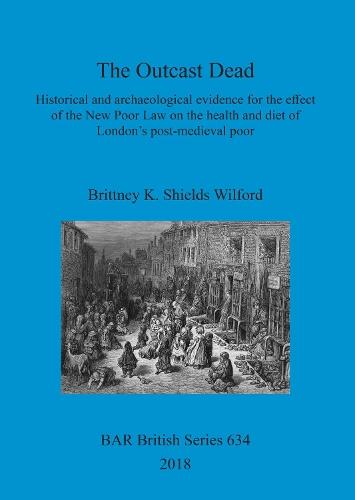
The Outcast Dead: Historical and archaeological evidence for the effect of the New Poor Law on the health and diet of London's post-medieval poor

Author:   Brittney K. Shields Wilford
Publisher:   BAR Publishing
ISBN:  

9781407316093


Pages:   104
Publication Date:   30 January 2018
Format:   Paperback
Availability:   Available To Order   Availability explained
We have confirmation that this item is in stock with the supplier. It will be ordered in for you and dispatched immediately.

Our Price $103.36 Quantity:  
Add to Cart

Share |

The Outcast Dead: Historical and archaeological evidence for the effect of the New Poor Law on the health and diet of London's post-medieval poor


Overview

Full Product Details

Author:   Brittney K. Shields Wilford
Publisher:   BAR Publishing
Imprint:   BAR Publishing
Weight:   0.415kg
ISBN:  

9781407316093


ISBN 10:   1407316095
Pages:   104
Publication Date:   30 January 2018
Audience:   Professional and scholarly ,  Professional & Vocational
Format:   Paperback
Publisher's Status:   Active
Availability:   Available To Order   Availability explained
We have confirmation that this item is in stock with the supplier. It will be ordered in for you and dispatched immediately.

Table of Contents

List of Tables List of Figures Abstract KEYWORDS Chapter 1 Introduction 1.1 HISTORICAL SOURCES AND ARCHAEOLOGY 1.2 RESEARCH IN SOCIOECONOMIC STATUS 1.3 PREVIOUS RESEARCH ON WORKHOUSES - HISTORICAL 1.4 PREVIOUS RESEARCH ON WORKHOUSES - ARCHAEOLOGICAL 1.5 BRIEF OVERVIEW OF POST-MEDIEVAL ENGLAND 1.5.1 Living Standards 1.6 RESEARCH QUESTIONS 1.7 STUDY LAYOUT Chapter 2 Historical Background 2.1 IMPORTANT EARLY STATUTES REGARDING THE POOR 2.1.1 The End of Feudalism and the Great Plague 2.1.2 The Provision of Outdoor Relief 2.1.3 Vagrancy and Begging 2.2 THE FOUNDATIONS OF THE OLD POOR LAWS 2.2.1 The Establishment of the Workhouse 2.2.2 Key Points: The Old Poor Laws 2.3 CHANGE IN PUBLIC OPINION OF THE POOR 2.3.1 Old Poor Laws and the Poor 2.3.2 Changing Perceptions of the Poor 2.4 FACTORS LEADING TOWARD POOR LAW REFORM 2.5 THE CREATION OF THE NEW POOR LAWS 2.5.1 Key Points: The New Poor Laws 2.6 GENDER AND POVERTY IN THE 19TH CENTURY 2.7 CHANGE IN MEDICAL CARE AVAILABLE WITHIN THE UNION WORKHOUSE 2.8 TREATMENT OF CHILDREN IN THE POOR LAWS 2.9 CONCLUSION 2.9.1 Key Points Chapter 3 Materials and Methods 3.1 RATIONALE BEHIND SITE SELECTION 3.1.1 Historical Background for Cemeteries Relating to the Parish (Old Poor Laws) 3.1.2 Historical Background for the Records Relating to the Union (New Poor Law) 3.1.3 Historical Background for the 19th Century Independent Labourer Cemetery 3.1.4 Historical Sources to Study Workhouse Admission and Discharge 3.2 METHODS OF OSTEOLOGICAL DATA COLLECTION 3.2.1 Pathological Conditions Recorded 3.3 HISTORICAL DATA COLLECTION 3.4 SURVIVING WORKHOUSE DIETARIES (PARISH AND UNION) 3.4.1 Methods for Studying the Diets of the Workhouse 3.5 POTENTIAL ISSUES AND BIASES 3.6 CONCLUSION Chapter 4 Results 4.1 DID THE DIETS OF THE WORKHOUSE INMATES DETERIORATE AFTER 1834? 4.1.1 Reformation of the Diets 4.1.2 Nutritional Status of the Parish and Union Diets 4.1.3 Caloric Expenditure and Intake 4.1.4 Key Points 4.2 DID THE DEMOGRAPHIC COMPOSITIONS OF THE WORKHOUSES CHANGE IN THE 19TH CENTURY? A LOOK AT THE OSTEOLOGICAL AND HISTORICAL RECORDS 4.2.1 Demographic Information from the Osteological Records 4.2.2 Historical Demography from the City of London Corporation of the Poor and the Shoreditch Union Workhouse 4.2.3 Cyclical Use of the Workhouse 4.2.4 Length of Stay within the Workhouse 4.2.5 Key Points 4.3 ARE THE HISTORICAL AND OSTEOLOGICAL RECORDS RELATING TO THE WORKHOUSES COMPARABLE? 4.3.1 Broadgate and London Corporation of the Poor 4.3.2 St Bride's lower and St Bride's Parish 4.3.3 Cross Bones and St Saviour's Parish 4.3.4 Key Points 4.4 CHANGE IN THE PRESENCE OF PATHOLOGICAL CONDITIONS 4.4.1 Infectious Disease 4.4.2 Joint Disease 4.4.3 Metabolic Conditions 4.4.4 Trauma 4.4.5 Cribra Orbitalia 4.4.6 Key Points 4.5 CHI-SQUARED RESULTS 4.6 CONCLUSION Chapter 5 Discussion 5.1 HOW THE LEGAL CHANGES AFFECTED THE INMATES' DIET 5.1.1 The Effects of Starvation on the Human Body 5.1.2 The Change in the Presentation of Metabolic Conditions between the Old and New Poor Laws 5.1.3 The Influence of Poverty and the Presence of Infectious Conditions 5.2 INSTANCES OF TRAUMA AND THE INFLUENCE OF TIME 5.2.1 Surgical Intervention 5.3 DID THE LIFE OF THE INMATE OF THE UNION WORKHOUSE GET WORSE? 5.4 HOW DOES THE DEMOGRAPHY CHANGE BETWEEN THE OLD AND NEW POOR LAWS WITHIN THE OSTEOLOGICAL SAMPLES 5.4.1 Bias between Male and Female Inmates? 5.4.2 Elderly Inmates 5.4.3 Children and Adults 5.4.4 How Did the Demography of Workhouse Inmates Change from the Old to the New Poor Laws? 5.5 HOW DO THE OSTEOLOGICAL AND HISTORICAL RECORDS COMPARE? 5.5.1 Length of Stay in the Shoreditch Union Workhouse 5.5.2 Cemeteries and Records Linked; Do They Agree or Present Differing Evidence? 5.6 CONCLUSION Chapter 6 Conclusion 6.1 REVISITING THE RESEARCH QUESTIONS 6.2 LIMITATIONS PRESENTED THROUGHOUT STUDY 6.2.1 Nutritional Limitations 6.2.2 Osteological Limitations 6.2.3 Historical Limitations 6.3 CYCLICAL NATURE OF WELFARE 6.3.1 The Creation of the Welfare State (1942-1980) 6.3.2 Thatcherism and the Age of Austerity (1980-Present) 6.3.3 The Cyclical Nature of Welfare 6.4 POSSIBLE FUTURE RESEARCH 6.5 FINAL REMARKS References 7.1 PARLIAMENTARY PAPERS 7.2 ANCESTRY.CO.UK RECORDS

Reviews

'[This work] contributes a valuable appraisal to an important and pivotal point in social history. It ... makes good use of the available historical and social data, with the addition of selected osteological sites.' Jelena Bekvalac, Museum of London 'Shields' integration of the nutritional value of [workhouse] diets, coupled with pathology data from the skeletal remains, is a powerful analysis. It greatly contributes to our understanding of how malnutrition, disease processes, and workload stressors impacted those seeking assistance in London's historical social welfare systems.' Professor Jennifer Muller, Ithaca College, NY


'[This work] contributes a valuable appraisal to an important and pivotal point in social history. It ... makes good use of the available historical and social data, with the addition of selected osteological sites.' Jelena Bekvalac, Museum of London 'Shields' integration of the nutritional value of [workhouse] diets, coupled with pathology data from the skeletal remains, is a powerful analysis. It greatly contributes to our understanding of how malnutrition, disease processes, and workload stressors impacted those seeking assistance in London's historical social welfare systems.' Professor Jennifer Muller, Ithaca College, NY


[This work] contributes a valuable appraisal to an important and pivotal point in social history. It ... makes good use of the available historical and social data, with the addition of selected osteological sites. Jelena Bekvalac, Museum of London Shields integration of the nutritional value of [workhouse] diets, coupled with pathology data from the skeletal remains, is a powerful analysis. It greatly contributes to our understanding of how malnutrition, disease processes, and workload stressors impacted those seeking assistance in Londons historical social welfare systems. Professor Jennifer Muller, Ithaca College, NY


Author Information

Brittney Shields Wilford is currently working as an osteologist with the National Park Service, USA. She assists with NAGPRA assessments and repatriations. Prior to this she completed an MPhil and MSc in paleopathology and bioarchaeology at Durham University, where she studied under Dr Rebecca Gowland.

Tab Content 6

Author Website:  

Countries Available

All regions
Latest Reading Guide

April RG 26_2


Shopping Cart
Your cart is empty
Shopping cart
Mailing List