Overview
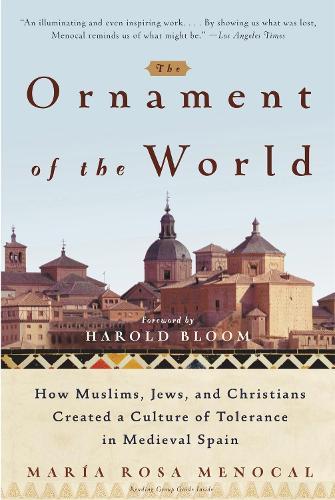
A rich and thriving culture where literature, science and religious tolerance flourished for 700 years is the subject of this enthralling history of medieval Spain. Living side by side in the Andalusian kingdoms, the 'peoples of the book' produced statesmen, poets and philosophers who influenced the rest of Europe in dramatic ways, giving it the first translations of Plato and Aristotle, love songs and secular poetry plus remarkable feats of architecture and technology. This evocative account explores the lost history whose legacy and lessons have a powerful resonance in today's world.
Full Product Details
Author: Maria Rosa Menocal
Publisher: Little, Brown & Company
Imprint: Little, Brown & Company
Dimensions:
Width: 21.00cm
, Height: 3.10cm
, Length: 14.00cm
Weight: 0.320kg
ISBN: 9780316168717
ISBN 10: 0316168718
Pages: 352
Publication Date: 03 July 2003
Audience:
General/trade
,
College/higher education
,
General
,
Tertiary & Higher Education
Format: Paperback
Publisher's Status: Active
Availability: To order

Stock availability from the supplier is unknown. We will order it for you and ship this item to you once it is received by us.
Reviews
' An illuminating and even inspiring work..By showing us what was lost Menocal reminds us of what might be.' - LOS ANGELES TIMES
Historians do not often acknowledge it, but mediaeval Spain was not all about inquisition and torture. In fact, for 700 years the country thrived as a place where Christians, Muslims and Jews lived together in harmony. They retained their distinct ideologies, customs and identities but respected and even came to like each other. The result was an awakening from the Dark Ages, a thriving development of art and science, and a peaceful co-existence never known before or since. Covering the period 786 to 1492, Iberian cultural expert Maria Rosa Menocal shows why most historians have overlooked that 'Andalucian golden age' but how it provides a lesson in possibilities for the modern world. What we now think of as 'Western' civilization began paradoxically with a massacre in the Middle East. A young Muslim named Abd al-Rahman - possibly still a teenager - fled Damascus and sought refuge in the Islamic world's farthest outpost. It was there, in southern Spain, that he established a new order that was to revolutionize the established way of thinking. Instead of fighting each other, Muslims, Christians and Jews first came to a grudging acceptance of co-existence, then to a realization that together they could create what appeared to be far more than the sum of its parts. We can still see the result in great forms of architecture, and in many artistic treasures. The multicultural enrichment also brought about scientific advances at a rate not known since ancient Greece. Menocal's story is told with a wonderful eye for detail. Her evocation of the past is as telling as that of any novel, and her analysis is cogent. On the downside, the illustrations are too few and would have been better on glossy plates, and one or two more maps would also have been helpful. (Kirkus UK)
Author Information
Maria Rosa Menocal is R Selden Rose Professor of Spanish and Portuguese at Yale University and is Director of Yale's Whitney Humanities Center. Foreward by Harold Bloom.