Full Product Details
Author: Mayumi Itoh
Publisher: Palgrave Macmillan
Imprint: Palgrave Macmillan
Edition: 1st ed. 2015
Dimensions:
Width: 14.00cm
, Height: 1.60cm
, Length: 21.60cm
Weight: 4.287kg
ISBN: 9781137570390
ISBN 10: 1137570393
Pages: 243
Publication Date: 30 November 2015
Audience:
Professional and scholarly
,
Professional & Vocational
Format: Hardback
Publisher's Status: Active
Availability: In Print

This item will be ordered in for you from one of our suppliers. Upon receipt, we will promptly dispatch it out to you. For in store availability, please contact us.
Reviews
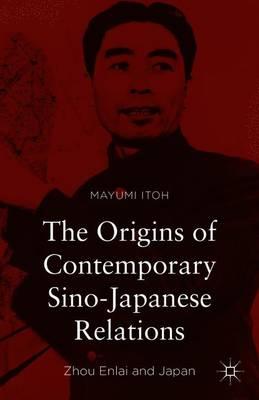
Mayumi Itoh's The Origins of Contemporary Sino-Japanese Relations is a meticulous, scholarly study of Zhou Enlai's early years in China and his political awakening in Japan in the 1910s. Zhou, Mao's premier and foreign minister, was one of the most important political leaders of the 20th century, but little is known about how this young man seeking a post as a Chinese governmental official developed to became a Marxist revolutionary. Itoh has masterfully blended together primary sources in Chinese, Japanese, and English, as few scholars can, in telling the story of the lives and experiences of young Chinese students in Japan. She skillfully explores the impact Taisho Japan had on these students and the course of Chinese history. The detail she has melded together in this book is as impressive as her previous research on zoo policy in wartime Japan and Japanese political leadership. I highly recommend this book especially for political scientists as well as historians of both Japan and China. - Ronald Hrebenar, University of Utah, USA Quansheng Zhao, American University Manuscript Review for Palgrave Macmillian Manuscript: Zhou Enlai and Japan: The Origins of Contemporary Sino-Japanese Relations My review of the book manuscript Zhou Enlai in Japan: The Origins of Contemporary Sino-Japanese Relations is with mixed opinion. On one hand, I believe it makes some valuable contributions to the field; on the other hand, I do see there are unsettled critical questions that require additional research from the author. Contributions: 1. Given the prominent role that Zhou Enlai played in Chinese foreign policy during his 27-year (1949-1976) service as Premier for the People's Republic of China, by nature, this work is significant. 2. The author was able to utilize previous scholars' work, involving materials not only in Japanese, but also Chinese and English; the author was also capable enough to assemble the materials together. As the author points out, 'this book is a synthesis of all of the previous works of Zhou Enlai' (Ch. 1, p. 7). 3. The manuscript also utilized some fresh, newly discovered materials based on recent publications. 4. The author also demonstrated meticulous skill for going through raw materials, both in China and Japan. 5. The author also provided detailed analysis of on the basic subjects of this study. Having recognized the important contributions this work may have to the field, I believe the manuscript needs more in-depth research that could substantiate a number of challenging arguments presented in this study. These necessary revisions, as suggested below, would constitute important steps for the preparation of the publication. Suggestions: * Among the manuscript's twelve chapters, the most intriguing and potentially controversial one is Chapter Ten, 'Returning to Tokyo.' In this chapter, the author claims that during his two-year study in Japan, Zhou Enlai was substantially supported by his friends from Nankai University, particularly with living expenses. Among those friends, two of them were identified, namely, Mr. Wu Dage (Wu Hantao/Wu Diqian) and Mr. Wang Xitian. According to the author's analysis, based on the newly discovered Yoshisono Diary, Wu and Wang were 'offspring of the Tanba-Oeyama people, who had worked for the Kyoto branch of the Japanese Imperial Family, a secret intelligence agency, for generations' (Ch.10, pp. 22-23). This could imply that Zhou Enlai was at least partially supported by the Japanese intelligence agents while he was in Japan, although the author stated 'it is uncertain whether Zhou was also part of it' (meaning, a secret international organization that Wu and Wang belong to). It is understandable that during that period young Chinese students had many interactions with different parts of Japanese society; however it would require deeper research to prove Zhou Enlai was actually supported by these intelligence agents. The author can begin by looking into such questions as: 'Are Wu and Wang Japanese or Chinese? What was their exact status while they were in Kyoto and Tokyo?' and so on. Given the serious nature of the assertion, it is imperative that the author conducts more in-depth research, although understandably there might be some difficulty since Zhou's study in Japan took place almost a century ago. * The book title, 'Zhou Enlai and Japan: The Origins of Contemporary Sino-Japanese Relations,' is somewhat misleading since it only concentrates on the two-year period of Zhou Enlai's life in Japan; it would be better to say 'Youth Zhou Enlai in Japan'. If the author would like to draw some conclusion on 'Contemporary Sino-Japanese Relations' then one more chapter would be necessary, given the fact that Zhou Enlai's critical and instrumental leadership for China's foreign policy toward Japan, and particularly the constructive role in the process of the 1972 China-Japan normalization. * The author may also wish to pay close attention to some basic logic and writing. For example, in the first paragraph in Chapter 12, it says 'Zhou was torn between two conflicting desires in Japan' saying that he 'looked for a third way' (Ch 12, p.1). It is better to further clarify here what the author means by 'third way.' * The author also needs to be careful with some terms used in the book. For example, the author refers to Zhou's life in Tokyo was 'financially unstable and psychologically insecure' (Ch 11, p.1). The psychological part may refer to Zhou's failure of the entrance exams and failure to enter university in Japan; if that's the case, the author may simply say, 'failure in exams' rather than 'psychologically insecure.' Conclusion: This manuscript could potentially make positive contributions in our understanding of Zhou Enlai's early years in Japan. It is, however, necessary for the author to conduct some substantial revisions before we can consider for publication. Among the four suggestions I've made, most are relatively easy to amend, except for the first point with regard to Chapter 10. We need to see more evidence or clarification on Zhou Enlai's relationship with Japan's intelligence agents, which requires additional substantial historical research or even alterations of some of the conclusions by the author. Without this further in-depth research and revision, I would not recommend publication at this stage. Quan
Mayumi Itoh's The Origins of Contemporary Sino-Japanese Relations is a meticulous, scholarly study of Zhou Enlai's early years in China and his political awakening in Japan in the 1910s. Zhou, Mao's premier and foreign minister, was one of the most important political leaders of the 20th century, but little is known about how this young man seeking a post as a Chinese governmental official developed to became a Marxist revolutionary. Itoh has masterfully blended together primary sources in Chinese, Japanese, and English, as few scholars can, in telling the story of the lives and experiences of young Chinese students in Japan. She skillfully explores the impact Taisho Japan had on these students and the course of Chinese history. The detail she has melded together in this book is as impressive as her previous research on zoo policy in wartime Japan and Japanese political leadership. I highly recommend this book especially for political scientists as well as historians of both Japan and China. - Ronald Hrebenar, University of Utah, USA
""Mayumi Itoh's The Origins of Contemporary Sino-Japanese Relations is a meticulous, scholarly study of Zhou Enlai's early years in China and his political awakening in Japan in the 1910s. Zhou, Mao's premier and foreign minister, was one of the most important political leaders of the 20th century, but little is known about how this young man seeking a post as a Chinese governmental official developed to became a Marxist revolutionary. Itoh has masterfully blended together primary sources in Chinese, Japanese, and English, as few scholars can, in telling the story of the lives and experiences of young Chinese students in Japan. She skillfully explores the impact Taisho Japan had on these students and the course of Chinese history. The detail she has melded together in this book is as impressive as her previous research on zoo policy in wartime Japan and Japanese political leadership. I highly recommend this book especially for political scientists as well as historians of bothJapan and China."" - Ronald Hrebenar, University of Utah, USA
Author Information
Mayumi Itoh is a former Professor of Political Science at the University of Nevada, Las Vegas, USA. She has also taught at Princeton University, USA, and Queens College, CUNY, USA. She is the author of numerous books, including Globalization of Japan: Japanese Sakoku Mentality and U.S. Efforts to Open Japan and The Hatoyama Dynasty: Japanese Political Leadership Through the Generations.