Overview
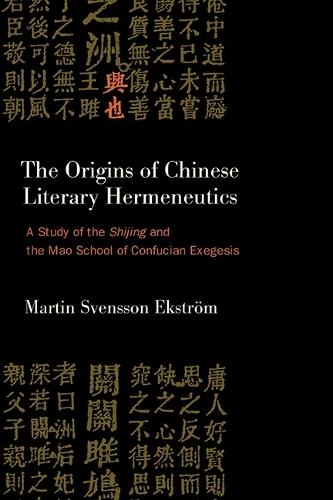
Explores how China's oldest poetry collection was interpreted in a Confucian exegetical text—the Mao Commentary—in the mid-second century BCE. The Shijing (""Canon of Odes"") is China's oldest poetry collection, traditionally considered to have been edited by Confucius himself. Despite their enormous importance for Confucianism and Chinese civilization, the 305 odes have for millennia also puzzled readers. Why did the Sage include in the Canon apparently lewd poems about women promising men to ""hitch up"" their skirts and ""wade the river,"" and men ""tossing and turning in bed"" yearning for young women? What did the innumerable representations of plants, beasts, and birds, and of various climactic and astronomical phenomena, signify beyond their immediate function as natural descriptions? One such puzzled reader was Mao Heng, a learned Confucian employed at a minor court in the mid-second century BCE. The object of this study is the Commentary that Mao composed on the Odes, and in particular the hermeneutic tool-the xing-that he invented to explain the figurality and tropes at play in them. Mao's ""xingish"" interpretation of the Odes is both genuinely hermeneutic, in that it explains the rhetorical organization of these poems, and thoroughly ideological, since it allows Mao to transform them into Confucian dogma. The book also argues that the xing, content, function, and cultural importance, is comparable to the Aristotelian concept of metaphor (metaphora), and that the xing, the Odes, and the practice of shi (Chinese ""poetry"") demand an intercultural, ""comparative"" reading for a more nuanced understanding.
Full Product Details
Author: Martin Svensson Ekström
Publisher: State University of New York Press
Imprint: State University of New York Press
Dimensions:
Width: 15.20cm
, Height: 2.50cm
, Length: 22.90cm
Weight: 0.794kg
ISBN: 9781438495392
ISBN 10: 1438495390
Pages: 504
Publication Date: 01 March 2024
Audience:
Professional and scholarly
,
Professional & Vocational
Format: Hardback
Publisher's Status: Active
Availability: Manufactured on demand

We will order this item for you from a manufactured on demand supplier.
Reviews
"""Ekström's work moves Shijing scholarship and exegesis to a whole new level, transcending as it does the simplistic dichotomous approach to Western–Chinese studies that has trapped people on both sides of this false divide for far too long. This is close reading scholarship at its best, for it allows ancient Chinese texts to speak for themselves, free of the distortions generated by false cultural assumptions underlying much of scholarship on such subjects in both China and the West."" — Richard John Lynn, University of Toronto"
""Svensson Ekström's work moves Shijing scholarship and exegesis to a whole new level, transcending as it does the simplistic dichotomous approach to Western–Chinese studies that has trapped people on both sides of this false divide for far too long. This is close reading scholarship at its best, for it allows ancient Chinese texts to speak for themselves, free of the distortions generated by false cultural assumptions underlying much of scholarship on such subjects in both China and the West."" — Richard John Lynn, University of Toronto
"""Svensson Ekström's work moves Shijing scholarship and exegesis to a whole new level, transcending as it does the simplistic dichotomous approach to Western–Chinese studies that has trapped people on both sides of this false divide for far too long. This is close reading scholarship at its best, for it allows ancient Chinese texts to speak for themselves, free of the distortions generated by false cultural assumptions underlying much of scholarship on such subjects in both China and the West."" — Richard John Lynn, University of Toronto"
Author Information
Martin Svensson Ekström is Associate Professor of Chinese at the University of Gothenburg.