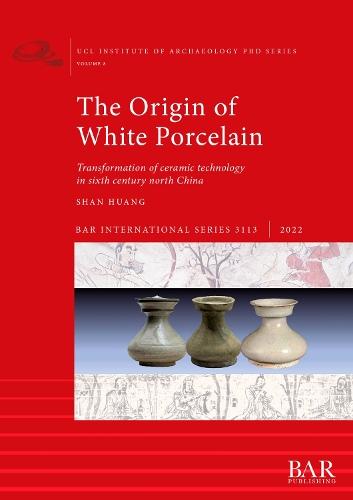
The Origin of White Porcelain, The: Transformation of ceramic technology in sixth century north China

Author:   Shan Huang
Publisher:   BAR Publishing
ISBN:  

9781407360492


Pages:   251
Publication Date:   30 December 2022
Format:   Paperback
Availability:   Available To Order   Availability explained
We have confirmation that this item is in stock with the supplier. It will be ordered in for you and dispatched immediately.

Our Price $178.20 Quantity:  
Add to Cart

Share |

The Origin of White Porcelain, The: Transformation of ceramic technology in sixth century north China


Overview

The sixth century saw a major transformation of ceramic technology. It initiated an era characterised by porcelain and polychrome decoration that overturned the earlier pattern of earthenware and stoneware production that had been used for thousands of years. However, the process of this dramatic transformation has been unclear. The Origin of White Porcelain focuses on the typo-chronology of three major categories of glazed ceramics recognised with in-situ pXRF analysis of items discovered from sixth-century burials in north China. It examines the chemical and mineralogical compositions of the body and glaze, the glazing methods and firing conditions of selected samples with optical microscopy, scanning electron microscopy with energy-dispersive X-ray spectrometry (SEM-EDS), X-ray diffraction (XRD) and thermal expansion measurement. These provide insights into the innovation of lead-glazed earthenware, the transfer of ash-glazed stoneware technology and the emergence of the earliest white porcelain. The social dynamics that drove the transformation and integration of ceramic technology and its impact on the succeeding period are discussed.

Full Product Details

Author:   Shan Huang
Publisher:   BAR Publishing
Imprint:   BAR Publishing
ISBN:  

9781407360492


ISBN 10:   1407360493
Pages:   251
Publication Date:   30 December 2022
Audience:   Professional and scholarly ,  Professional & Vocational
Format:   Paperback
Publisher's Status:   Active
Availability:   Available To Order   Availability explained
We have confirmation that this item is in stock with the supplier. It will be ordered in for you and dispatched immediately.

Table of Contents

List of Figures List of Tables Abstract 1. Introduction 1.1. Categories of Glazed Ceramics 1.2. Current Opinion on Early Porcelain 1.3. Research Questions 1.3.1. What was the pathway of the technological transformation of glazed ceramics from a materials science perspective? 1.3.2. What was the social impulse driving the emergence and popularity of white porcelain? 1.4. Originality of the Project 2. History and Archaeology Background 2.1. History Background 2.2. Archaeology Background 2.2.1. Kiln Sites 2.2.2. Residential Sites 2.2.3. Burials 3. Materials, Samples and Methods 3.1. Material Background 3.2. Samples 3.2.1. Samples for Non-destructive pXRF Analysis 3.2.2. Samples for Destructive Analysis 3.3. Material Analysis Methods 3.3.1. Munsell Rock Colour Book 3.3.2. pXRF 3.3.3. SEM-EDS 3.3.4. XRD 3.3.5. Thermal Expansion 4. Typo-chronology of Glazed Ceramics in Sixth Century North China 4.1. Material Examined 4.2. Distinction between Different Categories of Glazed Ceramics 4.3. Chronological Sequence and Archaeological Assemblage 4.3.1. Stage 1: 490s-540s 4.3.2. Stage 2: 550s-570s 4.3.3. Stage 3: 580s-600s 4.4. Summary 5. The Transformation of Lead-glazed Ceramics 5.1. Introduction 5.2. Materials and Methods 5.2.1. Sites and Materials 5.2.2. Analysis Methods 5.3. Results 5.3.1. Sample Description 5.3.2. Body Composition 5.3.3. Glaze Composition 5.3.4. Thermal Behaviour 5.4. Discussion 5.4.1. Compositional Grouping 5.4.2. Glaze Formulation 5.4.3. Firing Condition 5.4.4. Coloration 5.5. Conclusion 6. The Introduction of Celadon into North China 6.1. Introduction 6.2. Materials and Methods 6.2.1. Sites Sampled for this Study 6.2.2. Sample Description 6.2.3. Analysis Methods 6.3. Results 6.3.1. Microstructure 6.3.2. Body Compositions 6.3.3. Glaze Compositions 6.4. Discussion 6.4.1. Regional Affiliations 6.4.2. Glaze Formulation 6.4.3. Coloration 6.4.4. Relative Firing Conditions 6.5. Conclusion 7. The Emergence of White Porcelain 7.1. Introduction 7.2. Materials and Methods 7.2.1. Archaeological Sites of Interest 7.2.2. Analysis Methods 7.3. Results 7.3.1. Microstructure 7.3.2. Body Composition 7.3.3. Glaze Composition 7.4. Discussion 7.4.1. Body Material and Alternatives 7.4.2. Glaze Formulation and Coloration 7.4.3. Firing Conditions 7.5. Conclusion 8. Discussion 8.1. Stage 1: 490s-540s: the Local Ceramic Technological Tradition and Impact of External Cultures from the West and the South 8.2. Stage 2: 550s-570s: the Transformation of Lead-glazed Ceramics and Introduction of Celadon Technology via the East 8.3. Stage 3: 580s-600s: the Spread of Celadon and Emergence of White Porcelain in the North China Plain 8.4. Summary 9. Conclusion Index of Chinese Terminology and Place Names References The appendix can be viewed online at doi.org/10.30861/9781407360492/appendix

Reviews

'This is an excellent, original and thorough study of the origins of white porcelain. It explores research questions about the pathway of technological transformation and the social impulse that drove the emergence and popularity of this new ceramic.' Professor Mike Parker Pearson, UCL Institute of Archaeology 'Shan Huang's ground-breaking and comprehensive synthesis of dated burial assemblages, supported by extensive scientific analyses of the ceramics themselves, allows for a new understanding of the origins of white porcelain, the most successful ceramic of the pre-industrial world.' Professor Ian Freestone, UCL Institute of Archaeology


'This is an excellent, original and thorough study of the origins of white porcelain. It explores research questions about the pathway of technological transformation and the social impulse that drove the emergence and popularity of this new ceramic.' Professor Mike Parker Pearson, UCL Institute of Archaeology   'Shan Huang's ground-breaking and comprehensive synthesis of dated burial assemblages, supported by extensive scientific analyses of the ceramics themselves, allows for a new understanding of the origins of white porcelain, the most successful ceramic of the pre-industrial world.' Professor Ian Freestone, UCL Institute of Archaeology  


Author Information

Shan Huang has studied Chinese ceramic technology and trade over the past twenty years at Peking University, the Chinese Academy of Social Sciences and University College London. She has developed a multi-disciplinary approach to archaeology, archaeometry and art history to research ancient ceramics.

Tab Content 6

Author Website:  

Countries Available

All regions
Latest Reading Guide

April RG 26_2


Shopping Cart
Your cart is empty
Shopping cart
Mailing List