|
|
|||
|
||||
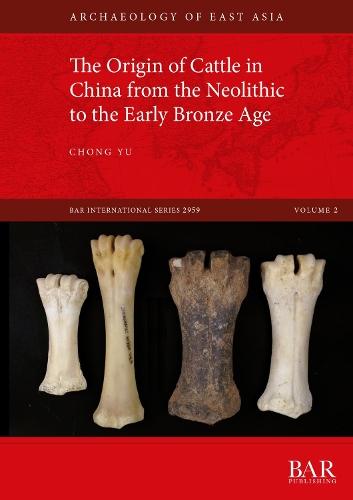
OverviewCattle (Bos taurus), domesticated from the extinct aurochs (Bos primigenius), has been an important animal to many human societies since prehistoric times. Cattle provides not only meat for subsistence, but also hide, blood, dung, milk and traction that contribute to the organization of human beliefs, cultural attitudes and social complexity. This book provides the widest range of cattle bone biometrical information from the Early Neolithic period to the Early Bronze Age (10000 to 3600 years ago) and investigates the morphological variation of this animal from a biological point of view: the main indicator for tracing domestication. The results suggest that cattle in ancient China was imported from the Near East around 4,300 years ago and made their first appearance in the Yellow River Valley. Once they had arrived in central China, these small-sized domesticated cattle soon spread and was exploited intensively from then on. Full Product DetailsAuthor: Chong YuPublisher: BAR Publishing Imprint: BAR Publishing ISBN: 9781407316871ISBN 10: 1407316877 Pages: 108 Publication Date: 02 January 2020 Audience: Professional and scholarly , Professional & Vocational Format: Paperback Publisher's Status: Active Availability: Available To Order We have confirmation that this item is in stock with the supplier. It will be ordered in for you and dispatched immediately. Table of ContentsList of Figures List of Tables Acknowledgements Abstract Chapter 1. Introduction Chapter 2. Cattle Domestication 2.1 Defining animal domestication 2.2 Detecting early cattle domestication using zooarchaeological evidence 2.3 The genetic evidence for cattle domestication 2.4 Previous research on cattle domestication in China Chapter 3. Methods 3.1 Introduction 3.2 Taxonomic identification 3.3 Data recording 3.3.1 Measurement choice 3.3.1.1 Complete measurable dimensions from completely fused or ossified skeletal parts 3.3.1.2 Skeletal parts without any carbonization and calcinations 3.3.1.3 Skeletal parts without any pathological and anatomical abnormality 3.3.2 Relative values of the measurements 3.4 Data analyses 3.4.1 Estimation of body size 3.4.2 Statistical analyses Chapter 4. Materials 4.1 Introduction 4.2 Published biometric datasets 4.3 Revisiting sites for primary data collection 4.3.1 The selection of revisited sites 4.3.2 Shuangta ?? 4.3.3 Yangguanzhai ??? 4.3.4 Dongying ?? 4.3.5 Shimao ?? 4.3.6 Zhoujiazhuang ??? 4.3.7 Taosi ?? 4.3.8 Huoshiliang ??? 4.3.9 Nanwa ?? 4.3.10 Donglongshan ??? 4.3.11 Changning ?? 4.3.12 Zhangdeng ?? 4.3.13 Summary 4.4 Bos primigenius biometric datasets 4.4.1 Biometric data for the Ullerslev aurochs 4.4.2 Biometric data for the Dabusu aurochs Chapter 5. Biometrical study of Chinese cattle 5.1 Measurements of individual skeletal elements 5.2 The application of Log Size Index (LSI) technique 5.3 Dating of the Shuangta metacarpal 5.4 Summary Chapter 6. Discussion and conclusion 6.1 Introduction 6.2 The evidence for early domestic cattle in China 6.2.1 Climate 6.2.2 Geographic variation and sexual dimorphism of Bos primigenius 6.3 Independent domestication or import of already domesticated cattle 6.4 Determining the origins of early Chinese domestic cattle 6.4.1 Possible routes for prehistoric exchange 6.4.2 Possible routes for domesticated cattle transmission into China 6.5 Motivation of cattle incorporation 6.6 Conclusion Bibliography Appendix 1 Published biometric dataset Appendix 1.1 Shuangta Appendix 1.2 Zuojiashan Appendix 1.3 Zhaobaogou Appendix 1.4 Baiyinchanghan Appendix 1.5 Xiliang Appendix 1.6 Miaozigou Appendix 1.7 Qianbu Appendix 1.8 Xishuipo Appendix 1.9 Cishan Appendix 1.10 Wadian Appendix 1.11 Duzhong Appendix 1.12 Xinzhai Appendix 1.13 Erlitou Appendix 1.14 Xinhua Appendix 1.15 Zhukaigou Appendix 1.16 Jiangzhai Appendix 1.17 Huoshiliang Appendix 1.18 Yangguanzhai Appendix 1.19 Dongying Appendix 1.20 Guantaoyuan Appendix 1.21 Dadiwan Appendix 1.22 Shishanzi Appendix 1.23 Yuchisi Appendix 1.24 Qingyuan Appendix 2 Cattle bone measurements from the revisited sites (mm) Appendix 3 Biometric dataset of aurochs (mm) Appendix 4 Results of independent samples T test of astragalus GLI Appendix 5 LSI values of cattle bones from the revisited sites Appendix 6 Median, maximum, minimum and average values of LSI values of revisited sites Appendix 7 Results of independent samples T test of LSI values Appendix 8 Results of independent samples T test of LSI values by one dimension from each body part Appendix 9 LSI values of aurochs bones Appendix 10 Summary of domesticated wheat, sheep and cattle along the possible route of cattle introductionReviews{\rtf1\ansi\ansicpg1252\deff0\deflang2057{\fonttbl{\f0\fswiss\fprq2\fcharset0 Calibri;}{\f1\fnil\fcharset0 Verdana;}} \viewkind4\uc1\pard\sa160\sl252\slmult1\f0\fs22\lquote Research on cattle domestication in China is in a period of great change and new revelation. Yu Chong\rquote s manuscript contributes important biometric data that complement the growing zooarchaeological and genetic evidence for overlapping exploitation of domestic and wild cattle populations during the Neolithic and Bronze Age. Dr. Yu\rquote s careful re-analysis of existing zooarchaeological collections is impressive and thorough. Her work shows how new insights can be gained by re-visiting existing zooarchaeological collections in China with new methods and new research questions.\rquote Dr Katherine Brunson, Brown University\par \pard\f1\fs17\par } Author InformationChong Yu is an associate professor at Sun Yat-sen University. She is a zooarchaeologist researching various aspects of bio-cultural evolution including the origins and spread of animal domestication, palaeoeconomy, food processing, ritual, and cultural uses of animal bones. This includes regional and comparative studies on Neolithisation, early civilisations, hierarchy, and social complexity with a special interest in ancient Asia. Tab Content 6Author Website:Countries AvailableAll regions |
||||