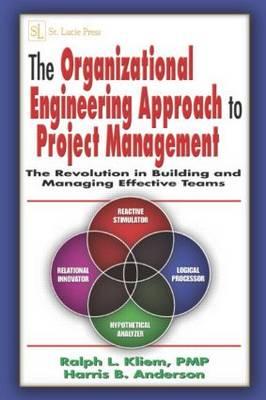
The Organizational Engineering Approach to Project Management: The Revolution in Building and Managing Effective Teams

Author:   Ralph L. Kliem, PMP (LeanPM, LLC, Redmond, Washington, USA) ,  Harris B. Anderson (2-Communicate.Com Inc., Bellevue, Washington, USA)
Publisher:   Taylor & Francis Ltd
ISBN:  

9781574443226


Pages:   264
Publication Date:   15 August 2002
Format:   Hardback
Availability:   Out of stock   Availability explained


Our Price $237.47 Quantity:  
Add to Cart

Share |

The Organizational Engineering Approach to Project Management: The Revolution in Building and Managing Effective Teams


Overview

Despite the advent of new methodologies and powerful tools, many projects continue to fail even when applying the well-accepted criteria of successful projects. These dismal results beg the question: If new methodologies and tools don't really impact project results, what does? Studies from major think tanks agree: people problems are the number-one challenge of team projects. The Organizational Engineering Approach to Project Management presents a powerful new way for harnessing the power of people and directing it to achieve the goals of any project. Organizational engineering (OE) seeks to understand, measure, predict and guide the behavior of groups of people. I-Opta is an instrument used to ascertain the strategic styles of an individual. It measures the different ways people learn and apply their conclusions, thus opening the door to accurate predictions. Using the principles of OE and I-Opta in combination, the text presents a proven approach to managing projects. These principles have been successful in substantially improving project performance in numerous Fortune 500 companies as well as in mid-size and smaller companies. The Organizational Engineering Approach to Project Management is the first book to apply OE and I-Opta to project management. The authors clearly explain this unique OE / I-Opta approach and how to use it effectively at any company or industry that utilizes project management. The text presents the rudiments of OE, explains the applicability of OE from a project management perspective, shows how to apply OE to common people issues, and concludes by providing step-by-step applications for new and existing projects. The concepts and techniques presented in this text will help you: Adapt to changing situations Apply the most appropriate and effective level of project management disciplines Maximize individual and team strengths Minimize individual and team weaknesses Match people to more appropriate tasks

Full Product Details

Author:   Ralph L. Kliem, PMP (LeanPM, LLC, Redmond, Washington, USA) ,  Harris B. Anderson (2-Communicate.Com Inc., Bellevue, Washington, USA)
Publisher:   Taylor & Francis Ltd
Imprint:   St Lucie Press
Dimensions:   Width: 15.60cm , Height: 1.90cm , Length: 23.40cm
Weight:   0.540kg
ISBN:  

9781574443226


ISBN 10:   1574443224
Pages:   264
Publication Date:   15 August 2002
Audience:   Professional and scholarly ,  Professional & Vocational
Format:   Hardback
Publisher's Status:   Unknown
Availability:   Out of stock   Availability explained

Table of Contents

Dedication Acknowledgement List of Tables List of Illustrations Preface THE BASICS OF ORGANIZATIONAL ENGINEERING (OE) AND I-Opt (TM) THE RECORD TELLS IT ALL New Paradigm Future Challenges Consequences of Challenges New Tool for Today and Beyond Desired Result Proven Track Record Summary THE ELEMENTS OF OE Assumptions of OE The Fundamentals Behavior Patterns Styles Display a Profile Characteristics of a Style Core Ingredients Summary THE WORLD OF THE RELATIONAL INNOVATOR Descriptions Characteristics of Behavior Probabilities of Success Good Marriage Summary THE WORLD O91F THE HYPOTHETICAL ANALYZER Descriptions Characteristics of Behavior Probabilities of Success Mind Power Summary THE WORLD OF THE LOGICAL PROCESSOR Descriptions Characteristics of Behavior Probabilities of Success Order! Summary THE WORLD OF THE REACTIVE STIMULATOR Descriptions Characteristics of Behavior Probabilities of Success Spark Summary TACTICAL PATTERNS Key Points Perfectors Performers Conservators Changers Versatiles Important Implications Boxing Summary OE AND PROJECT MANAGEMENT OE AND PROJECT MANAGEMENT Project Management Planning Organizing Controlling Leading OE and Project Management Planning and OE Organizing and OE Controlling and OE Leading and OE A Matter of Choices Summary PLANNING AND OE Reactive Stimulator Logical Processor Hypothetical Analyzer Relational Innovator Challenges during Planning Diversity in Planning Summary ORGANIZING AND OE Reactive Stimulator Logical Processor Hypothetical Analyzer Relational Innovator Challenges during Organizing Different Styles, Different Strengths Summary CONTROLLING AND OE Reactive Stimulator Logical Processor Hypothetical Analyzer Relational Innovator Challenges during Controlling Illusion of Control Summary LEADING AND OE - PART I Reactive Stimulator Logical Processor Hypothetical Analyzer Relational Innovator Flexing Challenges during Leading Errors Leading by Example Summary LEADING AND OE - PART II Ingredients for Success Match Individual Style with a Group's Importance of Adaptability Different Teaming Arrangement Right Response Summary LEADING AND OE - PART III General Assumptions Mismatching Consequences Matching Benefits Can People Change? Matching Peer Pressures Leading from Above and Below Summary USING OE TO HANDLE SIX MAJOR PROJECT MANAGEMENT CHALLENGES CHALLENGE NO. 1: DECISION-MAKING The Cycle Strengths, Risks, and Vulnerabilities Cycle Facilitation Hard Act to Follow Summary CHALLENGE NO. 2: PROCESSING INFORMATION Four variables Information Life Cycle Favorite Approaches, Tools, and Techniques Life Cycle Facilitation Right Moment and Ability Summary CHALLENGE NO. 3: LEARNING Elements Learning Preferences Learning Cycle Ramifications Personal Approach Summary CHALLENGE NO. 4: CREATIVITY What is Creativity? Blossoming Creativity and Style Stages Perspiration, not just Inspiration Summary CHALLENGE NO. 5: CONFLICT MANAGEMENT Modes of Behavior Stages Risks, Strengths, and Vulnerabilities Talking and Listening Handle with Care Summary CHALLENGE NO. 6: TEAMBUILDING Compatibility Tuchman Model Risks, Strengths, and Vulnerabilities Phase Facilitation No Assurance Summary CONCLUSION FINAL THOUGHTS Synopsis Getting Started Project Success, A Matter of Style Summary APPENDICES Appendix A - Case Study Background Analysis Principles Benefits One of Many Applications Appendix B - Feedback Sheet GLOSSARY AND BIBLIOGRAPHY

Reviews

I have used the I-Opt instrument and organizational engineering technology for the past four years and have found the accuracy of the analysis and the reliability of the predictions made using this instrumentation to be almost spooky at both an individual and a group level. The universal comment from clients who are being provided the analysis is 'wow' -Patrick O'Brien, Organizational Engineer and Senior Training Consultant with the Large Power System Division of Caterpillar Inc., in Trainingmag.com


I have used the I-Opt (TM) instrument and organizational engineering technology for the past four years and have found the accuracy of the analysis and the reliability of the predictions made using this instrumentation to be almost spooky at both an individual and a group level. The universal comment from clients who are being provided the analysis is 'wow' -Patrick O'Brien, Organizational Engineer and Senior Training Consultant with the Large Power System Division of Caterpillar Inc., in Trainingmag.com


Author Information

Tab Content 6

Author Website:  

Countries Available

All regions
Latest Reading Guide

NOV RG 20252


Shopping Cart
Your cart is empty
Shopping cart
Mailing List