Overview
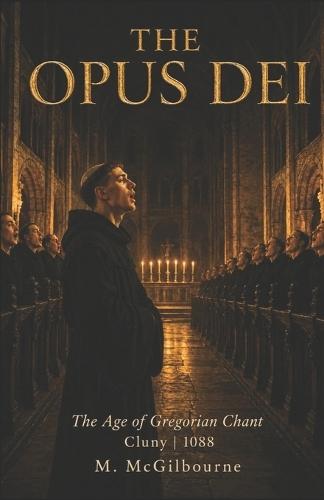
The Age of Gregorian Chant Cluny 1088 You are the end point of an unbroken chain of survival. Every person who came before you - through plague, war, famine, and flood - lived long enough to pass forward what was necessary for you to exist. You did not begin when you were born. You began when humanity began. Everything that happened between that beginning and this moment is not the past in any abstract sense. It is the story of the making of you. Cluny Abbey, Burgundy. 1088. Three hundred monks. One stone enclosure. Seven offices a day and one in the deep of the night. No instruments. No harmony. No individual voice permitted to rise above the rest. Only unison - one long unbroken melodic line, three hundred throats becoming one throat, the sound held by the vault for eight seconds after the last note ceased. The largest monastery in Christendom was not building a cathedral. It was building a silence large enough to hold something it could not name. What does it cost a man to erase his own voice? What remains when the self goes quiet? What were they actually singing toward? The Opus Dei places you inside that question. Not as an abbot. Not as a pope. But as the ordinary monk - the young singer who spent eleven years learning the chant, who one cold February morning opened his mouth in the choir and heard, for the first time, that his voice wanted to be heard - and understood that this wanting was the one thing his world had no place for. The facts are extraordinary enough. Cluny's monks sang up to 215 psalms in a single day at certain seasons - close to ten hours of continuous chant. Before Guido d'Arezzo's staff notation (c. 1025), a cantor spent ten years memorizing the full repertoire. Guido reduced that to one. The eight church modes were not musical categories. Medieval theologians described them as eight temperaments of the soul - eight different ways a human being could stand in the presence of God. Cluny III, begun in 1088, became the largest church in Christendom. It was demolished for building stone in 1811. A single transept survives. Pope Urban II - who preached the First Crusade in 1095 - had been a monk of Cluny. The crusade was announced. The choir sang that evening's Vespers unchanged. History is not a sequence of dates. It is billions of lives lived forward through a present as urgent as your own. A bell at two in the morning. Bare feet on cold limestone. Frankincense still in the walls from the night before. A vault thirty meters above, dark except where seven candles reached. They built something that dissolved into air every single day - and passed it forward anyway. The Opus Dei is the attempt of one ordinary witness to understand why. For homeschooling families: You are already doing the most important thing - putting the story of humanity directly into your children's hands. The Beyond His Story We Stand series was written for you. Each book takes one moment in human history and makes it lived rather than memorised, felt rather than filed away. Not a textbook. Not a syllabus. A story your child will not want to put down - and that will leave them asking the questions that no curriculum can generate for them. The questions that only wonder produces. The Opus Dei of the Beyond His Story We Stand series - a chronological journey through human history, told through the eyes of the people official history forgot to record. The chant survived. It survived in breath - passed from one throat to the next for a thousand years. Open your mouth. It is still moving through you.
Full Product Details
Author: Michael McGilbourne
Publisher: Independently Published
Imprint: Independently Published
Volume: 30
Dimensions:
Width: 14.00cm
, Height: 0.80cm
, Length: 21.60cm
Weight: 0.154kg
ISBN: 9798259260917
Pages: 128
Publication Date: 28 April 2026
Audience:
Young adult
,
Teenage / Young adult
Format: Paperback
Publisher's Status: Active
Availability: Available To Order

We have confirmation that this item is in stock with the supplier. It will be ordered in for you and dispatched immediately.