Overview
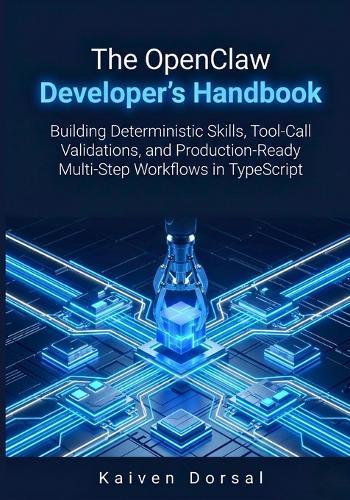
Stop ""spellcasting"" and start engineering. Move beyond the 85% success rate of ""vibe-based"" prompting and build AI agents that scale. In the early days of the AI boom, developers relied on ""vibes"" tweaking adjectives in prompts and hoping for valid JSON. But in a production environment, ""it works 85% of the time"" is functionally broken. If you are building high-stakes tools for finance, healthcare, or DevOps, that 15% failure rate is a catastrophic breach of trust. The OpenClaw Developer's Handbook is the definitive manual for the transition from LLM enthusiast to AI Systems Engineer. It introduces the OpenClaw framework, a minimalist, TypeScript-first approach that treats the Large Language Model (LLM) not as a magic box, but as a sophisticated component in a larger deterministic system. Master the 4 Pillars of Deterministic AI: Strong Typing via Zod: Use rigid schemas to ensure the LLM satisfies a technical contract before a single line of functional code is executed. Functional Determinism: Separate ""Thinking"" (LLM) from ""Doing"" (Skills) so you can test your business logic independently of the AI. State-Aware Orchestration: Manage multi-step workflows as state machines, enabling ""Wait-and-Resume"" patterns that span hours or days. Minimalist Weight: Avoid the ""abstraction tax"" of heavyweight frameworks. Build thin, observable, and maintainable orchestration layers. What You Will Learn: Guardrail Patterns: Prevent hallucinated parameters and malformed tool-calls using Zod validation. Self-Correcting Loops: Implement feedback mechanisms that allow the model to correct its own validation errors. Persistent Memory: Architect short-term and long-term memory using vector databases, PostgreSQL, and Redis. Production Error Handling: Build resilience with exponential backoff, model fallbacks, and graceful degradation. Advanced Deployment: Scale your agents using AWS Lambda, Vercel, and Dockerized microservices. Multi-Agent Autonomy: Design hierarchical and peer-to-peer systems where specialized agents collaborate on complex objectives. Who This Book Is For: This book is for the TypeScript developer who has moved past ""Hello World"" chatbots and is now facing the ""Production Gap"". If you need to stop your agent from hallucinating, manage long-running threads, and implement Evals that actually mean something, this is your roadmap. Build a harness around the lightning. Order your copy and start building production-ready AI systems today.
Full Product Details
Author: Kaiven Dorsal
Publisher: Independently Published
Imprint: Independently Published
Dimensions:
Width: 17.80cm
, Height: 0.70cm
, Length: 25.40cm
Weight: 0.240kg
ISBN: 9798258598295
Pages: 132
Publication Date: 23 April 2026
Audience:
General/trade
,
General
Format: Paperback
Publisher's Status: Active
Availability: Available To Order

We have confirmation that this item is in stock with the supplier. It will be ordered in for you and dispatched immediately.