Full Product Details
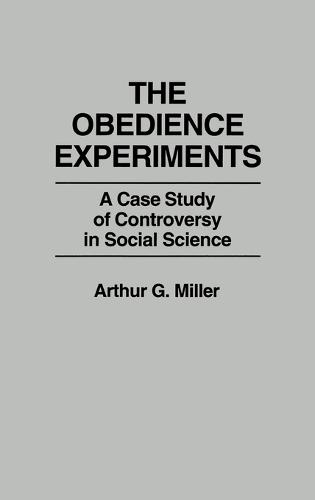
Author: Arthur Miller
Publisher: Bloomsbury Publishing Plc
Imprint: Praeger Publishers Inc
Dimensions:
Width: 15.20cm
, Height: 2.00cm
, Length: 22.90cm
Weight: 0.620kg
ISBN: 9780275920128
ISBN 10: 0275920127
Pages: 305
Publication Date: 18 March 1986
Audience:
College/higher education
,
General/trade
,
Postgraduate, Research & Scholarly
,
General
Format: Hardback
Publisher's Status: Active
Availability: In Print

This item will be ordered in for you from one of our suppliers. Upon receipt, we will promptly dispatch it out to you. For in store availability, please contact us.
Reviews
Miller thoroughly examines the controversies inspired by the late Stanley Milgrim's obedience experiments. He begins with a systematic review of the Milgram series, and some extensitons and replications of these experiments. The most basic and familiar finding is that ordinary people will attempt to administer severe electrial shocks to others if so instructed by an authority figure perceived to be legitimate. Miller next reviews challenges and defenses of the ethics of such deceptive and hupothetically traumatizing experiments. he then considers critiques of Milgrim's methodology, especially in terms of its external validity. Finally the book addresses the controversial claim that these experiments help explain the Nazi Holocaust, and that they have disturbing implications for the understanding of human nature....The significance of the controversies examined, renders this work an important addition to social science collections and a companion volume to Milgram's own Obedience to Authority. Upper-division undergraduates and above. -Choice Therapists must understand the ethical foundations of treatment and be able to answer the challenge with facts and logic. The Obedience Experiments provides an important foundation understanding both the opposition the ethics of treatment. -Behavioral Engineering ?Miller thoroughly examines the controversies inspired by the late Stanley Milgrim's obedience experiments. He begins with a systematic review of the Milgram series, and some extensitons and replications of these experiments. The most basic and familiar finding is that ordinary people will attempt to administer severe electrial shocks to others if so instructed by an authority figure perceived to be legitimate. Miller next reviews challenges and defenses of the ethics of such deceptive and hupothetically traumatizing experiments. he then considers critiques of Milgrim's methodology, especially in terms of its external validity. Finally the book addresses the controversial claim that these experiments help explain the Nazi Holocaust, and that they have disturbing implications for the understanding of human nature....The significance of the controversies examined, renders this work an important addition to social science collections and a companion volume to Milgram's own Obedience to Authority. Upper-division undergraduates and above.?-Choice ?Therapists must understand the ethical foundations of treatment and be able to answer the challenge with facts and logic. The Obedience Experiments provides an important foundation understanding both the opposition the ethics of treatment.?-Behavioral Engineering
?Miller thoroughly examines the controversies inspired by the late Stanley Milgrim's obedience experiments. He begins with a systematic review of the Milgram series, and some extensitons and replications of these experiments. The most basic and familiar finding is that ordinary people will attempt to administer severe electrial shocks to others if so instructed by an authority figure perceived to be legitimate. Miller next reviews challenges and defenses of the ethics of such deceptive and hupothetically traumatizing experiments. he then considers critiques of Milgrim's methodology, especially in terms of its external validity. Finally the book addresses the controversial claim that these experiments help explain the Nazi Holocaust, and that they have disturbing implications for the understanding of human nature....The significance of the controversies examined, renders this work an important addition to social science collections and a companion volume to Milgram's own Obedience to Authority. Upper-division undergraduates and above.?-Choice
Miller thoroughly examines the controversies inspired by the late Stanley Milgrim's obedience experiments. He begins with a systematic review of the Milgram series, and some extensitons and replications of these experiments. The most basic and familiar finding is that ordinary people will attempt to administer severe electrial shocks to others if so instructed by an authority figure perceived to be legitimate. Miller next reviews challenges and defenses of the ethics of such deceptive and hupothetically traumatizing experiments. he then considers critiques of Milgrim's methodology, especially in terms of its external validity. Finally the book addresses the controversial claim that these experiments help explain the Nazi Holocaust, and that they have disturbing implications for the understanding of human nature....The significance of the controversies examined, renders this work an important addition to social science collections and a companion volume to Milgram's own Obedience to Authority. Upper-division undergraduates and above. -Choice Therapists must understand the ethical foundations of treatment and be able to answer the challenge with facts and logic. The Obedience Experiments provides an important foundation understanding both the opposition the ethics of treatment. -Behavioral Engineering ?Therapists must understand the ethical foundations of treatment and be able to answer the challenge with facts and logic. The Obedience Experiments provides an important foundation understanding both the opposition the ethics of treatment.?-Behavioral Engineering ?Miller thoroughly examines the controversies inspired by the late Stanley Milgrim's obedience experiments. He begins with a systematic review of the Milgram series, and some extensitons and replications of these experiments. The most basic and familiar finding is that ordinary people will attempt to administer severe electrial shocks to others if so instructed by an authority figure perceived to be legitimate. Miller next reviews challenges and defenses of the ethics of such deceptive and hupothetically traumatizing experiments. he then considers critiques of Milgrim's methodology, especially in terms of its external validity. Finally the book addresses the controversial claim that these experiments help explain the Nazi Holocaust, and that they have disturbing implications for the understanding of human nature....The significance of the controversies examined, renders this work an important addition to social science collections and a companion volume to Milgram's own Obedience to Authority. Upper-division undergraduates and above.?-Choice