Overview
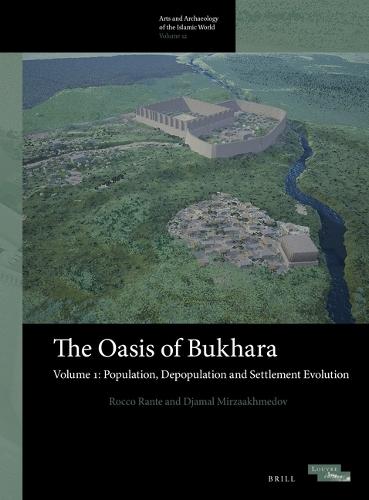
In The Oasis of Bukhara: Population, Depopulation and Settlement Evolution, Rocco Rante, archaeologist at the Louvre Museum, presents the results of a large-scale and ambitious regional archaeological investigation of the oasis of Bukhara, corresponding to the delta of the Zerafshan River, from the end of the 1st millennium BCE to the Timurid period. Rante reports the conclusions of several studies of the oasis, realised with the collaboration of distinguished specialists, and covers topics such as human migration, water and the city, urban development and changes in human behaviour. He also revisits the history of this part of Central Asia, providing new historical and cultural insights arising out of the intense archaeological activities undertaken in the field. The volume is co-published by Brill, Leiden, and the Louvre Museum, Paris.
Full Product Details
Author: Rocco Rante
Publisher: Brill
Imprint: Brill
Edition: Approx. 280 pp., incl. 230 illus.
Volume: 12
Dimensions:
Width: 21.50cm
, Height: 2.20cm
, Length: 28.90cm
Weight: 1.381kg
ISBN: 9789004396210
ISBN 10: 9004396217
Pages: 306
Publication Date: 26 September 2019
Audience:
Professional and scholarly
,
Professional & Vocational
Format: Hardback
Publisher's Status: Active
Availability: In Print

This item will be ordered in for you from one of our suppliers. Upon receipt, we will promptly dispatch it out to you. For in store availability, please contact us.
Language: English, French, Russian
Reviews
""Archaeologists Rante (Louvre Museum) and Mirzaakhmedov (Uzbek Academy of Sciences) envision a three-volume English language publication reporting the results of a large-scale, ten-year regional study by the Mission Archéologique Franco-Ouzbèke in western Central Asia, focusing on the geoarchaeology of the Zerafshan River delta for the long-durée: 3rd century BCE through 16th century CE. Three chapters of this initial volume, written mostly by Rante, concentrate on the survey of the landscape paleoecology, hydrography, and settlement evolution (1,040 archaeological sites), offering a detailed paradigm for urban morphology, differentiating unique sites and urban categories (bipartite and tripartite cities) through six well-defined chronological phases. The narrative emphasizes population dynamics; political administration and communication; the management of economic resources; interactions between urban, suburban, and rural communities; and sacred landscapes. Six chapters document in abundant detail trench excavations in six settlements, including three large cities: Ramitan, Paykend, and Bukhara. Rante’s concluding essay provides historical and cultural reconstructions of oasis irrigation systems, climate change, desiccation, and resulting social dynamics. The meticulous narrative is accompanied by 216 magnificent color illustrations, an extensive bibliography (172 references), and a comprehensive index. This report is unique for Central Asia and designed for professionals and researchers... Summing Up: Highly recommended. Graduate students, faculty, and professionals."" C.C. Kolb in: Choice Connect, Vol. 57 May 2020.
Archaeologists Rante (Louvre Museum) and Mirzaakhmedov (Uzbek Academy of Sciences) envision a three-volume English language publication reporting the results of a large-scale, ten-year regional study by the Mission Archeologique Franco-Ouzbeke in western Central Asia, focusing on the geoarchaeology of the Zerafshan River delta for the long-duree: 3rd century BCE through 16th century CE. Three chapters of this initial volume, written mostly by Rante, concentrate on the survey of the landscape paleoecology, hydrography, and settlement evolution (1,040 archaeological sites), offering a detailed paradigm for urban morphology, differentiating unique sites and urban categories (bipartite and tripartite cities) through six well-defined chronological phases. The narrative emphasizes population dynamics; political administration and communication; the management of economic resources; interactions between urban, suburban, and rural communities; and sacred landscapes. Six chapters document in abundant detail trench excavations in six settlements, including three large cities: Ramitan, Paykend, and Bukhara. Rante's concluding essay provides historical and cultural reconstructions of oasis irrigation systems, climate change, desiccation, and resulting social dynamics. The meticulous narrative is accompanied by 216 magnificent color illustrations, an extensive bibliography (172 references), and a comprehensive index. This report is unique for Central Asia and designed for professionals and researchers... Summing Up: Highly recommended. Graduate students, faculty, and professionals. C.C. Kolb in: Choice Connect, Vol. 57 May 2020.
Author Information
Rocco Rante, Ph.D. (2009), Professional Research Fellow (2018), University Pantheon-La Sorbonne, is archaeologist at the Louvre Museum. He has published Rayy: From Its Origins to the Mongol Invasion (Leiden, 2015) and The Greater Khorasan (Berlin, 2015).