Overview
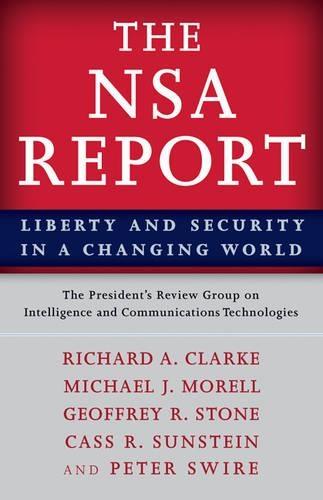
""We cannot discount the risk, in light of the lessons of our own history, that at some point in the future, high-level government officials will decide that this massive database of extraordinarily sensitive private information is there for the plucking. Americans must never make the mistake of wholly 'trusting' our public officials.""--The NSA Report This is the official report that is helping shape the international debate about the unprecedented surveillance activities of the National Security Agency. Commissioned by President Obama following disclosures by former NSA contractor Edward J. Snowden, and written by a preeminent group of intelligence and legal experts, the report examines the extent of NSA programs and calls for dozens of urgent and practical reforms. The result is a blueprint showing how the government can reaffirm its commitment to privacy and civil liberties--without compromising national security.
Full Product Details
Author: President's Review Group on Intelligence and Communications Technologies, The ,
Richard A. Clarke ,
Michael J. Morell ,
Geoffrey R. Stone
Publisher: Princeton University Press
Imprint: Princeton University Press
Dimensions:
Width: 14.00cm
, Height: 1.80cm
, Length: 21.60cm
Weight: 0.312kg
ISBN: 9780691163208
ISBN 10: 0691163200
Pages: 288
Publication Date: 20 April 2014
Audience:
General/trade
,
College/higher education
,
General
,
Tertiary & Higher Education
Format: Paperback
Publisher's Status: Active
Availability: Temporarily unavailable

The supplier advises that this item is temporarily unavailable. It will be ordered for you and placed on backorder. Once it does come back in stock, we will ship it out to you.
Language: English
Reviews
A remarkably thorough and well-reasoned report calling on the government to end its bulk phone-data collection program and to increase both the transparency and accountability of surveillance programs. --New York Times [The] recommendations take aim at some of the most controversial practices of the intelligence community. --Washington Post Within the 300-page report are 46 recommendations that would dramatically curtail the National Security Agency's surveillance powers. While the proposals are specific and varied, they all echo one theme: The government's reach can no longer be limited by technological capacity alone. It must be reined in with laws and institutional reform. --Atlantic
Fascinating insight . . . into how the nation's data-mining apparatus works--and how it's supposed to work. --Kirkus Reviews The Review Board's recommendations on protecting the civil liberties of non-US persons--a relatively new aspect of the policy discussion--are incredibly welcome. --Jennifer Granick, Stanford Center for Internet and Society blog The report is a brilliantly readable guide to the world [Edward] Snowden revealed; its clarity of analysis, proceeding from fundamental principles, impeccable. . . . Governments around the world would do well to reflect on the principles that underpin The NSA Report and relate them to their own intelligence-gathering activities. --Kieron O'Hara and Nigel Shadbolt, Science Within the 300-page report are 46 recommendations that would dramatically curtail the National Security Agency's surveillance powers. While the proposals are specific and varied, they all echo one theme: The government's reach can no longer be limited by technological capacity alone. It must be reined in with laws and institutional reform. --Atlantic [The] recommendations take aim at some of the most controversial practices of the intelligence community. --Washington Post A remarkably thorough and well-reasoned report calling on the government to end its bulk phone-data collection program and to increase both the transparency and accountability of surveillance programs. --New York Times
A remarkably thorough and well-reasoned report calling on the government to end its bulk phone-data collection program and to increase both the transparency and accountability of surveillance programs. --New York Times [The] recommendations take aim at some of the most controversial practices of the intelligence community. --Washington Post Within the 300-page report are 46 recommendations that would dramatically curtail the National Security Agency's surveillance powers. While the proposals are specific and varied, they all echo one theme: The government's reach can no longer be limited by technological capacity alone. It must be reined in with laws and institutional reform. --Atlantic The Review Board's recommendations on protecting the civil liberties of non-US persons--a relatively new aspect of the policy discussion--are incredibly welcome. --Jennifer Granick, Stanford Center for Internet and Society blog Fascinating insight ... into how the nation's data-mining apparatus works--and how it's supposed to work. -- Kirkus Reviews
Author Information
Richard A. Clarke served as a national security official under presidents Bill Clinton and George W. Bush. Michael J. Morell is a former deputy director of the Central Intelligence Agency. Geoffrey R. Stone is the Edward H. Levi Distinguished Service Professor of Law at the University of Chicago Law School. Cass R. Sunstein is the Robert Walmsley University Professor at Harvard University. Peter Swire is the Nancy J. and Lawrence P. Huang Professor in the Scheller College of Business at the Georgia Institute of Technology.