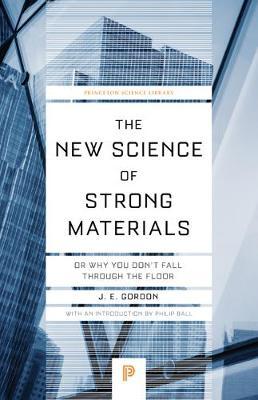
Full Product Details
Author: James Edward Gordon ,
Philip De Greff Ball
Publisher: Princeton University Press
Imprint: Princeton University Press
Edition: Revised edition
Volume: 58
ISBN: 9780691180984
ISBN 10: 0691180989
Pages: 328
Publication Date: 22 May 2018
Audience:
General/trade
,
Professional and scholarly
,
General/trade
,
General
,
Professional & Vocational
Format: Paperback
Publisher's Status: Active
Availability: In Print

This item will be ordered in for you from one of our suppliers. Upon receipt, we will promptly dispatch it out to you. For in store availability, please contact us.
Language: English
Reviews
I was thoroughly charmed and won over by this book which I now recommend to all my colleagues.--Daniel C. Mattis American Journal of Physics Praise for Princeton's original edition: -Princeton has brought to the public a highly readable treatise on the science of materials that emphasizes the strength of chemical and physical bonds, crystal structure, and cracks. . . . The author admits the necessity of being highly selective in the materials he can discuss so broadly, but he ably presents chemical and physical problems and how they have been solved in an orderly fashion, and he shows that the strength of materials is influenced as much by their environment and loading systems as by their own structures and shapes.---S. W. Dobyns, Science Books and Films -I was thoroughly charmed and won over by this book which I now recommend to all my colleagues.---Daniel C. Mattis, American Journal of Physics Praise for Princeton's original edition: Princeton has brought to the public a highly readable treatise on the science of materials that emphasizes the strength of chemical and physical bonds, crystal structure, and cracks. . . . The author admits the necessity of being highly selective in the materials he can discuss so broadly, but he ably presents chemical and physical problems and how they have been solved in an orderly fashion, and he shows that the strength of materials is influenced as much by their environment and loading systems as by their own structures and shapes. --S. W. Dobyns, Science Books and Films I was thoroughly charmed and won over by this book which I now recommend to all my colleagues. --Daniel C. Mattis, American Journal of Physics Praise for Princeton's original edition: Princeton has brought to the public a highly readable treatise on the science of materials that emphasizes the strength of chemical and physical bonds, crystal structure, and cracks. . . . The author admits the necessity of being highly selective in the materials he can discuss so broadly, but he ably presents chemical and physical problems and how they have been solved in an orderly fashion, and he shows that the strength of materials is influenced as much by their environment and loading systems as by their own structures and shapes.--S. W. Dobyns Science Books and Films I was thoroughly charmed and won over by this book which I now recommend to all my colleagues.--Daniel C. Mattis American Journal of Physics
I found Gordon's writing style fascinating; his book reads like a novel, and the technical content is superb. --Enoch J. Durbin, Princeton University Princeton has brought to the public a highly readable treatise on the science of materials that emphasizes the strength of chemical and physical bonds, crystal structure, and cracks.... The author admits the necessity of being highly selective in the materials he can discuss so broadly, but he ably presents chemical and physical problems and how they have been solved in an orderly fashion, and he shows that the strength of materials is influenced as much by their environment and loading systems as by their own structures and shapes.---S. W. Dobyns, , Science Books and Films I was thoroughly charmed and won over by this book, which I now recommend to all my colleagues.---Daniel C. Mattis, American Journal of Physics
Author Information
J. E. Gordon (1913–1998) was a founder of materials science and biomechanics. He was the author of Structures: Or Why Things Don't Fall Down and The Science of Structures and Materials. Philip Ball is a science writer whose work has appeared in Nature, New Scientist, the New York Times, and the Guardian, among others.