Full Product Details
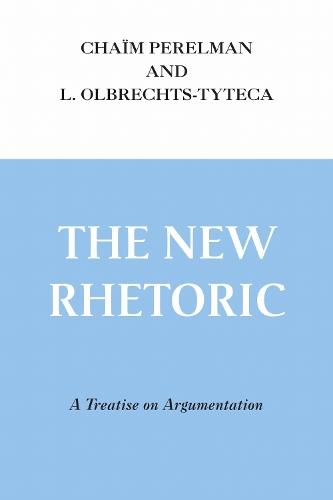
Author: Chaïm Perelman ,
L. Olbrechts-Tyteca
Publisher: University of Notre Dame Press
Imprint: University of Notre Dame Press
Dimensions:
Width: 15.20cm
, Height: 3.20cm
, Length: 22.90cm
Weight: 0.934kg
ISBN: 9780268001919
ISBN 10: 026800191
Pages: 576
Publication Date: 31 October 1973
Audience:
Professional and scholarly
,
Professional & Vocational
Format: Hardback
Publisher's Status: Active
Availability: Manufactured on demand

We will order this item for you from a manufactured on demand supplier.
Reviews
[A] readable English translation of this highly influential work in which Perelman and Olbrechts-Tyteca point out historical and systematic inadequacies in much of contemporary logic and methodology. -- The Review of Metaphysics
[A] readable English translation of this highly influential work in which Perelman and Olbrechts-Tyteca point out historical and systematic inadequacies in much of contemporary logic and methodology. -- The Review of Metaphysics
. . . a readable English translation of this highly influential work in which Perelman and Olbrechts-Tyteca point out historical and systematic inadequacies in much of contemporary logic and methodology. -The Review of Metaphysics It is difficult to see how any rhetorician, rhetorical critic, logician interested in verbal logic, or student of either philosophical or popular argument can claim full competence without familiarity with this work. It challenges the orthodoxies of all and suggests fresh modes of inquiry to all. -The Quarterly Journal of Speech An important work representing the recent increase of interest in rhetorical studies among Continental scholars. . . . The interest of philosophers of the rank of Perelman and Olbrechts-Tyteca in rhetoric marks a significant break from the influence of Ramus and Descartes upon Western philosophy's concept of reason and reasoning. An important work, highly recommended. -Choice One of the best features of the book is that the authors have not merely described kinds of argument used in persuasive discourse, but have constantly shown how such arguments can be countered-and not merely by one's saying 'but that doesn't follow logically'. Even if we abandon the slogan 'deductive or defective' we are not required to abandon all criticism of nondeductive arguments. The non-logical has its own logic. -Mind An important book, which should initiate re-estimation of the importance of a liberal art central to antiquity and the Renaissance, latterly eclipsed by the . . . logic of science and mathematics. . . . Dealing primarily with the written word, the authors analyze the constant and the variables in all argumentation, whether addressed to a universal audience or to one's self. Perelman claims that this work marks a break with a concept of reason which has dominated Western thought for three centuries. In 550 pages, he makes a good case for the claim. -The Key Reporter Readers will find this volume a fascinating and firm first step toward the solution of some important philosophical problems. -Philosophy and Rhetoric
Author Information
Chaïm Perelman (1912–1984), a Polish-born philosopher of law, studied, taught, and lived most of his life in Brussels. He became the youngest full professor in the history of the Université Libre de Bruxelles, where he remained for the rest of his career. He was among the most important argumentation theorists of the twentieth century. The New Rhetoric: A Treatise on Argumentation, written with Lucie Olbrechts-Tyteca in 1958, and translated into English by John Wilkinson and Purcell Weaver in 1969, is his chief work. He is also the author of The Realm of Rhetoric (University of Notre Dame Press, 1982). L.Olbrechts-Tyteca (1899–1987) was a Belgian academic and longtime co-worker of Chaïm Perelman. She volunteered in 1948 to support Perelman's work and developed several aspects of the New Rhetoric independently in later years.