|
Overview
Full Product Details
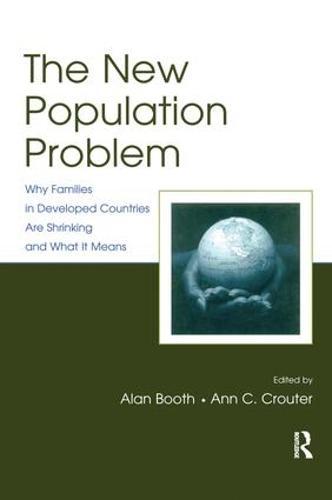
Author: Alan Booth , Ann C. Crouter
Publisher: Taylor & Francis Inc
Imprint: Psychology Press
Dimensions:
Width: 15.20cm
, Height: 1.50cm
, Length: 22.90cm
Weight: 0.408kg
ISBN: 9780805849790
ISBN 10: 0805849793
Pages: 276
Publication Date: 06 April 2005
Audience:
College/higher education
,
Professional and scholarly
,
Undergraduate
,
Postgraduate, Research & Scholarly
Format: Paperback
Publisher's Status: Active
Availability: In Print 
This item will be ordered in for you from one of our suppliers. Upon receipt, we will promptly dispatch it out to you. For in store availability, please contact us.
Table of Contents
Contents: Preface. Part I: Contemporary Patterns and Trends in U.S. Fertility: Where Have We Come From, and Where Are We Headed?S.P. Morgan, K. Hagewen, Is Very Low Fertility Inevitable in America? Insights and Forecasts From an Integrative Model of Fertility. R.K. Raley, The Role Of Nonmarital Births in Sustaining Replacement Fertility in the United States. M.B. Tucker, When the Rule Applies: Commentary on ""Is Very Low Fertility Inevitable in America?"" S.M. Bianchi, Time and Money: Market Work, Nonmarket Work, Gender Equality, and Fertility. Part II: How Do Social and Cultural Values and Attitudes Shape Fertility Patterns in the Developed World?J.S. Barber, W.G. Axinn, How Do Attitudes Shape Childbearing in the United States? S. Lundberg, Childbearing Decisions: Can Attitude Measures Play a Role in Casual Modeling? H-P. Kohler, Attitudes and Low Fertility: Reflections Based on Danish Twin Data. D.F. Alwin, Attitudes, Beliefs, and Childbearing. Part III: How and Why Is Fertility Tied to Marriage--Or Not?E. Thompson, Partnerships and Parenthood: A Comparative View of Cohabitation, Marriage, and Childbearing. S. Jaffee, Partnership Stability and Marital Outcomes in a Representative UK Sample. H.B. Presser, The Importance of Gender Relations for Understanding Low Fertility and Single Motherhood. N.S. Landale, The Changing Partnership Context of Parenthood: Where Do Researchers Go From Here? Part IV: What Are the Long-Term Consequences of Current Fertility Trends for Individuals, Families, and Society.C. Bachrach, R. King, A. Yuan, Children as Private and Public Goods: Implications of Fertility Trends. L. White, Creating the Next Generation: Whose Responsibility? D.T. Lichter, J. Wooton, The Concentration of Reproduction in Low-Fertility Societies: The Case of the United States. Panel Discussion: W.G. Axinn, C. Bachrach, J.S. Barber, D. Lichter, S.P. Morgan, E. Thomson, L. White, The Future of Low Fertility. T. St. Pierre, J.K. Dariotis, Understanding Low Fertility: The Impact of Life-Course Competition on Fertility Behavior in Developed Nations.
Reviews
This volume would be of interest to all with an interest in changes affecting fertility and childbearing in developed countries. -Australian Institute of Family Studies
Author Information
Alan Booth (Edited by) , Ann C. Crouter (Edited by)
Tab Content 6
Author Website:
Countries Available
All regions
|