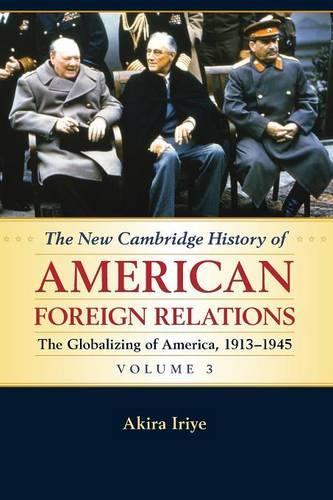
Full Product Details
Author: Akira Iriye (Harvard University, Massachusetts)
Publisher: Cambridge University Press
Imprint: Cambridge University Press
Dimensions:
Width: 15.00cm
, Height: 1.70cm
, Length: 22.90cm
Weight: 0.420kg
ISBN: 9781107536197
ISBN 10: 1107536197
Pages: 270
Publication Date: 16 April 2015
Audience:
Professional and scholarly
,
Professional & Vocational
Format: Paperback
Publisher's Status: Active
Availability: Manufactured on demand

We will order this item for you from a manufactured on demand supplier.
Reviews
'A clear overview of American ascendance - cultural, military, and economic - in an era punctuated by war and economic crisis. Iriye's global perspective helps us understand the rise of the United States in the context of wider challenges to European power; his analysis of deglobalizing forces and reglobalizing efforts casts new light on American leadership in this tumultuous time.' Kristin Hoganson, author of Consumers' Imperium: The Global Production of American Domesticity 'No one has done more than Akira Iriye to promote the study of U.S. foreign relations in a global frame that includes civil society actors and institutions. Skilfully bridging the domains of politics, economics, and culture, The Globalizing of America, 1913-1945 charts the United States' interwar rise as a world power largely defined by its pursuit of economic interdependence, in the context of global crises and struggles over the nationalizing and internationalizing of power. Far from isolated in the decades prior to World War II, he shows that the United States possessed a growing presence abroad, particularly in the fields of investment, commerce, philanthropy, education and popular culture, that would come to transform both the world and the United States itself.' Paul A. Kramer, author of The Blood of Government: Race, Empire, the United States, and the Philippines 'Iriye has no peer as an international historian, as attested to by this revision of his third volume of The Cambridge History of U.S. Foreign Relations. With command and complexity he highlights America's role from the First World War to the end of the Second in restructuring the global system without neglecting the agency of other states and non-state actors. The Globalizing of America, 1913-1945 is history at its best: a multidimensional study of power that is as accessible as it is challenging.' Richard H. Immerman, Temple University 'Akira Iriye's volume, now updated with recent scholarship, continues to represent the best of historical interpretation and writing on its period. Scholars and students will continue to benefit from the provocative insights and graceful style of America's most distinguished international historian.' Emily S. Rosenberg, editor of A World Connecting, 1870-1945
'A clear overview of American ascendance - cultural, military, and economic - in an era punctuated by war and economic crisis. Iriye's global perspective helps us understand the rise of the United States in the context of wider challenges to European power; his analysis of deglobalizing forces and reglobalizing efforts casts new light on American leadership in this tumultuous time.' Kristin Hoganson, author of Consumers' Imperium: The Global Production of American Domesticity 'No one has done more than Akira Iriye to promote the study of U.S. foreign relations in a global frame that includes civil society actors and institutions. Skilfully bridging the domains of politics, economics, and culture, The Globalizing of America, 1913-1945 charts the United States' interwar rise as a world power largely defined by its pursuit of economic interdependence, in the context of global crises and struggles over the nationalizing and internationalizing of power. Far from isolated in the decades prior to World War II, he shows that the United States possessed a growing presence abroad, particularly in the fields of investment, commerce, philanthropy, education and popular culture, that would come to transform both the world and the United States itself.' Paul A. Kramer, author of The Blood of Government: Race, Empire, the United States, and the Philippines 'Iriye has no peer as an international historian, as attested to by this revision of his third volume of The Cambridge History of American Foreign Relations. With command and complexity he highlights America's role from the First World War to the end of the Second in restructuring the global system without neglecting the agency of other states and non-state actors. The Globalizing of America, 1913-1945 is history at its best: a multidimensional study of power that is as accessible as it is challenging.' Richard H. Immerman, Temple University, Philadelphia 'Akira Iriye's volume, now updated with recent scholarship, continues to represent the best of historical interpretation and writing on its period. Scholars and students will continue to benefit from the provocative insights and graceful style of America's most distinguished international historian.' Emily S. Rosenberg, editor of A World Connecting, 1870-1945
Author Information
Akira Iriye is Charles Warren Professor of American History, Emeritus, at Harvard University. He is the author of Global Community: The Role of International Organizations in the Making of the Contemporary World (2002), Cultural Imperialism and World Order (1998), China and Japan in the Global Setting (1993), Power and Culture: The Japanese-American War 1941–1945 (1981), Pacific Estrangement: Japanese and American Expansion, 1897–1911 (1972), Across the Pacific: An Inner History of American-East Asian Relations (1967) and After Imperialism: The Search for a New Order in the Far East, 1921–1931 (1965).