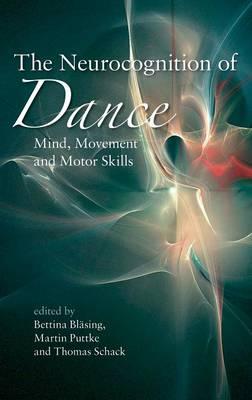
Full Product Details
Author: Bettina Bläsing (Bielefeld University, Germany) ,
Martin Puttke ,
Thomas Schack (Bielefeld University, Germany)
Publisher: Taylor & Francis Ltd
Imprint: Psychology Press Ltd
Dimensions:
Width: 15.60cm
, Height: 2.00cm
, Length: 23.40cm
Weight: 0.544kg
ISBN: 9781848720244
ISBN 10: 1848720246
Pages: 264
Publication Date: 14 April 2010
Audience:
College/higher education
,
Postgraduate, Research & Scholarly
,
Tertiary & Higher Education
Replaced By: 9781138847859
Format: Hardback
Publisher's Status: Out of Print
Availability: Awaiting stock

Reviews
This book is the first of its kind, combining science with the art of dance. The editors provide an appealing and informative overview of cognitive and neuroscientific approaches to dance, and use clear, effective diction to deepen the understanding of the physical, neural and cognitive principles of human motor learning. - Juliane Jacqueline Honisch, Behavioural Brain Sciences, School of Psychology, University of Birmingham, UK This text provides a successful and exciting interdisciplinary approach to complex human behavior. It is suitable for students and researchers in the field of motor research in psychology and neuroscience, as well as for persons in sport education with a deep interest in dance from a practical and theoretical perspective. - Andrea Kiesel, Associate Professor of Cognitive Psychology, University of Wuerzburg, Germany Actions speak louder than words, but this book finds the words and pictures with which to give actions their voice. It does so by focusing on actions which are expressive and emotional rather than instrumental, the actions of dance, in a way which enriches and is enriched by new studies of the cognitive science and neuroscience of action. - Michael Arbib, USC Brain Project, University of Southern California, USA
This book is the first of its kind, combining science with the art of dance. The editors provide an appealing and informative overview of cognitive and neuroscientific approaches to dance, and use clear, effective diction to deepen the understanding of the physical, neural and cognitive principles of human motor learning. - Juliane Jacqueline Honisch, Behavioural Brain Sciences, School of Psychology, University of Birmingham, UK This text provides a successful and exciting interdisciplinary approach to complex human behavior. It is suitable for students and researchers in the field of motor research in psychology and neuroscience, as well as for persons in sport education with a deep interest in dance from a practical and theoretical perspective. -- Andrea Kiesel, Associate Professor of Cognitive Psychology, University of Wuerzburg, Germany Actions speak louder than words, but this book finds the words and pictures with which to give actions their voice. It does so by focusing on actions which are expressive and emotional rather than instrumental, the actions of dance, in a way which enriches and is enriched by new studies of the cognitive science and neuroscience of action. - Michael Arbib, USC Brain Project, University of Southern California, USA
Author Information
Bettina Blasing is a research scientist at the Neurocognition and Action Research Group at Bielefeld University, responsible investigator at the Center of Excellence Cognitive Interaction Technology (CITEC), and member of the Research Institute for Cognition and Robotics (CoR-Lab). Her main research interests are the control and learning of complex movements, mental representations of the body, movement, actions and skills and neurocognitive aspects and expertise in dance. Martin Puttke was formerly a dancer, headmaster and artistic director of the State Ballet School Berlin. He was also the ballet director of the State Opera Ballet Company Berlin and of the Aalto Ballett Theater Essen. He is a renowned ballet pedagogue. In 1988 he became a Professor at the Hochschule fur Schauspielkunst ""Ernst Busch"" Berlin. His main interest is the renewal of the school of classical dance by his new system DANAMOS. Thomas Schack is Professor and head of the Neurocognition and Action Research Group at Bielefeld University. He is principal investigator at the Center of Excellence Cognitive Interaction Technology (CITEC) and member of the Research Institute for Cognition and Robotics (CoR-Lab). His main research interests concern mental movement representation, mental training, cognitive robotics and the neurocognitive basis of complex movement.