Overview
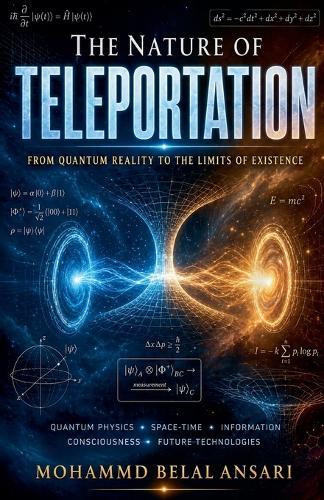
What if teleportation is not a distant technological fantasy-but a natural consequence of the deepest laws that govern reality? The Nature of Teleportation is not a typical science book. It does not simply describe a concept; it deconstructs it, rebuilds it, and places it within the broader framework of how the universe itself operates. Moving far beyond popular imagination, this work explores teleportation as a convergence point of modern physics, information theory, artificial intelligence, and philosophical inquiry. The journey begins with the foundations of quantum mechanics, where the classical idea of objects moving through space gives way to a more subtle understanding of reality. Here, the book explains how quantum states-rather than physical matter-can be transferred across distance, revealing that teleportation is not about transporting objects, but about transferring the information that defines them. From there, the exploration expands into the structure of space-time. Drawing on the principles of relativity, the book challenges the assumption that distance and location are fundamental. Instead, it presents the possibility that space itself may emerge from deeper relationships between systems. In this view, teleportation becomes not a violation of space, but a transformation within it. As the discussion advances, the book introduces the role of information as a fundamental element of reality. Systems are no longer seen as collections of particles alone, but as patterns-structures defined by relationships and interactions. Teleportation, in this context, is the controlled reconfiguration of these patterns, preserving identity while altering context. The exploration then moves into the technological domain, examining how teleportation could be implemented and scaled. It analyzes quantum networks, error correction, and the critical role of intelligent systems in managing complexity. The integration of advanced computation and artificial intelligence is presented not as an enhancement, but as a necessity for handling the precision and adaptability required by teleportation processes. Yet this book does not stop at science and technology. It confronts some of the most profound and unresolved questions about existence itself. If a system can be reconstructed elsewhere with perfect accuracy, does it remain the same system? Is identity tied to continuity of matter, or continuity of information? Can consciousness be preserved through transformation, or does it depend on something deeper that cannot be replicated? These questions move the discussion into philosophy, where the limits of scientific explanation are examined. The book does not offer simplistic answers. Instead, it carefully distinguishes between what is experimentally verified, what is theoretically possible, and what remains speculative. It acknowledges uncertainty while maintaining logical rigor, allowing the reader to explore these questions with clarity and depth. As the journey continues, the book ventures into advanced and speculative frameworks-emergent space-time, holographic principles, and the possibility that reality itself is fundamentally informational. These ideas are presented not as established facts, but as structured extensions of known science, offering a glimpse into what future theories might reveal. Throughout the book, a consistent theme emerges: teleportation is not an isolated phenomenon. It is a lens through which deeper principles become visible. It reveals that reality is not built from static objects, but from dynamic relationships. It shows that limits are not simply barriers, but defining features of the system. And it demonstrates that understanding the universe requires moving beyond intuition toward deeper conceptual frameworks.
Full Product Details
Author: Mohammad Belal Ansari
Publisher: Mohammad Belal Ansari
Imprint: Mohammad Belal Ansari
Dimensions:
Width: 14.00cm
, Height: 1.70cm
, Length: 21.60cm
Weight: 0.358kg
ISBN: 9798235253100
Pages: 310
Publication Date: 01 May 2026
Audience:
General/trade
,
General
Format: Paperback
Publisher's Status: Active
Availability: Available To Order

We have confirmation that this item is in stock with the supplier. It will be ordered in for you and dispatched immediately.
Author Information
Mohammad Belal Ansari is an independent researcher and writer with a deep passion for cosmology, theoretical physics, and the fundamental nature of the universe. His work focuses on exploring some of the most profound questions in science, including the mysteries of dark matter, dark energy, quantum gravity, and the structure of spacetime. Without formal institutional affiliation, he represents a new generation of self-driven thinkers who pursue knowledge beyond traditional boundaries. Through dedicated study and independent research, he aims to bridge the gap between complex scientific theories and accessible understanding, making advanced concepts approachable for curious readers and aspiring learners. Ansari is the author of The Dark Universe series, a multi-volume exploration of modern cosmology and the hidden forces shaping our universe. His writing combines scientific insight with philosophical depth, encouraging readers to think critically about reality and the laws that govern it. Driven by curiosity and a commitment to knowledge, Mohammad Belal Ansari continues to explore new ideas and contribute to the ongoing quest to understand the universe at its most fundamental level.