Overview
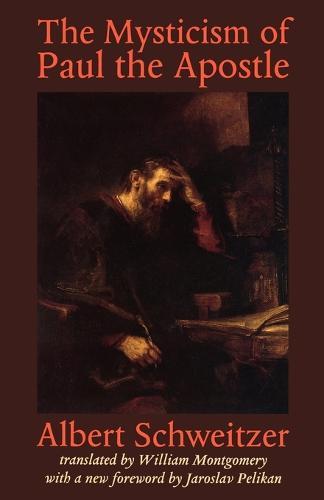
Immediately after the Gospels, the New Testament takes up the history of the early Christian Church, describing the works of the 12 disciples and introducing Paul, the man whose influence on the history of Christianity is beyond calculation. Teacher, preacher, conciliator, diplomat, theologian, rule giver, consoler and martyr, his life and writings became foundations for Christianity. He inspired a vast, serious and intelligent literature that seeks to recapture his meaning, his thinking and his purpose. In his letters to early Christian communities, Paul gave much practical advice about organization and orthodoxy. These treated the early Christian communities as something more than a group of people who believed in the same faith: they were people bound together by a common spirit unknown before. The significance of that common spirit occupied the greatest of Christian theologians from Athanasius and Augustine through Luther and Calvin. In this work, Schweitzer goes against Luther and the Protestant tradition to look at what Paul actually writes in the Epistles to the Romans and Galatians: an emphasis upon the personal experience of the believer with the divine. Paul's mysticism was not like the mysticism elsewhere described as a soul being at one with God. In the mysticism he felt and encouraged, there is no loss of self but an enriching of it; no erasure of time or place but a comprehension of how time and place fit within the eternal. Schweitzer writes that Paul's mysticism is especially profound, liberating and precise. He introduces readers to his own point of view at once, then describes how he came to it, its scholarly antecedents, what its implications are, what objections have been raised, and why all of this matters.
Full Product Details
Author: Albert Schweitzer ,
William Montgomery ,
Jaroslav Pelikan
Publisher: Johns Hopkins University Press
Imprint: Johns Hopkins University Press
Edition: New edition
Dimensions:
Width: 14.00cm
, Height: 2.40cm
, Length: 21.60cm
Weight: 0.612kg
ISBN: 9780801860980
ISBN 10: 0801860989
Pages: 440
Publication Date: 05 February 1999
Recommended Age: From 17
Audience:
College/higher education
,
Professional and scholarly
,
Undergraduate
,
Postgraduate, Research & Scholarly
Format: Paperback
Publisher's Status: Active
Availability: Available To Order

We have confirmation that this item is in stock with the supplier. It will be ordered in for you and dispatched immediately.
Language: German
Reviews
[The book's] fourteen chapters deal with the distinctive character of Pauline mysticism, wheter it was Hellenistic or Judaic, the Pauline epistles, the eschatological doctrine of redemption,... and the permanent elements in Paul's mysticism. New Testament Abstracts
<p> [The book's] fourteen chapters deal with the distinctive character of Pauline mysticism, wheter it was Hellenistic or Judaic, the Pauline epistles, the eschatological doctrine of redemption, ... and the permanent elements in Paul's mysticism. -- New Testament Abstracts
Author Information
Albert Schweitzer (1875-1965) won the Nobel Prize for Peace in 1952. Although he proved himself highly gifted in science, theology, and music, and as an author, Schweitzer dedicated the later part of his life to medicine and to a hospital he founded in French Equatorial Africa. A true humanitarian, he used his Nobel Prize stipend to expand the hospital and to build a leper colony. His other titles available from Johns Hopkins University Press include The Quest of the Historical Jesus, The Primeval Forest, and Out of My Life and Thought.