Overview
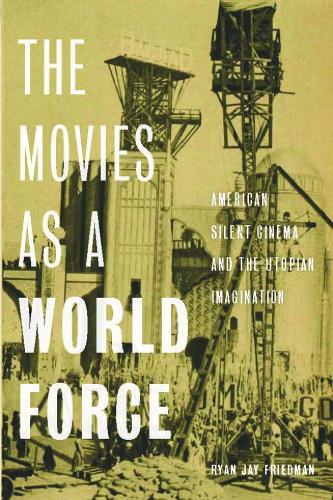
Throughout the silent-feature era, American artists and intellectuals routinely described cinema as a force of global communion, a universal language promoting mutual understanding and harmonious coexistence amongst disparate groups of people. In the early 1920s, film-industry leaders began to espouse this utopian view, in order to claim for motion pictures an essentially uplifting social function. The Movies as a World Force examines the body of writing in which this understanding of cinema emerged and explores how it shaped particular silent films and their marketing campaigns. The utopian and universalist view of cinema, the book shows, represents a synthesis of New Age spirituality and the new liberalism. It provided a framework for the first official, written histories of American cinema and persisted as an advertising trope, even after the transition to sound made movies reliant on specific national languages.
Full Product Details
Author: Ryan Jay Friedman
Publisher: Rutgers University Press
Imprint: Rutgers University Press
Dimensions:
Width: 15.20cm
, Height: 1.80cm
, Length: 22.90cm
Weight: 0.426kg
ISBN: 9780813593593
ISBN 10: 081359359
Pages: 264
Publication Date: 04 February 2019
Audience:
College/higher education
,
Professional and scholarly
,
Tertiary & Higher Education
,
Professional & Vocational
Format: Paperback
Publisher's Status: Active
Availability: In Print

This item will be ordered in for you from one of our suppliers. Upon receipt, we will promptly dispatch it out to you. For in store availability, please contact us.
Reviews
The Movies as a World Force is a significant contribution to the historical study of the American cinema of the silent era, charting an expansive but largely unacknowledged utopian discourse about history, social progress, and the massification of culture that was central to the screen practices of early Hollywood and to various middlebrow projects of linking commercialized culture to the progress of democracy. Friedman does an outstanding job of making visible the contours of this expansive and decidedly anti-modern historical tendency, describing how the cinema was its inspiration and a principal site for its articulation. This book challenges us to rethink our understanding of the emergent studio system and the function of public relations in relation to what were undoubtedly widespread beliefs in the cinema as a spiritual force of global transformation.
Recommended. --Choice The Movies as a World Force is a significant contribution to the historical study of the American cinema of the silent era, charting an expansive but largely unacknowledged utopian discourse about history, social progress, and the massification of culture that was central to the screen practices of early Hollywood and to various middlebrow projects of linking commercialized culture to the progress of democracy. Friedman does an outstanding job of making visible the contours of this expansive and decidedly anti-modern historical tendency, describing how the cinema was its inspiration and a principal site for its articulation. This book challenges us to rethink our understanding of the emergent studio system and the function of public relations in relation to what were undoubtedly widespread beliefs in the cinema as a spiritual force of global transformation. --Mark Lynn Anderson author of Twilight of the Idols: Hollywood and the Human Sciences in 1920s America
Author Information
RYAN J. FRIEDMAN is an associate professor of English and the director of film studies at Ohio State University in Columbus. He is the author of Hollywood's African American Films: The Transition to Sound (Rutgers University Press).