Overview
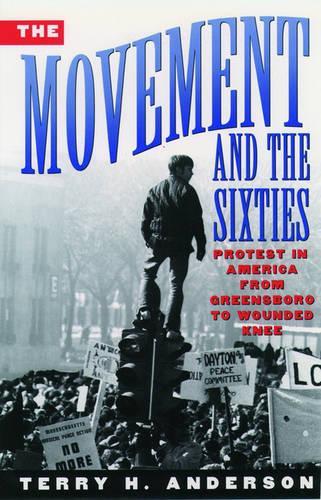
It began in 1960 with the Greensboro sit-ins. By 1973, when a few Native Americans rebelled at Wounded Knee and the U.S. Army came home from Vietnam, it was over. In between came Freedom Rides, Port Huron, the Mississippi Summer, Berkeley, Selma, Vietnam, the Summer of Love, Black Power, the Chicago Convention, hippies, Brown Power, and Women's Liberation--The Movement--in an era that became known as The Sixties. Why did millions of Americans become activists; why did they take to the streets? These are questions Terry Anderson explores in The Movement and The Sixties, a searching history of the social activism that defined a generation of young Americans and that called into question the very nature of ""America."" Drawing on interviews, ""underground"" manuscripts collected at campuses and archives throughout the nation, and many popular accounts, Anderson begins with Greensboro and reveals how one event built upon another and exploded into the kaleidoscope of activism by the early 1970s. Civil rights, student power, and the crusade against the Vietnam War composed the first wave of the movement, and during and after the rip tides of 1968, the movement changed and expanded, flowing into new currents of counterculture, minority empowerment, and women's liberation. The parades of protesters, along with schocking events--from the Kennedy assassination to My Lai--encouraged other citizens to question their nation. Was America racist, imperialist, sexist?Unlike other books on this tumultuous decade, The Movement and The Sixties is neither a personal memoir, nor a treatise on New Left ideology, nor a chronicle of the so-called leaders of the movement. Instead, it is a national history, a compelling and fascinating account of a defining era that remains a significant part of our lives today.
Full Product Details
Author: Anderson
Publisher: Oxford University Press Inc
Imprint: Oxford University Press Inc
Dimensions:
Width: 15.50cm
, Height: 3.50cm
, Length: 23.30cm
Weight: 0.771kg
ISBN: 9780195104578
ISBN 10: 0195104579
Pages: 544
Publication Date: 05 September 1996
Audience:
Professional and scholarly
,
Professional & Vocational
Format: Paperback
Publisher's Status: Active
Availability: To order

Stock availability from the supplier is unknown. We will order it for you and ship this item to you once it is received by us.
Reviews
Should be the standard for years to come. --Kirkus Reviews<br> A marvelous tour de force. --Mary King, author of Freedom Song<br> Anderson has done the nearly impossible, giving us historical and intellectual synthesis. --The Seattle Times<br>
a very detailed and absorbing account * Socialist Review, November 1996 * Anderson leaves no lunch counter unturned. It is all there, from Rosa Parks and the Summer of Love to bra burnings and the March on the Pentagon, complete with selected quotations from various songs of the era atop each chapter. -William McGurn, writing in The Wall Street Journal A fascinating, extensively researched account of a time when the younger generation opened pop culture's Pandora's box, and an estranged segment of America took to the streets and said: 'We're mad as hell and we're not going to take it anymore.'...Dig it, man. It's a trip. -Fort Worth Star-Telegram This volume is a lively account of the turbulence experienced by American society after two decades of Cold War...While the whole book is compelling, chapter 6, entitled Power and Liberation , is particularly incisive...a welcome addition to the literature of the period. Written with both passion and control. * The Historian * Ably surveys a busy, complex era....This is a resonant book. Most of all, it recalls a not-so-distant past when Americans thought we could and should reform our society. -The Dallas Morning News Perceptive....Anderson takes on all strands of the Movement. -Booklist (starred review) For those already tested in the political fires of the '60s, [Anderson's] book is a reminder to keep alert and stay active. For a younger generation, he provides a concise and closely packed history that precedes the roil and boil of today's political activity. -The Seattle Times Anderson's well-written, accessible history is much more than nostalgic reading for baby boomers, the great majority of whom sat on the sidelines during most of the decade while a minority acted. Neither is it a polemic in unquestioning defense of '60s activists. Instead, it attempts to understand the motives of 'the movement' and place its actions in the context of the times. In doing so, it provides a valuable counterpoint to the reductionist and revisionist views now prevalent. -The Christian Science Monitor A valuable, refreshingly unbiased reassessment of the '60s legacy. -Publishers Weekly Hundreds of voices resound in this thoroughgoing analysis of '60s radicalism....A highly accessible survey that should be the standard for years to come. -Kirkus Reviews A disturbing tale, well told in exhaustive detail....It is the merit of Terry Anderson's book that it captures the tone, as well as the events, of a decade in which America finally emerged from cold-war simplicities and began the painful discovery of itself. -The Economist Anderson has written a very detailed and absorbing account of these events..a detailed description of events, this is a useful book * Socialist Review * A marvelous tour de force....Anderson's book is an indispensable tool for anyone trying to understand the perplexing range of movements during the 1960s. It should be on the bookshelf of every serious student of social activism. -Mary King, author of Freedom Song A splendid study, exhaustively researched and engagingly written, and a useful-indeed essential-corrective to the new conventional wisdom about a tumultuous era. -George C. Herring, Professor of History, University of Kentucky Terry Anderson has written the best book yet on the broad protest movement that dominated American life in the 1960s. Unlike earlier writers, who focus on elites or just one group, he offers a kaleidoscopic view that stresses the grass-roots involvement of American youth as they challenged both the politics and the values of their elders in a frontal assault on the established Cold War culture. It is a tour de force. -Robert A. Divine, George W. Littlefield Professor in American History, University of Texas at Austin
Hundreds of voices resound in this thoroughgoing analysis of '60s radicalism. If people demonstrate in a manner to interfere with others, they should be rounded up and put in a detention camp, argues Deputy Attorney General Richard Kleindienst in 1972. Abbie Hoffman, speaking shortly before his suicide in 1989, gleefully proclaims, We were young, we were reckless, arrogant, silly, headstrong - and we were right. I regret nothing! Novelist Philip Caputo recalls that in his worldview John F. Kennedy was a modern King Arthur, the officers of the Army his knights, and Vietnam the new Crusade. Rock lyrics, SDS slogans, and official pronouncements from the likes of Spiro Agnew, Richard Daley, and George Wallace also abound. But Anderson (History/Texas A&M Univ.; The United States, Great Britain, and the Cold War, not reviewed) brings order to the period's chaos in his rigorous account of the intellectual origins of modern dissent, tracing the baby-boom generation's involvement with the civil-rights and free-speech movements as the proving ground for what, after the murders of Martin Luther King and Robert Kennedy, would very nearly become civil war. The author skewers a system that sent so many impoverished minority youngsters to Southeast Asia ( of the 30,000 male graduates from Harvard, Princeton, and MIT in the decade following 1962, only 20 died in Vietnam ) and condemns a national ethos that idolized Nazi rocket scientist Wernher von Braun while imprisoning conscientious objectors. Clearly, for him the '60s are very much alive, and his passionate remembrance galvanizes the book. However, it suffers from occasional but annoying errors. Anderson misdates songs and truncates and mistransposes lyrics; he implies that musicians Mama Cass Elliot and Keith Moon died of drag overdoses (in fact, both suffered heart attacks); he places Fort Bliss (Texas) in New Jersey. Despite these lapses, a highly accessible survey that should be the standard for years to come. (Kirkus Reviews)
Author Information
Terry Anderson, a Vietnam veteran, is a Professor of History at Texas A&M University, and also has taught in Malaysia, Japan, and has received a Fulbright to China. He has written many articles on the 1960s and on the Vietnam War, and is the author of The United States, Great Britain and the Cold War, 1944-1947, and the co-author of A Flying Tiger's Diary (with fighter pilot Charles Bond, Jr.).