Overview
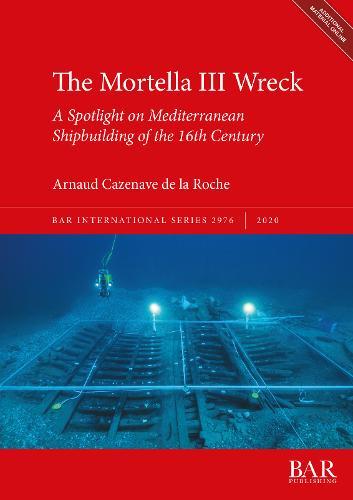
During the Renaissance period, Mediterranean shipbuilding-particularly Italian-was renowned for its quality. But it is largely unappreciated today due to the scarcity of written sources and the lack of archaeological documentation. The discovery of the Mortella wrecks in Saint-Florent, Corsica, in 2005-2006, and the 2010-2019 excavation of the 16th century Mortella III, helps to fill these gaps. The main objective of this archaeological study is to identify 'technical fingerprints' and 'architectural traits' that could contribute to the formulation of an Italo-Mediterranean shipbuilding model from the early modern period. The analysis is based on comparisons with archaeological data from other wrecks of the period as well as written sources. Finally, literature research allows us to link the Mortella wrecks to their history, that of Genoese 'navis' sunk during the Italian wars of 1527, complementing the archaeological study with historical research.
Full Product Details
Author: Arnaud Cazenave de la Roche
Publisher: BAR Publishing
Imprint: BAR Publishing
Weight: 0.973kg
ISBN: 9781407354132
ISBN 10: 1407354132
Pages: 173
Publication Date: 31 March 2020
Audience:
Professional and scholarly
,
Professional & Vocational
Format: Mixed media product
Publisher's Status: Active
Availability: Available To Order 
We have confirmation that this item is in stock with the supplier. It will be ordered in for you and dispatched immediately.
Language: French
Table of Contents
{\rtf1\fbidis\ansi\ansicpg1252\deff0\deflang2057{\fonttbl{\f0\fswiss\fprq2\fcharset0 Calibri;}{\f1\fnil\fcharset0 Verdana;}} \viewkind4\uc1\pard\ltrpar\b\f0\fs22 List of Figures\par List of Tables\par Lists of Abbreviations\par Introduction\par \b0 The Mortella wrecks: a valuable source of information\par The issues addressed and the objectives of the study\par The limits of the archaeological study\par Construction techniques\par The architecture of the ship\par Archaeological sources\par Documentary sources\par The sources of the historical perspective\par \b 1. Shipbuilding in the Mediterranean in the 16th century: State of the art and issues\par \b0 1.1. The concepts of \lquote maritime space\rquote and \lquote technical culture\rquote at the heart of current issues\par 1.2. Construction techniques: in search of \lquote technical fingerprints\rquote\par 1.3. The components of the architectural project: in search of an architectural model\par 1.3.1. Proportions: the relationship between dimensions\par 1.3.2. The form: the shape of the master-frame\par 1.3.3. The design method: the moulding process\par \b 2. Portraits of the Mortella wrecks: The discovery of the sites, their characteristics, their chronology & excavation methods\par \b0 2.1. The Mortella II and III: discovery of two sites of the same origin. Characteristics and background\par 2.1.1. The discovery of the sites\par 2.1.2. General description of the Mortella sites at the time of their discovery\par 2.1.2.1. Site characteristics\par 2.1.2.2. Nature of the sites\par 2.1.2.3. The link between the two sites\par 2.1.3. Background and history of interventions\par 2.2. Archaeological material and wood of the hull: the artefacts and the material helping the chronology\par 2.2.1. The contribution of the artefacts to the understanding of the wreck and to its dating\par 2.2.1.1. Artillery\par 2.2.1.2. Ceramics\par 2.2.2. The wood: its characteristics and contribution to dating using dendrochronology\par 2.2.2.1. The wood and its origin\par 2.2.2.2. Its use in shipbuilding\par 2.2.2.3. Woodworking and tool marks\par 2.2.2.4. Dendrochronological study\par 2.3. General layout of the Mortella III site and context of the shipwreck\par 2.3.1. General layout of the remains of the hull (fig.26)\par 2.3.2. The context surrounding the sinking\par 2.4. Defining the research programme: research axis, methodology and excavation strategy\par 2.4.1. Methodology and excavation strategy\par 2.4.1.1. Objectives and excavation strategy\par 2.4.1.2. Means and excavation methodology\par 2.4.2. Conservation and protection of the site\par 2.4.2.1. Preventive conservation of the artefacts\par 2.4.2.2. Conservation of the remains on the site\par \b 3. The hull of the Mortella III wreck and its construction method\par \b0 3.1. The transversal framework: organization, dimensions, morphology and scarfs methods\par 3.1.1. General layout of the transverse framing\par 3.1.1.1. Definition of the frames groups\par 3.1.1.2. Sequencing of the frame components, room and space\par 3.1.1.3. The frames of the aft part of the hull\par 3.1.1.4. Frames located between the tailframes\par 3.1.1.5. Frames of the fore part of the hull\par 3.1.2. Components of the frames (see Table 10 for a summary of dimensions)\par 3.1.2.1. The floor-timbers\par 3.1.2.2. Scarfs of the floor-timbers to the first-futtocks\par 3.1.2.3. The first-futtocks\par 3.1.2.4. Scarfs from first to second-futtocks\par 3.1.2.5. The second-futtocks\par 3.1.2.6. Summary tables of the frames measurements\par 3.1.3. Scarfs typology of the frame components\par 3.1.3.1. A technical choice\par 3.1.3.2. A possible architectural design function\par 3.2. The longitudinal framework: layout, dimensions, morphology and scarfs methods\par 3.2.1. The keel, the heel of the keel and the keelson\par 3.2.1.1. Search for keel length\par 3.2.1.2. Morphology of the keel and types of scarfs\par 3.2.1.3. The heel of the keel, its scarf to the keel and the stern\par 3.2.1.4. The keelson\par 3.2.2. Clamps, sill and ceiling\par 3.2.2.1. Clamps\par 3.2.2.2. The ceiling and the sill\par 3.2.3. The planking and its fastening method to the frames\par 3.2.3.1. The wood\par 3.2.3.2. Morphology and dimensions\par 3.2.3.3. Fastening method of the planking to the frames\par 3.2.3.4. The forward end of the planking\par 3.2.3.5. Caulking and sealing products\par 3.3. Fastening system for the timbers\par 3.3.1. Iron nails and absence of treenails\par 3.3.2. Circular section of the nails\par 3.3.3. Folded down nails tips\par \b 4. The attributes of the hull: The mainmast step, the pump, and the rudder\par \b0 4.1. The main mast-step\par 4.1.1. The longitudinal timbers of the mast-step arrangement (or sister-keelsons)\par 4.1.2. The buttresses\par 4.1.3. The keys\par 4.1.4. A major Mediterranean technical \lquote fingerprint\rquote\par 4.2. The pump\par 4.2.1. The foot-valve\par 4.2.2. The pump-tube\par 4.3. The rudder\par 4.3.1. The rudder device: definitions and vocabulary\par 4.3.2. Morphology of the rudder blade\par 4.3.3. The nailing\par 4.3.4. The bolts\par 4.3.5. The iron-works\par 4.4. Analysis and interpretation of the remains uncovered\par \b 5. The architectural profile of the Mortella III wreck: Shapes and proportions\par \b0 5.1. Attempt to restore the shape of the master-frame M27\par 5.1.1. Position of the master-frame on the keel\par 5.1.2. Characteristics and shape of the frame\par 5.1.2.1. The rising and narrowing of the master floor-timber\par 5.1.2.2. The shape of the master-frame M27\par 5.1.2.3. The design of the master-frame\par 5.1.2. Restoration of the master-frame shape\par 5.2. The deck and depth of hold\par 5.2.1. The number of decks\par 5.2.2. Decks height\par 5.2.3. The depth of hold\par 5.3. Rake of the sternpost and shape of the stem\par 5.3.1. The rake of the sternpost and the overhang\par 5.3.2. The stern and its overhang\par 5.4. Proportions of the ship, the attempt to restore her shape and longitudinal dimensions\par 5.4.1. The main proportion ratios\par 5.4.1.1. The keel width/length ratio\par 5.4.1.2. Summary of proportions\par 5.4.2. Attempt to restore the longitudinal shape and the dimensions of the ship\par 5.5. The gauging\par 5.5.1. An essential unit of volume in 16th century shipbuilding\par 5.5.2. Calculation of tonnage in the 16th century\par 5.5.2.1. The Venetian method\par 5.5.2.2. The Spanish method\par \b 6. Historical study: Issues, references, and identification attempt of the Mortella wrecks\par \b0 6.1. Hypothesis and historical issues\par 6.2. The naval combat and shipwrecks of 1555\par 6.2.1. The historical context of the period\par 6.2.2. Related Texts\par 6.2.3. Analysis of the hypothesis of the shipwrecks of 1555\par 6.3. The shipwrecks of 1526\par 6.3.1. The historical context of the period\par 6.3.2. Related texts\par 6.3.3. Analysis of the texts on shipwrecks of 1526\par 6.4. The shipwrecks of 1527\par 6.4.1. The historical context of the period\par 6.4.2. Related texts\par 6.4.3. Analysis of the texts on shipwrecks of 1527\par 6.5. Provisional lessons drawn from historical research\par 6.5.1. The architectural portrait of a Genoese nave\par 6.5.2. Historical landmarks on the development of the Genoese nave\par \b Conclusion\par \b0 The architectural portrait of the Mortella III ship\par The historical portrait of the Mortella III ship\par The contribution of the wreck to a Mediterranean technical model\par The contribution of the wreck to the definition of a Mediterranean architectural model\par The exploration of the Venetian treatises in relation to the Mortella III wreck.\par Future prospects for knowledge of Mediterranean shipbuilding\par \b Sources and Bibliography\par Glossary\par Annex 1. General layout and planimetry of the Mortella III wreck\par Annex 2. Photomosaic of the Mortella III wreck\par Annex 3. Dendrochronological study\par Annex 4. Study of the transverse compression of the Mortella III timbers\par Annex 5. Chemical analysis of caulking and sealing materials\par Annex 6. Main original texts resulting from literature research\par Annex 7. Selection of texts mentioning or inducing the \i As-Dos-Tres\i0 rule\par Annex 8. Study of the West Anchor of the Mortella III wreck\par Annex 9. Divers team list\par Annex 10. Photos of the excavation\par Annexes 1 and 2 are also available as an accompanying download\b0\f1\fs17\par }
Reviews
{\rtf1\fbidis\ansi\ansicpg1252\deff0\deflang2057{\fonttbl{\f0\fswiss\fprq2\fcharset0 Calibri;}{\f1\fnil\fcharset0 Verdana;}} \viewkind4\uc1\pard\ltrpar\sa160\sl252\slmult1\lang1033\f0\fs22\lquote This is a detailed and well-set-out excavation report with high-quality illustrations. But it is more than that. Its starting point is to record in full and accurate detail the nature of these well-preserved ship-remains, and to consider the processes of construction. This it achieves admirably. From this it goes on to place data in their wider historical and archaeological contexts, emphasizing similarities and differences in ships built at different times and in different places. It is a must-have book for archaeologists and historians who are interested in these things.\rquote Colin Martin, International Journal of Nautical Archaeology, Vol 50, 2021\lang2057\par \lquote The quality of both archaeological and historical data is excellent.\rquote Prof. Sylviane Llinares, Universit\'e9 Bretagne Sud \par \lquote Le travail pr\'e9sent\'e9 par Arnaud Cazenave de la Roche est vraiment original.\rquote Dr David Plouviez, Universit\'e9 de Nantes\par \pard\ltrpar\f1\fs17\par }
{\rtf1\ansi\ansicpg1252\deff0\deflang2057{\fonttbl{\f0\fswiss\fprq2\fcharset0 Calibri;}{\f1\fnil\fcharset0 Verdana;}} \viewkind4\uc1\pard\sa160\sl252\slmult1\f0\fs22\lquote The quality of both archaeological and historical data is excellent.\rquote Prof. Sylviane Llinares, Universit\'e9 Bretagne Sud \par \lquote Le travail pr\'e9sent\'e9 par Arnaud Cazenave de la Roche est vraiment original.\rquote Dr David Plouviez, Universit\'e9 de Nantes\par \pard\f1\fs17\par }
Author Information
{\rtf1\ansi\ansicpg1252\deff0\deflang2057{\fonttbl{\f0\fswiss\fprq2\fcharset0 Calibri;}{\f1\fnil\fcharset0 Verdana;}} \viewkind4\uc1\pard\f0\fs22 Arnaud Cazenave de la Roche is a researcher at the Consejo Superior de Investigaciones Cient\'edficas (CSIC) with a research grant from Marie Sklodowsca-Curie Actions (Horizon 2020 EU Programme). He has been studying naval architecture from the Renaissance and modern periods for several years. He is an associate member of the Laboratoire d'Histoire et d'Arch\'e9ologie Maritimes (FED 4124) at the University of Paris-Sorbonne where he defended his doctoral thesis.\f1\fs17\par }
Tab Content 6
Author Website:
Countries Available
All regions
|