Overview
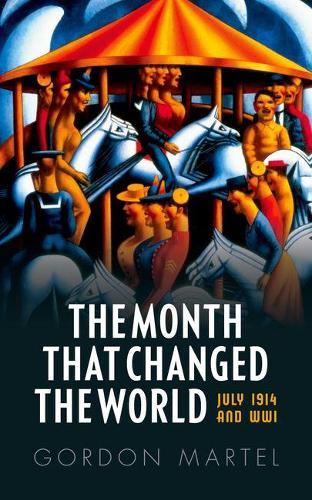
On 28 June 1914 the Austrian Archduke Franz Ferdinand was assassinated in the Balkans. Five fateful weeks later the Great Powers of Europe were at war. Much time and ink has been spent ever since trying to identify the 'guilty' person or state responsible, or alternatively attempting to explain the underlying forces that 'inevitably' led to war in 1914. Unsatisfied with these explanations, Gordon Martel now goes back to the contemporary diplomatic, military, and political records to investigate the twists and turns of the crisis afresh, with the aim of establishing just how the catastrophe really unfurled. What emerges is the story of a terrible, unnecessary tragedy - one that can be understood only by retracing the steps taken by those who went down the road to war. With each passing day, we see how the personalities of leading figures such as Kaiser Wilhelm II, the Emperor Franz Joseph, Tsar Nicholas II, Sir Edward Grey, and Raymond Poincaré were central to the unfolding crisis, how their hopes and fears intersected as events unfolded, and how each new decision produced a response that complicated or escalated matters to the point where they became almost impossible to contain.Devoting a chapter to each day of the infamous 'July Crisis', this gripping step by step account of the descent to war makes clear just how little the conflict was in fact premeditated, preordained, or even predictable. Almost every day it seemed possible that the crisis could be settled as so many had been over the previous decade; almost every day there was a new suggestion that gave statesmen hope that war could be avoided without abandoning vital interests. And yet, as the last month of peace ebbed away, the actions and reactions of the Great Powers disastrously escalated the situation. So much so that, by the beginning of August, what might have remained a minor Balkan problem had turned into the cataclysm of the First World War.
Full Product Details
Author: Gordon Martel (Emeritus Professor of History, University of Northern British Columbia , and Adjunct Professor of History, University of Victoria)
Publisher: Oxford University Press
Imprint: Oxford University Press
Dimensions:
Width: 13.50cm
, Height: 2.70cm
, Length: 21.50cm
Weight: 0.612kg
ISBN: 9780199665396
ISBN 10: 0199665397
Pages: 512
Publication Date: 13 April 2017
Audience:
General/trade
,
General
Format: Paperback
Publisher's Status: Active
Availability: To order

Stock availability from the supplier is unknown. We will order it for you and ship this item to you once it is received by us.
Reviews
Gordon Martel's book stands for its authoritative judgements and for its no-nonsense focus on the decisions that caused the conflict's outbreak. It offers a detailed but compelling narrative of the July 1914 crisis, based overwhelmingly on first-hand and contemporary evidence. * David Stevenson, author of 1914-1918: the History of the First World War * [A] very readable day-by-day analysis of the crisis * Duncan Kelly, Financial Times * This gripping account of the descent into the abyss of war makes clear just how little the conflict was premeditated, preordained, or predictable. * Military History Monthly *
This gripping account of the descent into the abyss of war makes clear just how little the conflict was premeditated, preordained, or predictable. Military History Monthly [A] very readable day-by-day analysis of the crisis Duncan Kelly, Financial Times Gordon Martel's book stands for its authoritative judgements and for its no-nonsense focus on the decisions that caused the conflict's outbreak. It offers a detailed but compelling narrative of the July 1914 crisis, based overwhelmingly on first-hand and contemporary evidence. David Stevenson, author of 1914-1918: the History of the First World War
Author Information
Gordon Martel is a leading authority on war, empire, and diplomacy in the modern age. His numerous publications include studies of the origins of the first and second world wars, modern imperialism, and the nature of diplomacy. A founding editor of The International History Review, he has taught at a number of Canadian universities, and has been a visiting professor or fellow in England, Ireland and Australia. Editor-in-chief of the five-volume Encyclopedia of War, he is also joint editor of the longstanding Seminar Studies in History series.