Overview
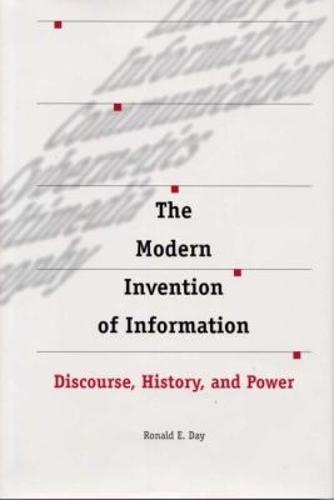
Ronald E. Day provides a historically informed critical analysis of the concept and politics of information in the twentieth century. Analyzing texts in Europe and the United States, his critical reading method goes beyond traditional historiographical readings of communication and information by engaging specific historical texts in terms of their attempts to construct and reshape history. After laying the groundwork and justifying his method of close reading for this study, Day examines the texts of two pre-World War II documentalists, Paul Otlet and Suzanne Briet. Through the work of Otlet and Briet, Day shows how documentation and information were associated with concepts of cultural progress. Day also discusses the social expansion of the conduit metaphor in the works of Warren Weaver and Norbert Wiener. He then shows how the work of contemporary French multimedia theorist Pierre Levy refracts the earlier philosophical writings of Gilles Deleuze and Felix Guattari through the prism of the capitalist understanding of the ""virtual society."" Turning back to the pre-World War II period, Day examines two critics of the information society: Martin Heidegger and Walter Benjamin. He explains Heidegger's philosophical critique of the information culture's model of language and truth as well as Benjamin's aesthetic and historical critique of mass information and communication. Day concludes by contemplating the relation of critical theory and information, particularly in regard to the information culture's transformation of history, historiography, and historicity into positive categories of assumed and represented knowledge.
Full Product Details
Author: Ronald E Day
Publisher: Southern Illinois University Press
Imprint: Southern Illinois University Press
Dimensions:
Width: 15.20cm
, Height: 1.90cm
, Length: 22.90cm
Weight: 0.386kg
ISBN: 9780809323906
ISBN 10: 0809323907
Pages: 152
Publication Date: 15 August 2001
Audience:
College/higher education
,
Professional and scholarly
,
Undergraduate
,
Postgraduate, Research & Scholarly
Format: Hardback
Publisher's Status: Active
Availability: Out of stock

The supplier is temporarily out of stock of this item. It will be ordered for you on backorder and shipped when it becomes available.
Reviews
"[A] beautifully thought-through attempt to develop a historiography of information. He draws together a number of threads from the histories of documentalism, cybernetics, information theory, and what is called critical theory to make the argument that information, so frequently portrayed as a purely abstract commodity, is materially textured and temporally rich. Geoffrey C. Bowker, author of ""Sorting Things Out: Classification and Its Consequences"""" [A] ""beautifully thought-through attempt to develop a historiography of information. He draws together a number of threads from the histories of documentalism, cybernetics, information theory, and what is called critical theory to make the argument that 'information, ' so frequently portrayed as a purely abstract commodity, is materially textured and temporally rich.""--Geoffrey C. Bowker, author of ""Sorting Things Out: Classification and Its Consequences"" [A] 0;beautifully thought-through attempt to develop a historiography of information. He draws together a number of threads from the histories of documentalism, cybernetics, information theory, and what is called critical theory to make the argument that 6;information,7; so frequently portrayed as a purely abstract commodity, is materially textured and temporally rich.1;2;Geoffrey C. Bowker, author of ""Sorting Things Out: Classification and Its Consequences"" [A] "" beautifully thought-through attempt to develop a historiography of information. He draws together a number of threads from the histories of documentalism, cybernetics, information theory, and what is called critical theory to make the argument that ' information, ' so frequently portrayed as a purely abstract commodity, is materially textured and temporally rich."" -- Geoffrey C. Bowker, author of ""Sorting Things Out: Classification and Its Consequences"""
[A] beautifully thought-through attempt to develop a historiography of information. He draws together a number of threads from the histories of documentalism, cybernetics, information theory, and what is called critical theory to make the argument that 'information, ' so frequently portrayed as a purely abstract commodity, is materially textured and temporally rich. --Geoffrey C. Bowker, author of Sorting Things Out: Classification and Its Consequences
[A] beautifully thought-through attempt to develop a historiography of information. He draws together a number of threads from the histories of documentalism, cybernetics, information theory, and what is called critical theory to make the argument that information, so frequently portrayed as a purely abstract commodity, is materially textured and temporally rich. Geoffrey C. Bowker, author of Sorting Things Out: Classification and Its Consequences
Author Information
Ronald E. Day is an assistant professor in the Library and Information Science Program at Wayne State University.