Overview
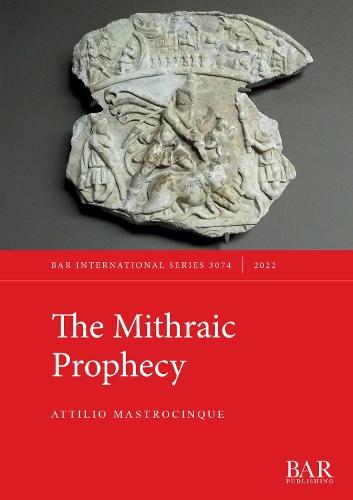
Why did the Romans worship a Persian god? This book presents a new reading of the Mithraic iconography taking into account that the cult had a prophecy. It is likely that the Mithraic reliefs alluded to it and the scenes in the upper panels depict the Golden Age which was the final result of many apocalyptic, prophetic texts including the 4th Eclogue of Virgil. The Avesta, the Vedas, and Herodotus associate Mithras with the morning star and the dawn and this god was the mediator between darkness and light. Additionally, Mithras was a protector of rulers and, similar to Apollo, arbiter and mediator between opposite elements, and saviour of humankind. For these reasons he was ideal to become the god of Augustus and the Roman emperors.
Full Product Details
Author: Attilio Mastrocinque
Publisher: BAR Publishing
Imprint: BAR Publishing
Weight: 0.451kg
ISBN: 9781407359137
ISBN 10: 1407359134
Pages: 113
Publication Date: 31 March 2022
Audience:
Professional and scholarly
,
Professional & Vocational
Format: Paperback
Publisher's Status: Active
Availability: Available To Order 
We have confirmation that this item is in stock with the supplier. It will be ordered in for you and dispatched immediately.
Table of Contents
List of Figures 1. Introduction 1.1. The Prophecy 1.2. Virgil and Mithraism 1.3. Virgil, the Gigantomachy, and the Iron Generation 1.4. The Sistrum and the Thunderbolt 1.5. Saturn, the Birth of Mithras, the Coming of a New Generation, and the Harvest 2. Mithras and the Golden Age 2.1. He will see the Gods 2.2. Molli paulatim flavescet campus arista 2.3. Durae quercus sudabunt roscida mella. 2.4. Tauris iuga soluet arator 2.5. The Golden Age 2.6. Shepherds and Ships in the Golden Age 2.7. nec nautica pinus mutabit merces 2.8. convexo nutantem pondere mundum, terrasque tractusque maris caelumque profundum 2.9. The Sacrifice of the Bull 2.10. The Final Episodes on Mithraic Panels 3. The Origin of the Virgilian Prophecy 3.1. Virgil and Isaiah 3.2. The Testimony of Nigidius Figulus 3.3. The Apocalypse of Hystaspes 3.4. Lactantius and Commodianus 3.5. Hystaspes and Persia 3.6. Persian Apocalypses 3.7. The Meaning of Similarities between Iranian Apocalypses and Mithraism 4. Mithras and Dawn 4.1. Mithras, Venus, Libra, and Dawn 4.2. Augustus and Libra 4.3. Augustus and Dawn 4.4. Mithras Mesites 4.5. Mithras between Sol and Luna 4.6. Eros and Mithraism 4.7. Eros, Mithras, and Mercury Abbreviations Bibliography
Reviews
'The author grounds his arguments in written testimony and iconographic evidence. In particular, he associates diverse sources, including Virgil's IV Eclogue and the Iranian prophecies of Hystaspes, the Bahman Yasht and the Jamasp Nama to provide new insights into the study of Mithraism and to offer a new interpretation the iconographic evidence of the Mithras cult.' Dr Olympia Panagiotidou, Aristotle University of Thessaloniki 'The author goes beyond the methodology of classical philology, but also of that of history of art, and analyses the literary passages and the visual narratives of the Mithraic reliefs using a new, innovative comparative method.' Dr Csaba Szabo, University of Szeged
Author Information
Attilio Mastrocinque is a fellow of the Istituto Italiano per gli Studi Storici, the Consiglio Nazionale delle Ricerche, and the Alexander von Humboldt-Stiftung. He was a researcher of Ancient History (University of Venice), professor of Greek History (University of Trento), is full professor of Roman History (University of Verona), and director of archaeological research at Tarquinia.
Tab Content 6
Author Website:
Countries Available
All regions
|