Overview
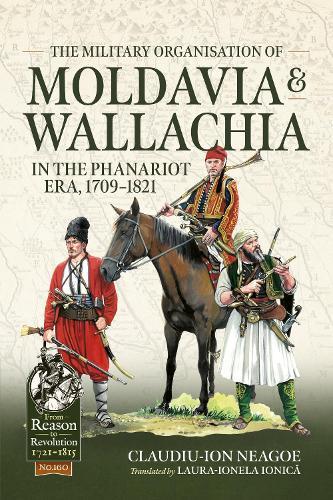
In the summer of 1806, Charles-Frédéric Reinhard (1761-1837), resident and general commissioner of France in the Romanian Principalities, stated that there weren't any armies in the two Romanian principalities, but rather `some individuals registered on the police lists and exempted from taxes'. Most of them `had to guard the borders, provide postal services, and serve the district prefect'. A series of reputable Romanian historians from the second half of the 20th century emphasized, during some public conferences, but very few in their scientific contributions, the fact that one of the negative consequences of the numbers of the Phanariot rulers at the head of Moldavia and Wallachia, was the abolition of the armies the two Romanian principalities. At the end of a careful analysis of the historical sources available to us up to this point, we can firmly affirm the fact that the armies of the two Romanian principalities were not abolished by the Phanariot rulers. But their numbers were significantly reduced, especially in peacetime, often for fiscal reasons. They were mainly used to defend borders, maintain internal peace and collect taxes. We would like to specify the fact that during the war, the Ottoman Gate requested the Phanariot rulers to increase the number of military servants, by recruiting local volunteers or Balkan mercenaries. The troops of Moldavia and Wallachia continued to be used as 'auxiliary troops' of the Ottoman army. AUTHOR: Dr. Claudiu-Ion Neagoe (born in 1974) is an associate professor at the National University of Science and Technology POLITEHNICA Bucharest, Pitesti University Center, Romania. In his 23 years of teaching and scientific research activity, Dr. Neagoe has participated in two national grants, carried out a scientific research project and published 22 articles in academic journals (in Romanian, English and French) on the military structures of Moldavia and Wallachia in the medieval and early modern period. To these can be added 3 works on military history, two published in Romanian and one in English and French. His professional experience also includes teaching medieval and early modern military history at the Faculty of Theology, Letters, History and Arts in Pitesti University Center, Romania. For the last three years Dr. Neagoe has also been engaged in a series of activities aimed at reconstructing the history of military structures from the Phanariot period. 43 b/w illustrations, 8 colour plates, 37 b/w tables
Full Product Details
Author: Claudiu-Ion Neagoe
Publisher: Helion & Company
Imprint: Helion & Company
ISBN: 9781804518199
ISBN 10: 1804518190
Pages: 230
Publication Date: 04 March 2026
Audience:
General/trade
,
General
Format: Paperback
Publisher's Status: Active
Availability: Not yet available

This item is yet to be released. You can pre-order this item and we will dispatch it to you upon its release.
Author Information
Dr. Claudiu-Ion Neagoe (born in 1974) is an associate professor at the National University of Science and Technology POLITEHNICA Bucharest, Pitesti University Center, Romania. In his 23 years of teaching and scientific research activity, Dr. Neagoe has participated in two national grants, carried out a scientific research project and published 22 articles in academic journals (in Romanian, English and French) on the military structures of Moldavia and Wallachia in the medieval and early modern period. To these can be added 3 works on military history, two published in Romanian and one in English and French. His professional experience also includes teaching medieval and early modern military history at the Faculty of Theology, Letters, History and Arts in Pitesti University Center, Romania. For the last three years Dr. Neagoe has also been engaged in a series of activities aimed at reconstructing the history of military structures from the Phanariot period.