Awards
- Winner of Winner, 2023 APSA Migration and Citizenship Best Book Award Winner, 2023 Thomas & Znaniecki Best Book Award.
- Winner of Winner, 2023 APSA Migration and Citizenship Best Book Award.
Overview
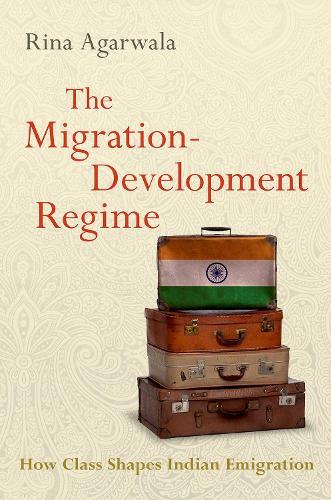
A sweeping history of how India has used its poor and elite emigrants to further Indian development and how Indian emigrants have reacted, resisted, and re-shaped India's development in response. How can states and migrants themselves explain the causes and effects of global migration? The Migration-Development Regime introduces a novel analytical framework to help answer this question in India, the world's largest emigrant exporter and the world's largest remittance-receiving country. Drawing on an archival analysis of Indian government documents, an original data base of Indian migrants' transnational organizations, and over 200 interviews with poor and elite Indian emigrants, recruiters, and government officials, this book exposes the vital role the Indian state (from the colonial era to the present day) has long played in forging and legitimizing class inequalities within India through the management of international emigration. It also exposes how poor and elite emigrants have differentially resisted and re-shaped state emigration practices over time. By taking a long and class-based view, this book recasts contemporary migration not simply as a problematic function of neoliberalism or as a development panacea for sending countries, but as a dynamic historical process that sending states and migrants have long used to shape local development. In doing so, it re-defines the primary problems of global migration, exposes the material and ideological impact that migration has on sending state development, and isolates what is truly novel about contemporary migration.
Full Product Details
Author: Rina Agarwala (Associate Professor; Director of Undergraduate Studies, Associate Professor; Director of Undergraduate Studies, Johns Hopkins University)
Publisher: Oxford University Press Inc
Imprint: Oxford University Press Inc
ISBN: 9780197586396
ISBN 10: 0197586392
Pages: 296
Publication Date: 06 July 2023
Audience:
Professional and scholarly
,
Professional & Vocational
Format: Hardback
Publisher's Status: Forthcoming
Availability: To order

Reviews
This beautifully written, lucidly argued book is distinguished by two unusual analytic moves. Agarwala is among the few scholars to explore the historical dynamics of migration from the perspective of a sending state rather than that of destination countries. In addition, she relentlessly excavates class differences, comparing the trajectories of elite and poor Indian emigrants and the contrasting policies shaping their divergent experiences. A provocative and essential contribution. * Ruth Milkman, CUNY Graduate Center, and author of Immigrant Labor and the New Precariat * The subject of Indian emigration needed a great book and this is it. Agarwala gives us a meticulous history of Indian emigration and a novel framework for understanding the role the state plays in shaping emigration. In doing so she not only shows how class differences have been at the heart of all India's emigration regimes, but also reveals the dynamic link between emigration, political legitimacy and global economic transformations. The Migration-Development Regime is bold, beautifully argued and guaranteed to change how we think of migration and development. * Patrick Heller, Professor of Sociology and International Affairs, Brown University * Rina Agarwala provides a compelling sociological insight into how the India 'migration state' reproduces, if not amplifies, class inequalities. The book highlights how sending states' emigration practices are a complex amalgam of global and domestic forces, and their unintended consequences. * Devesh Kapur, Starr Foundation Professor of South Asian Studies, Johns Hopkins University * Master ethnographer Rina Agarwala has done it again. The Migration-Development Regime tells, as only Agarwala can do, the much-needed but woefully overlooked story of how class matters in the complex relations between a migrant-sending country and its emigrants. * Chris Tilly, Professor of Urban Planning, UCLA * For more than a century, India has sent migrants abroad to work; today, remittances from overseas workers make up one of the country's largest sources of foreign exchange. Yet, as Rina Agarwala points out in her remarkable new work, discussions of India's economic growth rarely acknowledge migrants' contributions, nor do they explore the way national and state policies continue to shape migrants' options, from Silicon Valley's highly-educated computer scientists, to construction workers packed into migrant hostels in the Middle East. Agarwala's carefully-researched, insightful analysis will change the way we think about India's diaspora, provoke new questions about how sending countries could protect workers abroad, and ensure their communities benefit from the 'development' that the migrants are supporting. * Gay Seidman, Martindale Bascom Professor of Sociology, University of Wisconsin-Madison *
This beautifully written, lucidly argued book is distinguished by two unusual analytic moves. Agarwala is among the few scholars to explore the historical dynamics of migration from the perspective of a sending state rather than that of destination countries. In addition, she relentlessly excavates class differences, comparing the trajectories of elite and poor Indian emigrants and the contrasting policies shaping their divergent experiences. A provocative and essential contribution. * Ruth Milkman, CUNY Graduate Center, and author of Immigrant Labor and the New Precariat * The subject of Indian emigration needed a great book and this is it. Agarwala gives us a meticulous history of Indian emigration and a novel framework for understanding the role the state plays in shaping emigration. In doing so she not only shows how class differences have been at the heart of all India's emigration regimes, but also reveals the dynamic link between emigration, political legitimacy and global economic transformations. The Migration-Development Regime is bold, beautifully argued and guaranteed to change how we think of migration and development. * Patrick Heller, Professor of Sociology and International Affairs, Brown University * Rina Agarwala provides a compelling sociological insight into how the India 'migration state' reproduces, if not amplifies, class inequalities. The book highlights how sending states' emigration practices are a complex amalgam of global and domestic forces, and their unintended consequences. * Devesh Kapur, Starr Foundation Professor of South Asian Studies, Johns Hopkins University * Master ethnographer Rina Agarwala has done it again. The Migration-Development Regime tells, as only Agarwala can do, the much-needed but woefully overlooked story of how class matters in the complex relations between a migrant-sending country and its emigrants. * Chris Tilly, Professor of Urban Planning, UCLA * For more than a century, India has sent migrants abroad to work; today, remittances from overseas workers make up one of the country's largest sources of foreign exchange. Yet, as Rina Agarwala points out in her remarkable new work, discussions of India's economic growth rarely acknowledge migrants' contributions, nor do they explore the way national and state policies continue to shape migrants' options, from Silicon Valley's highly-educated computer scientists, to construction workers packed into migrant hostels in the Middle East. Agarwala's carefully-researched, insightful analysis will change the way we think about India's diaspora, provoke new questions about how sending countries could protect workers abroad, and ensure their communities benefit from the 'development' that the migrants are supporting. * Gay Seidman, Martindale Bascom Professor of Sociology, University of Wisconsin-Madison *
Author Information
Rina Agarwala is Associate Professor of Sociology at Johns Hopkins University. Agarwala is the award-winning author of Informal Labor, Formal Politics and Dignified Discontent in India (2013) and coeditor of Whatever Happened to Class? Reflections from South Asia (2016).