Overview
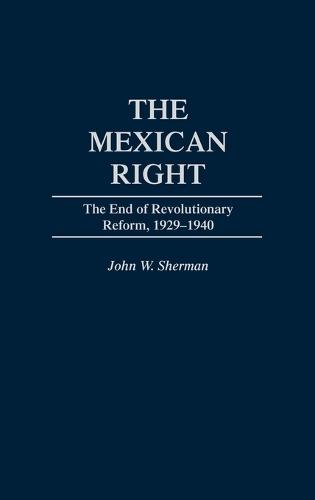
What are the historical roots of the Mexican right, which has seemingly come from nowhere to play a critical role in contemporary Mexico? This lucid study of the right in the pivotal decade of the 1930s provides the answer. Traditionally, historians have viewed the presidency of Lázaro Cárdenas (1934-1940) as the apogee of a successful Institutionalized Revolution. In truth, at odds with a conservative political culture, cardenismo failed. Its demise assured the rule of a corrupt, oligarchical regime that employs revolutionary rhetoric even while vigorously suppressing popular aspirations, and placed Mexico on its sad course into the present. The presidency of Lázaro Cárdenas (1934-1940) has long been viewed as the successful apogee of Mexico's Institutionalized Revolution. Scholars have traditionally portrayed Cárdenas as a widely popular reformer: the idealist who gave peasants land and the nationalist who seized American oil company properties. Others hold him responsible for establishing Mexico's modern authoritarian state. Now these interpretations are challenged in this evocative book, which examines the vital role of the Mexican right on the eve of cardenismo and during its tenure. Even while the institutional right withered in the face of Mexico's Revolutionary leviathan, a new right emerged and undermined cardenismo in Mexico's fundamentally conservative political culture. Employing the media, literature, and spontaneous grassroots politics, the right appealed to values rooted in faith, family, and fatherland, and convinced a majority of Mexicans that Fat Lips Cárdenas vision for their country was radical and dangerous. The 1940 presidential election debacle followed, when the President imposed his moderate successor on a reluctant electorate. Despite this, the Cardenista agenda for Mexico could not endure. Cardenismo, rather than a defining point in 20th-century Mexican history, became only a noteworthy exception to a continuity of conservatism.
Full Product Details
Author: John W. Sherman
Publisher: Bloomsbury Publishing Plc
Imprint: Praeger Publishers Inc
Dimensions:
Width: 15.20cm
, Height: 1.40cm
, Length: 22.90cm
Weight: 0.435kg
ISBN: 9780275957360
ISBN 10: 0275957365
Pages: 176
Publication Date: 25 February 1997
Recommended Age: From 7 to 17 years
Audience:
College/higher education
,
Professional and scholarly
,
Undergraduate
,
Postgraduate, Research & Scholarly
Format: Hardback
Publisher's Status: Active
Availability: Manufactured on demand

We will order this item for you from a manufactured on demand supplier.
Reviews
Critical background reading for anyone interested in the resurgence of the Mexican right. Carefully researched, well written, and persuasively argued. -Michael C. Meyer, Professor of History University of Arizona
[T]his study makes use of valuable archival work. It is a straightforward book dealing briefly with the antecedents of the Mexican right, which essentially formed as part of the opposition to the revolution and then to Cardenismo...[T]he book is a valuable addition to the historiography of the emergence of present-day Mexican conservatism, which has been blurred by the Mexican ruling party's co-optation of the ideological spectrum. -Choice Sherman offers a significantly nuanced discussion of the political opposition of the period in question...an interesting discussion of that opposition that enhances not only our understanding of the period, but helps set a baseline for the post-1940 poliitical development of Mexico. -The Journal of Arizona History �T�his study makes use of valuable archival work. It is a straightforward book dealing briefly with the antecedents of the Mexican right, which essentially formed as part of the opposition to the revolution and then to Cardenismo...�T�he book is a valuable addition to the historiography of the emergence of present-day Mexican conservatism, which has been blurred by the Mexican ruling party's co-optation of the ideological spectrum. -Choice ?Sherman offers a significantly nuanced discussion of the political opposition of the period in question...an interesting discussion of that opposition that enhances not only our understanding of the period, but helps set a baseline for the post-1940 poliitical development of Mexico.?-The Journal of Arizona History ?[T]his study makes use of valuable archival work. It is a straightforward book dealing briefly with the antecedents of the Mexican right, which essentially formed as part of the opposition to the revolution and then to Cardenismo...[T]he book is a valuable addition to the historiography of the emergence of present-day Mexican conservatism, which has been blurred by the Mexican ruling party's co-optation of the ideological spectrum.?-Choice Critical background reading for anyone interested in the resurgence of the Mexican right. Carefully researched, well written, and persuasively argued. -Michael C. Meyer, Professor of History University of Arizona
"""Critical background reading for anyone interested in the resurgence of the Mexican right. Carefully researched, well written, and persuasively argued.""-Michael C. Meyer, Professor of History University of Arizona ?[T]his study makes use of valuable archival work. It is a straightforward book dealing briefly with the antecedents of the Mexican right, which essentially formed as part of the opposition to the revolution and then to Cardenismo...[T]he book is a valuable addition to the historiography of the emergence of present-day Mexican conservatism, which has been blurred by the Mexican ruling party's co-optation of the ideological spectrum.?-Choice ?Sherman offers a significantly nuanced discussion of the political opposition of the period in question...an interesting discussion of that opposition that enhances not only our understanding of the period, but helps set a baseline for the post-1940 poliitical development of Mexico.?-The Journal of Arizona History ""�T�his study makes use of valuable archival work. It is a straightforward book dealing briefly with the antecedents of the Mexican right, which essentially formed as part of the opposition to the revolution and then to Cardenismo...�T�he book is a valuable addition to the historiography of the emergence of present-day Mexican conservatism, which has been blurred by the Mexican ruling party's co-optation of the ideological spectrum.""-Choice ""Sherman offers a significantly nuanced discussion of the political opposition of the period in question...an interesting discussion of that opposition that enhances not only our understanding of the period, but helps set a baseline for the post-1940 poliitical development of Mexico.""-The Journal of Arizona History ""[T]his study makes use of valuable archival work. It is a straightforward book dealing briefly with the antecedents of the Mexican right, which essentially formed as part of the opposition to the revolution and then to Cardenismo...[T]he book is a valuable addition to the historiography of the emergence of present-day Mexican conservatism, which has been blurred by the Mexican ruling party's co-optation of the ideological spectrum.""-Choice"
[T]his study makes use of valuable archival work. It is a straightforward book dealing briefly with the antecedents of the Mexican right, which essentially formed as part of the opposition to the revolution and then to Cardenismo...[T]he book is a valuable addition to the historiography of the emergence of present-day Mexican conservatism, which has been blurred by the Mexican ruling party's co-optation of the ideological spectrum. -Choice Sherman offers a significantly nuanced discussion of the political opposition of the period in question...an interesting discussion of that opposition that enhances not only our understanding of the period, but helps set a baseline for the post-1940 poliitical development of Mexico. -The Journal of Arizona History YThis study makes use of valuable archival work. It is a straightforward book dealing briefly with the antecedents of the Mexican right, which essentially formed as part of the opposition to the revolution and then to Cardenismo...YThe book is a valuable addition to the historiography of the emergence of present-day Mexican conservatism, which has been blurred by the Mexican ruling party's co-optation of the ideological spectrum. -Choice ?Sherman offers a significantly nuanced discussion of the political opposition of the period in question...an interesting discussion of that opposition that enhances not only our understanding of the period, but helps set a baseline for the post-1940 poliitical development of Mexico.?-The Journal of Arizona History ?[T]his study makes use of valuable archival work. It is a straightforward book dealing briefly with the antecedents of the Mexican right, which essentially formed as part of the opposition to the revolution and then to Cardenismo...[T]he book is a valuable addition to the historiography of the emergence of present-day Mexican conservatism, which has been blurred by the Mexican ruling party's co-optation of the ideological spectrum.?-Choice Critical background reading for anyone interested in the resurgence of the Mexican right. Carefully researched, well written, and persuasively argued. -Michael C. Meyer, Professor of History University of Arizona
Author Information
JOHN W. SHERMAN is Assistant Professor of Latin American History at Wright State University./e