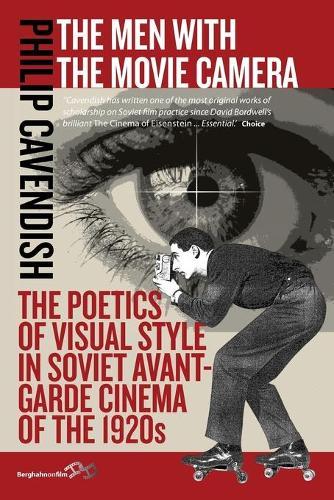
The Men with the Movie Camera: The Poetics of Visual Style in Soviet Avant-Garde Cinema of the 1920s

Author:   Philip Cavendish
Publisher:   Berghahn Books
ISBN:  

9781785331947


Pages:   362
Publication Date:   01 February 2016
Format:   Paperback
Availability:   In Print   Availability explained
This item will be ordered in for you from one of our suppliers. Upon receipt, we will promptly dispatch it out to you. For in store availability, please contact us.

Our Price $52.67 Quantity:  
Add to Cart

Share |

The Men with the Movie Camera: The Poetics of Visual Style in Soviet Avant-Garde Cinema of the 1920s


Overview

Full Product Details

Author:   Philip Cavendish
Publisher:   Berghahn Books
Imprint:   Berghahn Books
Dimensions:   Width: 15.20cm , Height: 1.90cm , Length: 22.90cm
Weight:   0.490kg
ISBN:  

9781785331947


ISBN 10:   1785331949
Pages:   362
Publication Date:   01 February 2016
Audience:   College/higher education ,  Postgraduate, Research & Scholarly
Format:   Paperback
Publisher's Status:   Active
Availability:   In Print   Availability explained
This item will be ordered in for you from one of our suppliers. Upon receipt, we will promptly dispatch it out to you. For in store availability, please contact us.

Table of Contents

Reviews

Cavendish's carefully researched book argues that men like Eduard Tisse, Anatolii Golovnia, and Danylo Demutskyi, among others, should be acknowledged as coauthors, in terms of visual styles, of the films on which they worked. [It] offers exacting descriptions of many shots, developing an appreciation for the styles cultivated by these camera artists despite differences in subject matter or dramatic theme. Though he may at times downplay the director's role in determining how shots were jointly shaped, Cavendish has written one of the most original works of scholarship on Soviet film practice since David Bordwell's brilliant The Cinema of Eisenstein. Summing Up: Essential. Choice


Cavendish's carefully researched book argues that men like Eduard Tisse, Anatolii Golovnia, and Danylo Demuts'kyi, among others, should be acknowledged as coauthors, in terms of visual styles, of the films on which they worked. [It] offers exacting descriptions of many shots, developing an appreciation for the styles cultivated by these camera artists despite differences in subject matter or dramatic theme. Though he may at times downplay the director's role in determining how shots were jointly shaped, Cavendish has written one of the most original works of scholarship on Soviet film practice since David Bordwell's brilliant The Cinema of Eisenstein. Summing Up: Essential. * Choice Boasting an impressive grasp of silent cinema's historical trends, Cavendish provides useful analysis of the camera work and lighting underlying the collaboration of four camera operator-director pairs. Cavendish has produced an invaluable study of Soviet avant-garde cinema that finally gives cameramen their due credit. * Slavic Review


Author Information

Philip Cavendish is Reader in Russian and Soviet Film Studies at the School of Slavonic and East European Studies, University College London. He is the author of Mining for Jewels: Evgenii Zamiatin and the Literary Stylization of Rus′ (MHRA, 2000), and Soviet Mainstream Cinematography: The Silent Era (UCL, 2007).

Tab Content 6

Author Website:  

Countries Available

All regions
Latest Reading Guide

MRGC26


Shopping Cart
Your cart is empty
Shopping cart
Mailing List