Overview
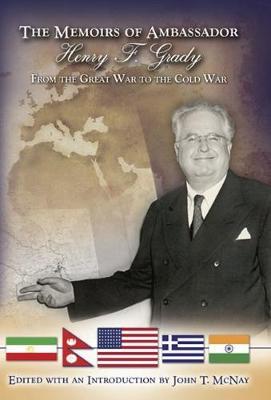
When Henry Grady died in 1957, one obituary called him 'America's top diplomatic soldier' for a critical period of the Cold War, and over a long career he was deeply involved in events that changed our role in the world. Even so, this self-described 'soft' cold warrior has been largely overlooked by historians. His memoirs, left to languish with his other papers, are now published for the first time, offering new insight into the origins and implementation of American trade and development policies - and into the tumult that was the Cold War. A specialist in international economic policy, Grady helped create the system of reciprocal trade established under FDR during the depression. Progressing in his career through his abilities rather than through political connections, he was sent to India during World War II to spark its production for the war effort, then to Italy to help jump-start its economy once German forces were driven out. After the war, he was the first American ambassador to an independent India, then served as ambassador to Greece and Iran - where he was embroiled in the oil industry crisis that eventually led to the CIA's overthrow of Prime Minister Mohammad Mossadegh. Grady's memoirs are an intriguing and informative account of early Cold War diplomacy in significant and turbulent regions of the Third World, embellished by his thoughts about the changing nature of American economic policies and his role as a representative of that system abroad. It offers new perspectives on the crisis in Iran in the early 1950s, where Grady was especially critical of Secretary of State Dean Acheson's support for the remnants of British imperialism in Iran - and paid for his criticism with his job. Editor John McNay's introduction and comments shed light on Grady's thinking and his role in the policy-making process. More than a chronicle of a wide-ranging career - one that reflects the emergence of the United States as the world's leading economic power - Grady's memoirs are a trenchant critique of U.S. foreign policy in the first half of the twentieth century. They provide modern readers an opportunity to reconsider the conflict between realism and idealism in foreign relations during the Cold War years.
Full Product Details
Author: John McNay ,
John McNay
Publisher: University of Missouri Press
Imprint: University of Missouri Press
Dimensions:
Width: 15.20cm
, Height: 2.30cm
, Length: 22.90cm
Weight: 0.476kg
ISBN: 9780826218322
ISBN 10: 0826218326
Pages: 232
Publication Date: 15 February 2009
Audience:
College/higher education
,
Professional and scholarly
,
Tertiary & Higher Education
,
Professional & Vocational
Format: Hardback
Publisher's Status: Active
Availability: Out of stock

The supplier is temporarily out of stock of this item. It will be ordered for you on backorder and shipped when it becomes available.
Reviews
Here is a remarkable memoir by a diplomat ahead of his time. For all of the achievements, and there were many, by Secretary of State Dean Acheson, the secretary had little understanding of the seething dangers of nationalism in countries outside of Western Europe. And Ambassador Henry F. Grady did. John T. McNay has organized and edited the memoir with impeccable taste and scholarship. -- Robert H. Ferrell
Here is a remarkable memoir by a diplomat ahead of his time. For all of the achievements, and there were many, by Secretary of State Dean Acheson, the secretary had little understanding of the seething dangers of nationalism in countries outside of Western Europe. And Ambassador Henry F. Grady did. John T. McNay has organized and edited the memoir with impeccable taste and scholarship. --Robert H. Ferrell
Here is a remarkable memoir by a diplomat ahead of his time. For all of the achievements, and there were many, by Secretary of State Dean Acheson, the secretary had little understanding of the seething dangers of nationalism in countries outside of Western Europe. And Ambassador Henry F. Grady did. John T. McNay has organized and edited the memoir with impeccable taste and scholarship. Robert H. Ferrell
Author Information
About the Editor John T. McNay is Associate Professor of History at the University of Cincinnati and author of Acheson and Empire: The British Accent in American Foreign Policy (University of Missouri Press).